Episode: 460
If You Get Anxious Around Other People, You Need to Hear This
with Vinh Giang
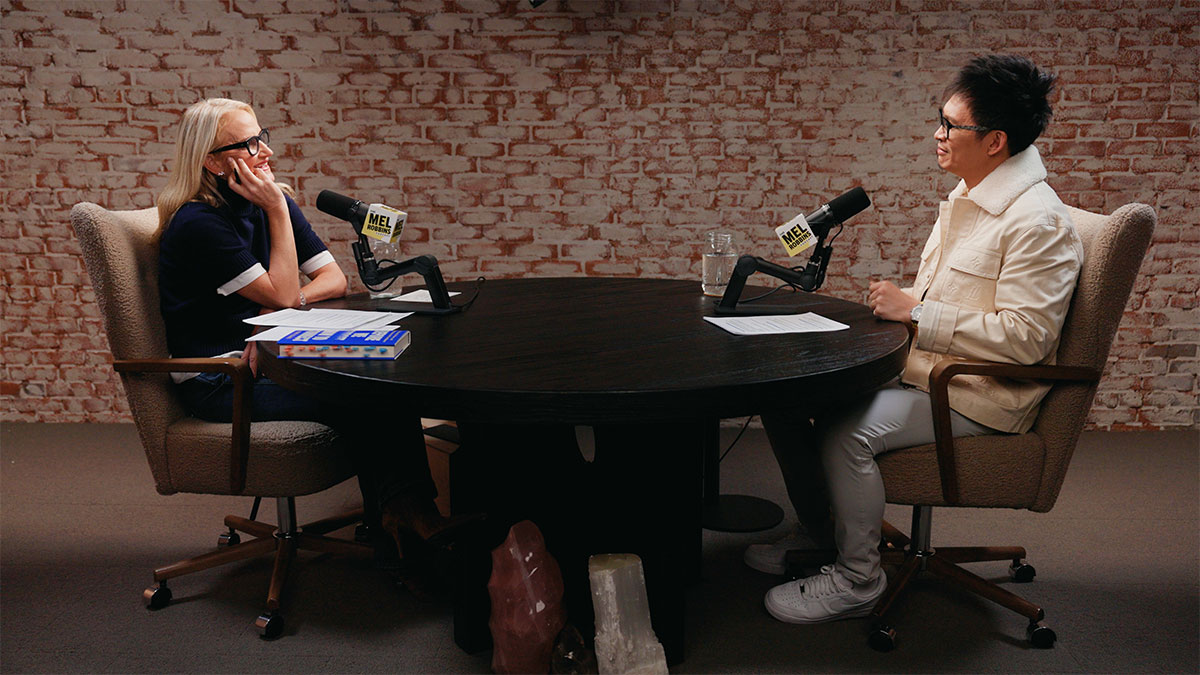
There's a bigger version of you that deserves to be heard. Here's how to stop holding yourself back.
For the first time, Mel invites her own team into the studio for live coaching with world-renowned communication expert Vinh Giang.
One goes blank when put on the spot. Another can't stop interrupting. Others are afraid to speak up or struggle to sound confident under pressure.
Vinh gets right to work with simple, practical exercises designed to help them break old habits and communicate with confidence, and you get to learn alongside them.
In this episode, you’ll discover how to find your words, listen better, speak with authority, and make yourself heard when it matters most.


When you learn to communicate, you amplify the best parts of who you are.
Vinh Giang
All Clips
Transcript
Vinh Giang (00:00):
I'm on my way to the Mel Robbins podcast.
Mel Robbins (00:06):
Today on the Mel Robbins Podcast. All the way from Australia.
Vinh Giang (00:09):
From Australia.
Mel Robbins (00:10):
For the first time ever, we are going to do live coaching on the show with the world's number one communication expert, Vinh Giang.
Vinh Giang (00:21):
My favorite framework, Mel, is this simple one. It's called three, two, one.
Mel Robbins (00:26):
We can remember that. Three, two, one.
Vinh Giang (00:28):
Three steps, two types. The one thing. While we're learning this, in your mind, remember look, feel, and sound. One, two, three.
Mel Robbins (00:34):
Vin is teaching you if adrenaline rushes in your body, you got to move it out by moving.
Jennie (00:41):
That own narrative I put in my head of, you're not good enough, this idea isn't good enough.
Vinh Giang (00:46):
There's another beautiful little technique you can learn here too.
Janaya (00:49):
I am struggling with cutting people off. I'm a professional yapper.
Vinh Giang (00:53):
The tactical thing here is wildly simple. What you're going to learn as we go through the coaching and as you listen to the other episode is that you're going to learn that these are all a series of behaviors and skills anybody can learn.
Mel Robbins (01:09):
Hey, it's your friend Mel and welcome to the Mel Robbins Podcast. I am so fired up that you hit play on this. This is going to be an extraordinary episode. We have never done this before on the show. We are going to learn how to communicate with more confidence from the world's number one expert in communication. I am so excited to introduce you to my dear, dear, dear friend Vinh. Vinh has written a blockbuster bestseller, Before We Forget How to Connect. This book is packed with extraordinary takeaways, frameworks, tools to help you communicate better. It's an incredible gift to give to people in your life, particularly young adults who need to learn how to assert themselves, be seen, be heard, and anybody can learn how to do this. And I'm sitting next to an empty chair. And even though you're listening, I wanted to tell you that because for the first time ever, we are going to do live coaching on the show.
(02:07):
And Vinh, I am so proud of you. I'm so happy you are here. And we just taped an episode where you taught us for 90 minutes how to communicate with more confidence. And at the end of it, I was like, "This is so amazing." We have a line out the door of staff members who are like, "Can I get some time with Vinh? I have an issue with communicating." And so you so graciously said, "Mel, I will stay and I will coach all kinds of people on the team here at the Mel Robbins Podcast." And I would just love, in case the person who's with us right now has not heard the episode that we did just before this one, we'll link to it in the show notes, just share a little bit about why communication matters. I mean, you're the world's leading expert. Millions of people follow you.
(02:53):
You've been doing this. We've known each other for a decade. You flew here from Australia to do this. I'm so grateful, so proud of you, but why does this matter so much?
Vinh Giang (03:02):
Well, because it's a skill we've never been taught. So if you're sitting there thinking, why do I ramble? Why do I freeze? Why do I go blank? Why do I and ah all the time? Why don't people take me seriously? It's not your fault. It's because when were you ever taught this skill? When we were young, the one day we got to present at school, what happens? You go, oh mom, I've got a tummy ache. I don't want to go. So the one time you have the opportunity to practice the skill of communication, you shy away from it. So it's not your fault. So what you're going to learn as we go through the coaching and as you listen to the other episode is that you're going to learn that these are all a series of behaviors and skills anybody can learn.
Mel Robbins (03:35):
Oh my God. And you are the single best person on the planet to teach it to us.
Vinh Giang (03:41):
Thank you Mel.
Mel Robbins (03:41):
And as you are listening, I want you to step into the shoes of the person on our team who is here talking about the issue that they want to have a breakthrough in, that they would love coaching from Vinh on. And I want you to think about yourself and I want you to think about somebody that you care deeply about because I promise you, you are going to learn something that will change how you communicate. It will make you more confident. And as Vinh is coaching, I want you to be playing in your mind what your answers would be because yeah, you're going to be entertained, but I also want you to lean in and learn and you do that by participating. Is there anything else you want to say to the person who's listening, Vinh, about how to best...
Vinh Giang (04:26):
What I would say is don't be so attached to who you are in the present. You don't give the future version of your chance.
Mel Robbins (04:31):
I love that.
Vinh Giang (04:33):
Yeah.
Mel Robbins (04:33):
Oh, I love that. Okay, you are so special. I'm so excited you said yes and I'm so excited that our team member was like knocknock knock. Can I get time with him please before he jumps on the plane?
Mel Robbins (04:41):
And first up, we've got Scott, our extraordinary photographer. Hey Scott. Scott, who Scott and I also, when I was on that global tour, Scott was with me. He was our tour photographer.
Vinh Giang (04:54):
In Australia.
Scott (04:54):
Yep.
Mel Robbins (04:55):
And New Zealand and all over the US.
Vinh Giang (04:57):
Oh mate, that was a great time.
Mel Robbins (04:59):
And he also is a photographer that photographs massive stadium concerts. Scott.
Vinh Giang (05:06):
Oh gosh. How did you get him?
Mel Robbins (05:08):
Lucky. You know what? How I got him? He was meant to be here and I was meant to work with him and he was meant to work with me. And now he is supposed to be in this seat because I am certain even though I don't know what he's going to ask you.
Vinh Giang (05:20):
Me neither.
Mel Robbins (05:20):
He's dealing with something and he's a phenomenal human being and I can't wait to hear what it is you want coaching on.
Scott (05:28):
Thank you. I appreciate it. Well, I probably am already bright red, so that probably gives it away a little bit. But when I have to direct a large group of people, for example, a large group photo of people that I don't necessarily know or I'm working for somebody who might be really high level or something like that, I just get so flustered when it's like you just want to have the good product at the end and have everybody happy so you get a little bit of imposter syndrome maybe or something like that. I get so jumbled up in my brain. It's just very difficult to keep it together, keep that doing it now, keeping
Vinh Giang (06:03):
That
Scott (06:04):
Brainwave where I want it to go and on track and I also get very shaky.
Vinh Giang (06:08):
Yeah. Is it that I want to be able to communicate with more authority in those moments? Is it I want to learn how to deal with the thoughts coming through? Is there a key thing you want to focus on?
Scott (06:17):
I think the authority, but also the shakiness and not having to do that. I don't feel anxious talking to you at all really if I think about it or talking to anybody, but my body's saying you need to be... I'm sweating. And it doesn't matter who it is. It just happens to everybody that I talk to.
Vinh Giang (06:35):
Well, one of the first things we got to do is we've got to get rid of the adrenaline. So let's do a couple of star jumps together straight away.
Scott (06:41):
Sure.
Vinh Giang (06:41):
We got to do it and maybe we'll do some pushups together too.
Scott (06:43):
All right.
Vinh Giang (06:44):
Let's do it too if you want.
Scott (06:44):
Oh my God.
Vinh Giang (06:45):
We just got to do it because -
Mel Robbins (06:46):
I'm going to sit on my rear end and watch you too.
Vinh Giang (06:48):
I want to help you get rid of this. So we want to do maybe, we'll do together 20. We don't have to show all 20.
Mel Robbins (06:53):
Oh God, I'm glad to st up.
Vinh Giang (06:54):
And then after that we'll do some pushups too.
Scott (06:55):
Sounds good.
Vinh Giang (06:56):
Let's just do it. And then we'll get red, but that's fine. Okay, so let's go. I'll do it with you. Ready? One, two, three, three, four, five, six. Keep breathing sound.
Mel Robbins (07:05):
Now as you're listening, you and I get to just pretend we're exercising, but the takeaway here is Vinh is teaching you if adrenaline rushes in your body and starts to make you shake, you got to move it out by moving.
Vinh Giang (07:20):
Let's do it.
Mel Robbins (07:20):
We're doing it together.
Vinh Giang (07:22):
There it goes. One, two, three, four, five.
Mel Robbins (07:28):
You're doing five pushups and now they're back. All right. So explain to the person listening real quick and to Scott, why does moving your body before you're about to be in a situation where you get shaky help with the body?
Vinh Giang (07:41):
Well, the first thing is it manages the adrenaline because when you're put in a situation where you've got the senior people watching you, people that need to be given direction, you start to feel nervous. So your body creates all this adrenaline. What we just did is we're managing that adrenaline. So as you do brisk forms of exercise, it gets rid of that adrenaline, which stops and reduces the shakiness. And then I'm puffed. What we just did there, it encourages deep breathing. So exercising naturally makes you breathe more deeply. So then now if you ask me the question again, after doing that, just see how you feel. Just ask me the question and I want you to frame it with, Vinh, my question is.
Scott (08:20):
Okay? Okay.
Vinh Giang (08:21):
Yeah.
Scott (08:22):
Vin, my question is how can I be less flustered and anxious when I have to talk to a lot of high level people or a large group of people?
Vinh Giang (08:29):
You see, after we did that exercise and you asked me that question again, do you also notice what happened? Your question was clearer because you got rid of all the adrenaline. Your brain isn't going crazy. Because before you told me so many different things, whereas now your question is so clear, concise, and coherent. That clarity comes from us feeling more at ease.
Scott (08:49):
Yeah, I feel it. I mean, I feel more focused right on you right now. Everything doesn't seem like it's all running around in my brain, so definitely.
Vinh Giang (08:56):
So that means one immediate tip for you at home as well is before you're about to do something that you know is going to create lots of adrenaline or make you nervous, obviously don't do this where everybody can see you, where all of a sudden you're like, just wave everybody and then you do 20 star jobs. Do this backstage. Do this in the car park before you go in for the job interview. Do it there first. And as you're going, you'll find yourself more relaxed.
Mel Robbins (09:19):
Can I add something? Are you open to me sharing an insight with you?
Scott (09:22):
Sure.
Mel Robbins (09:23):
Are you sure?
Scott (09:23):
Absolutely.
Mel Robbins (09:24):
Okay. Zero to 10, how nervous does it make you to know that I'm about to ask you something?
Scott (09:28):
It's fine.
Mel Robbins (09:29):
Okay, good.
Scott (09:29):
Probably like a five.
Mel Robbins (09:30):
Okay. Thank you for being honest. So my observation of you, and when you go on tour with somebody, you literally are living with somebody and you're together all the time. And so my observation of you is that you are, first of all, the kindest person I've ever met.
Scott (09:48):
Thank you. Appreciate it.
Mel Robbins (09:49):
You are exceptionally talented, like world freaking class photographer. I can't even describe how talented you are. It's jaw dropping. Jaw dropping. And what I've noticed is you do not relate to yourself like that and you do not insert your expertise or advocate for yourself. And the thing I will share with you is that I'm leaning on you because of your expertise and it is disrespectful to you to not insert yourself, to not say there's a better way to do this, to not offer up either the recommendation or the request of what you need. What are you afraid of?
Scott (10:46):
I think I'm afraid of people being upset necessarily or stepping on someone else's toes when you don't think you should be, and that's why you kind of try to stay below the radar as best as you can.
Mel Robbins (10:58):
This is so relatable to have something to say, whether it's in your family or your relationship, to have something that you need, and then to become very afraid of the reaction and the negative thing that might happen. And so is that a communication skill or is that the skill of learning how to tolerate your own discomfort as you practice this?
Vinh Giang (11:24):
It's both and it can also be really practical because I'm going to use the flip chart Scott.
Scott (11:28):
Sure. Go for it.
Vinh Giang (11:29):
Because when I think about different communication styles, I see you in two particular styles.
Scott (11:35):
Okay.
Vinh Giang (11:36):
So I'm just going to take this off.
Mel Robbins (11:42):
Bye.
Vinh Giang (11:43):
I can see from the way you communicate, I call these vocal archetypes. We have different archetypes that we use when we communicate. I see you live in two, and the first one is what I call friend. And the goal of the friend archetype is connection. And I can see that's something you value. You really value connection, so you're in friend. I do. And then I also see you in the archetype of educator. I know you know your stuff and you can speak on something complex, but again, these are the two I see you play and you play a lot in friend. So the other thing, which is the one you need to lean more into, if you want to be more assertive, but most people have a negative association with this one, and this is coach.
(12:30):
And coach is when you are guiding and directing somebody and you need to be able to lean into coach. But most people think of coach and they think, again, these are just different versions of you, but we all tend to have an idea of what a coach is. So you might think, oh, David Goggins, or you might think a football coach, and you think, oh, that's too much. But the thing about coaching all of these archetypes is that there's also a scale. There's a scale from zero to 10. So I'll give you a sense of it. If I was a level 10 coach, in my head, this is going to be really dramatic. I'm sorry. Okay. So level 10 coaches, if you don't get in spot right now, this photo's not going to get taken and this is going to take bloody forever. That's ridiculous.
Scott (13:07):
Yeah, that'd be bad.
Vinh Giang (13:08):
And you're thinking about that and see you're crossing your arms away.You're like, "I don't ever want to do that." But the thing is, there's a scale, so I can back it off. I can say, "Listen, if we don't get in place, this photo will never be taken. You can back it off even more. Listen, I need you to all get in spot so we can take the photo because everyone's got to be somewhere." And then you take the photo. So then as you're thinking through these things, you may have a negative association with moving into a more authoritative archetype because you are picturing the 10 out of 10. You like, "That's not me." You rarely have to go there. You rarely have to go there. So what I just want you to play with is I want you to pretend you're getting me to go for a photo, but I want assertive body language and tell me to sit down so you can take a photo.
Scott (13:51):
Okay.
Vinh Giang (13:51):
You got to push the boundaries of this.
Scott (13:53):
Right.
Vinh Giang (13:53):
Let's go. Okay.
Scott (13:54):
All right. Vinh, I need you to move that chair and put it right in front of the mic right there.
Vinh Giang (13:58):
No, not loud enough.
Scott (13:59):
Not loud enough.
Vinh Giang (14:00):
I want to give me more. Give me more. Come on, let's go. Let's go.
Scott (14:02):
Okay. Vinh, I need you to move that chair right over there, right in front of the microphone.
Vinh Giang (14:07):
Okay.
Scott (14:07):
Turn it so it's square to the table and just sit down.
Vinh Giang (14:10):
Volume dropped a bit so I'm not doing it.
Scott (14:12):
I need you to sit down in the chair facing the table and just put your arms just like this.
Vinh Giang (14:17):
Okay.
Scott (14:18):
And now I'm going to have you cross your arms a little bit.
Vinh Giang (14:19):
Not loud enough.
Scott (14:21):
Cross your arms a little bit, Vinh.
Vinh Giang (14:22):
Yep.
Scott (14:23):
And lean back into your chair a bit.
Vinh Giang (14:25):
Okay.
Scott (14:26):
And now I'm going to have you put your left arm down a little bit and your right arm down. And now just lean forward a little bit.
Vinh Giang (14:35):
But you see, that's what I need in that moment. As the talent, you have to understand that I fear doing something wrong and I need your expertise, but I need your expertise, not in friend, not in educator in that moment. I need someone to guide me and to guide me. I need full clarity. Clarity, vocal clarity, physical clarity. So your body language is very important because I didn't know what to do. And then what did you do naturally is you showed me exactly what to do. You were playing around a six or a seven then, that was great, but that made me feel safe because I was in your hands there. But the moment you went soft, I'm like, "I'm on my own. I don't know what I'm doing. I feel like I'm going to get this wrong." But then the moment you went loud, you controlled it, I felt safe again.
Scott (15:18):
And you probably feel less confident in my directions if I'm putting back my voice a little bit because maybe I'm not as confident in what I'm telling you.
Vinh Giang (15:25):
Yes. But you are confident because you know what I should be doing. So make me feel safe by being in control. And this is where people get a lot of things wrong. They say to me, they go, "Vin, people don't take me seriously." Well, it's because you're stuck in friend all the time. Because if we were having the conversation, "Hey, hey, don't worry. You just sit however you want. That's totally fine. Oh, I don't care. It doesn't matter. Maybe just do this if you want. I don't know, maybe do this." It's not effective in friend. In that moment, we need someone to guide and coach us. Even educator, because if we drop it all off and we're like, "I need you to sit in a moment, and when you're sitting, I need you to place it." We need to coach in those moments. So practice that archetype, practice it with the instructions that you give.
(16:09):
And the fourth is, this is important too, is you're a motivator.
(16:16):
So you motivate the person. So I learned this early on from my communication mentors where they said there are four core archetypes that help us in life. And motivator is when you are trying to inspire people. So you could inspire Mel going, Mel, if we get this image and if we can get the series of it, we're going to be able to inspire millions of people if we get these carousels out because carousel's extremely effective. Hey, let's do this. Let's get these pictures and it'll be better if you're comfortable. So I'm going to teach you how. So you're inspiring. And the best way to practice these, believe it or not, I can create an audio track and share it with you listening as well, is I learned this from my vocal teacher where she would play a really silly song and she would go, speak to it, honey.
(16:58):
Speak to it. She was teaching me friend. So it'd be this silly little song and then she goes, harmonize with it. Then she'll play a really intense song and she goes, speak to this one now. And what she was teaching me was coach. And then she would play this classical song, educator. And as you play an inspiring song, motivator. Motivator, educator, coach, friend. You just got to itch up that volume notch and not be afraid of it. Yeah. And as you speak up for yourself, you create more clarity, more understanding, and more empathy. But you've got to speak up and you did great.
Mel Robbins (17:33):
You did great. How do you feel?
Scott (17:33):
Thank you. I feel good. I probably am covered in sweat. I'm afraid to stand up, but we'll see how that goes.
Mel Robbins (17:39):
Well, you did great. I'm really proud of you.
Scott (17:41):
Thank you so much.
Mel Robbins (17:42):
Thank you for jumping in and knocking on the door.
Vinh Giang (17:44):
Yeah, that was amazing. Yeah. What a man.
Mel Robbins (17:47):
You're so great. You're so great.
Mel Robbins (17:49):
I cannot wait to introduce you and the person who is listening to Janaya.
Vinh Giang (17:54):
Hey, Janaya.
Mel Robbins (17:55):
Janaya, this is Vinh.
Janaya (17:57):
Nice to meet you, Vinh.
Vinh Giang (17:58):
Nice to meet you too.
Mel Robbins (17:59):
Janaya is an extraordinarily talented video editor here at the Mel Robbins podcast.
Janaya (18:04):
Lucky you, Mel.
Mel Robbins (18:05):
You are.
Janaya (18:06):
Thank you. I'm happy to be here.
Mel Robbins (18:07):
Okay. So what are you struggling with?
Janaya (18:09):
I am struggling with cutting people off. I'm a professional yapper, so I often feel like I'm going to forget what I want to say next. So in the middle of someone's thought, I immediately cut them off.
Vinh Giang (18:24):
Gosh.
Janaya (18:24):
How do I fix that?
Mel Robbins (18:27):
I've never experienced that with you.
Janaya (18:28):
Really?
Mel Robbins (18:29):
Never.
Janaya (18:29):
That's the first someone has ever said that to me.
Mel Robbins (18:31):
For real?
Janaya (18:32):
I cut a lot of people off.
Mel Robbins (18:33):
Let's try because I'm not cutting you off because I'm a professionalist yapper too.
Vinh Giang (18:37):
It's not a bad trait.
Janaya (18:38):
It's not a bad trait.
Vinh Giang (18:39):
No, it's because you're the boss. You never cut the boss off.
Mel Robbins (18:43):
That's true. But how does that impact you? Is there a particular relationship where it's really bothering you or is it just something you're working on? Why is this something you want to change?
Janaya (18:55):
Yeah. I often find when I'm talking to people that I care about, my friends, my family, they will be speaking. And when I cut them off, they often forget their point. And I feel like that kind of makes our relationship a little bit less of what it needs to be, because I'm known as the person who's always going to cut you off. So I would like to stop, but I don't know how.
Vinh Giang (19:19):
I just want to say, first of all, it's so beautiful that you're aware of this because most yappers or interrupters have no idea they're doing it. How did you become aware of this? Did they tell you?
Janaya (19:32):
I felt it. The energy shifts within a conversation. When you cut someone off, they're confused. You can even see it on their face. They're just like, ugh. And they instantly forget what they're talking about because I cut them off. So I think it's just been a pattern that I've been recognizing and I don't like it. I feel like it's really just hindering a lot of my close, close relationships.
Vinh Giang (19:56):
And that's beautiful because you're prioritizing the relationship over getting what you want to say.
Janaya (20:01):
Absolutely. Yeah.
Vinh Giang (20:02):
The tactical thing here is wildly simple. Anytime now you're connecting with someone you really love, you have to now ask follow-up questions on the very thing they're speaking about, and only then and then after you've finished asking them the questions, are you allowed to share your thoughts?
Janaya (20:18):
Okay.
Vinh Giang (20:18):
You want to practice with me?
Janaya (20:19):
Yeah, let's practice.
Vinh Giang (20:20):
Okay, sure. So I'm going to talk about something that I'm really excited about.
Janaya (20:24):
Okay.
Vinh Giang (20:24):
And then you have to, again, you're going to think of things because you're in the world of video editing, right?
Janaya (20:28):
Yes.
Vinh Giang (20:28):
Okay. So this is cool. All right. What's been wild is that my friend Peter has just worked out how to play with AI and get it to assist him in the editing process.
Janaya (20:40):
What do you think about AI? What are your thoughts about it, your true thoughts?
Vinh Giang (20:44):
Really scared of it. I'm actually quite scared of AI. Even though it's productive and the temptation is so strong to use it, I feel it takes the humanity out of some of the edits that we do. So I'm a little bit scared of it.
Janaya (20:56):
So what do you think can counteract that or change that?
Vinh Giang (21:02):
Don't lose the humanity in what you do. Don't lose that. I feel so heard. I went to depths that I probably wouldn't have gone to if you didn't ask me those questions. You gave me an opportunity to share how I really felt and you gave me the opportunity to go deeper. How does that make you feel doing that with me?
Janaya (21:27):
I feel closer to you, Ben.
Vinh Giang (21:28):
Yeah.
Janaya (21:28):
I feel like we're good friends now.
Vinh Giang (21:30):
Yeah. But you see, and that's all you had to tactically do.
Janaya (21:33):
Yeah.
Vinh Giang (21:34):
From a tactical standpoint, you just create a new behavior because the initial behavior was... And I do this too, so you try talking about something you enjoy, just try the opposite of that. I'll be old Vinh.
Janaya (21:47):
Okay. Something that I really, really like to do is I'm a huge foodie,
Vinh Giang (21:52):
So I love - I love food too, because from the Vietnamese culture, have you ever tried Bunsell yellow pancakes? Have you ever tried that?
Janaya (21:59):
No. Can you say that one more time?
Vinh Giang (21:59):
You got to try it. You totally have to try yellow pancakes. It's so good. What about spring rolls? Ave you tried spring rolls?
Janaya (22:05):
Yeah, I love spring rolls.
Vinh Giang (22:05):
Oh, you love me too. Me too. But you know what else I love?
Janaya (22:07):
What do you love?
Vinh Giang (22:08):
But you see, sometimes we don't do that out of trying to be mean. I can sense your heart and your soul as you speak.
Janaya (22:15):
You don't have that in me. It's a statement though.
Vinh Giang (22:16):
It is.
Janaya (22:17):
That's what I'm feeling.
Vinh Giang (22:18):
And it's also connection.
Janaya (22:19):
Yeah.
Vinh Giang (22:19):
You want to connect with that person.
Janaya (22:21):
Yeah.
Vinh Giang (22:21):
So all you're doing is by asking those questions, you're holding space for that person for a good three to five minutes. And then when you share, "Oh, it's beautiful now." And you've got this beautiful cadence where they're going to start asking you questions too. Otherwise, our conversations stay one layer deep.
Janaya (22:38):
Yeah.
Vinh Giang (22:39):
"You love food. "Oh, I love food too. Here's my favorite food. Whereas that depth comes from staying with them, staying on that topic and going deeper.
Janaya (22:49):
Yeah. Now let me ask a follow-up question though.
Vinh Giang (22:51):
Okay. Okay.
Janaya (22:52):
So how do I deal with all of those other thoughts that are running through my mind as you are speaking to me about what you're excited about? Because when we were talking about food, so many different things popped into my mind. So my mind is now racing as I'm listening to you. And I think that's also a challenge for me too.
Vinh Giang (23:12):
Well, we'll try another game.
Janaya (23:15):
Okay.
Vinh Giang (23:15):
Okay. Because I want to check in on listening here for a second. You open to this?
Janaya (23:20):
Yes.
Vinh Giang (23:20):
Okay. The game is called last word, last letter.
Janaya (23:22):
Okay.
Vinh Giang (23:23):
Okay. So you are only allowed to think of what you're going to say when I finish my sentence, and you have to continue the conversation with a word that starts with my last letter of my last word.
Mel Robbins (23:35):
Can you give me an example?
Vinh Giang (23:36):
Okay. So say for example, I said, "How are you going today?" Last word, "Today, last letter, why?" Why? You have to continue the conversation with me going, "Yeah, I know what you mean. I've had a bit of a hard day too." So again, we have to continue the conversation. Only rule is it has to make sense.
Janaya (23:56):
Okay.
Vinh Giang (23:57):
So you can't just be like, "Yellow." That doesn't make sense. That doesn't make sense.
Janaya (24:00):
Okay. I can try my best.
Vinh Giang (24:02):
Okay. All right. I can't wait to get home and see my kids.
Janaya (24:10):
So how many kids do you have?
Vinh Giang (24:13):
Everybody asks me that question, and sometimes they think I don't have any kids because I don't show them on social media, but I've got two. I've got Melody, who's two and a half, and I've also got Xander, who's nine.
Janaya (24:25):
Mel, help me out. E. Excellent. I love the fact that you have such a close relationship with your kids and you're able to tell me that much about them.
Vinh Giang (24:42):
More on that. Like I said in the other podcast, I actually miss them a lot and I can't wait to go home and see them because right now the only connection we get is this five-minute window at night at 1:00 AM, and I see them just for one moment.
Janaya (24:57):
Touche. I feel the same way about my family sometimes. Sometimes I don't get to speak to them throughout the day and I miss them a lot.
Vinh Giang (25:10):
Thank you. Now I'm going to ask you a question, okay?
Janaya (25:12):
Okay.
Vinh Giang (25:12):
You did great.
Janaya (25:13):
Thank you.
Vinh Giang (25:14):
From a scale of one to 10, 10 is, that was so hard. One is do that anytime. That's so easy. Where do you feel you sit?
Janaya (25:23):
A seven.
Vinh Giang (25:24):
Okay. So it was kind of difficult, right?
Janaya (25:26):
Yeah.
Vinh Giang (25:27):
So what that does, and if you are doing this at home too, try this in another conversation at home and try this so you can get a number out of 10. The reason why I'm getting you to do this is it brings awareness. Awareness to what? This game is specifically designed so that you can't think of what you are going to say next until I finish talking. So if you are at a seven, that means that you're correct in saying, "But I want to contribute," right?
Janaya (25:51):
Yeah.
Vinh Giang (25:53):
But instead of thinking, "What I contribute right now needs to come immediately," what you contribute will change once you ask them those questions. You are still going to have thoughts that come to you, but after you've asked them those questions, you still will have it. It may not be the same thought, but that's okay. It doesn't have to be because now we're three layers deep. That shifts the conversation. It's moved. It's gone somewhere else. And what you're going to think of in that moment after those questions have been asked is even better. So instead of thinking to yourself, "Oh, I've got something really good. I've got to tell you about this food that I ate," by the time you and I go three layers deeper, the thing you are going to say next with me is better than the one you're thinking of right now.
Janaya (26:33):
Wow.
Vinh Giang (26:33):
Yeah.
Janaya (26:34):
That is amazing.
Mel Robbins (26:35):
Okay. I have a couple questions. So I noticed when you started talking and then immediately interrupted you and started yapping on about Vietnamese food, your face almost looked like somebody splashed cold water on it. Could you share what it felt like in that moment to be interrupted?
Janaya (26:57):
It felt, although it was a good conversation, it felt like a little like, "Whoa, what is going on?" I couldn't follow the last thing that was said, so I immediately felt like just shaken up a little bit and a little anxious.
Mel Robbins (27:14):
And how did you feel as the person talking and not being able to complete what you wanted to say to him because he interrupted you?What did that feel like for you personally?
Janaya (27:28):
It felt confusing. It truly did. And I felt like I couldn't follow the conversation properly, although I wanted to.
Mel Robbins (27:36):
Did you feel like he didn't care what you were saying?
Janaya (27:39):
Kind of, yeah.
Vinh Giang (27:41):
Especially when I did it three times.
Janaya (27:43):
And that's putting a lot into perspective for me. Now I can feel what other people are feeling on the other side when I'm constantly interrupting. So that puts a lot into perspective for me.
Vinh Giang (27:58):
And there's another beautiful little technique you can learn here too, what we're just doing here. When you don't say anything, you give me an opportunity to contribute more, and that's holding space. Sometimes we get taught that we see an Instagram reel where hold space for the ones you love. What does that actually mean? It means ask a question, let them talk, and when it seems like they're finished, and this is really powerful for podcasts too, Mel, is even when it seems like they're finished, don't jump in straight away because that pause might lead to more. And you'll be shocked how many times when we hold space for the ones we love, we ask questions upon questions and they will share more because you've created space for it. Otherwise, often we don't create that space and then we go, "Oh, I don't know why I don't have deeper relationships." It's because the opportunities for depth weren't seized because we think we just always got to feel the silence.
Janaya (28:58):
I love that. Let it breathe.
Vinh Giang (29:00):
Yeah.
Janaya (29:00):
That's what I'm going to call that.
Vinh Giang (29:01):
Hey, I love that. You made it your own. Yeah.
Janaya (29:03):
Let it breathe.
Vinh Giang (29:04):
You added to the framework. I love that.
Janaya (29:05):
Let the conversation breathe.
Mel Robbins (29:07):
Yeah. What are you taking away from this?
Janaya (29:09):
I'm taking away so much right now. I think that I've learned, well, I know that I've learned so much about myself and my communication style based off of what I learned today. And my biggest takeaway today is to let it breathe. Sometimes you have to let conversations breathe and you really have to take your time because there's no need to rush through conversations. We got all the time in the world. So let people get their points off and I can get mine off too.
Vinh Giang (29:41):
And can I just compliment you on the questions you asked me were wonderful?
Janaya (29:48):
Yeah.
Vinh Giang (29:48):
So questions are a beautiful form of value and you asked great questions which create incredible depth. So don't discount that as value. It's not just what we say. Is the questions we ask to create more depth.
Janaya (30:03):
I love that. Thank you, Vinh.
Vinh Giang (30:05):
Thank you.
Janaya (30:05):
And thank you, Mel, too.
Mel Robbins (30:06):
I love you too.
Janaya (30:08):
Oh,
Mel Robbins (30:08):
You're pretty awesome. Thank you.
Vinh Giang (30:11):
Oh, that's so great answer.
Mel Robbins (30:12):
And you may even be the one editing this video, which would be pretty cool.
Vinh Giang (30:15):
It's going to be super weird.
Mel Robbins (30:16):
Give it to me. Let it breathe when you do. All right.
Janaya (30:19):
Thank you.
Mel Robbins (30:20):
You're welcome. All right. That's amazing. Great job, Janaya. These are amazing. There's so many layers to this.
Vinh Giang (30:26):
There really is.
Mel Robbins (30:27):
And next up, we got Jennie. Come on in, Jennie.
Vinh Giang (30:30):
Jennie.
Mel Robbins (30:31):
Jennie is a creator on the social media team. This is Vinh.
Vinh Giang (30:34):
Awesome. Great to meet you, Jennie.
Jennie (30:35):
Nice to meet you.
Mel Robbins (30:36):
I have no idea what Jennie's struggle is.
Vinh Giang (30:37):
Me too.
Mel Robbins (30:38):
Yeah, I'm excited to hear what this is.
Vinh Giang (30:39):
Yeah.
Jennie (30:40):
I would say my biggest struggle is that I consider myself to be outgoing and have a lot to contribute in conversations and settings. But when it comes to group settings, I find myself shrinking and getting intimidated to speak up or to make myself seen.
Mel Robbins (30:57):
What are you afraid of or what is the intimidation?
Jennie (31:00):
I think
Mel Robbins (31:01):
The
Jennie (31:01):
Fear is rejection of if I put myself out there
Mel Robbins (31:05):
And
Jennie (31:05):
In
Mel Robbins (31:06):
A
Jennie (31:06):
Social setting, I am too vulnerable or too open, that I would be rejected by the people around me. Or at work, if I have an idea and I speak up and it's shot down, then I just find myself shrinking. And so I think it's that own narrative I put in my head of, you're not good enough, this idea isn't good enough, and your ideas are your worth. And so when someone doesn't like something you say, they don't like you. And I have a hard time separating things that I bring to
Vinh Giang (31:35):
The
Jennie (31:36):
Table with who I am as a person.
Vinh Giang (31:39):
Was there a moment in your life that caused you to believe that? Is there an incident that occurred where you shared an idea and you were shut down for that and then they, as a result, didn't like you? Has that happened?
Jennie (31:51):
I don't think one individual significant moment, but I think I just have always been a person that has been very sensitive to perception. And so I want to stay at this level in someone's eyes and I'm afraid that anything I do or say is going to just keep dropping that level. And so I don't think it's just one specific situation I can recall. It's just the small things that add up over time.
Vinh Giang (32:15):
Well, you said social situations before. And in social situations, there's a lot of pressure because if you are having a group conversation and everyone's talking, it's the, when do I go in? What am I going to talk about? Is that the key thing here that's causing that anxiety, that worry?
Jennie (32:30):
Definitely.
Vinh Giang (32:30):
Yeah. People tend to think that the only form of contribution is me sharing something about myself. But the thing that takes the pressure off all of that is join the conversation that's currently in play because you can contribute by also asking questions. So someone talked about how they've got alpacas. You don't have to have alpacas to join that conversation. You can ask, "Hey, what's your favorite thing about alpacas and what do you hate about your alpacas right now?" But what that does is that warms you up. So now you're in the conversation as opposed to thinking, "Oh, I have to think about how am I going to relate to alpacas? What am I going to say? How can I do this?" You don't need to relate to it. You can ask a question about it and that gets you in. And the worst part is getting into the conversation.
(33:16):
And once you're in and they start to talk to you and they answer your question, you're now warm. So to me, that's something to keep in mind is not just I am contributing my ideas to the conversation, my topic. I can also follow the threads that exist in the conversation and then it's like skipping. Now you're in. Now you're in, you're skipping together. And then inevitably the question will come back to you and they'll ask you one. And if they don't, now you have to create your own space. But you've done it politely because you've joined the conversation first, made it about them, and then you say, "Hey, I may not have an alpaca, but I've got two crazy cats." And then you join the conversation.
Vinh Giang (33:55):
But this is the skill of improv. So when you think of a conversation, well, I say something, but you don't know what I'm going to say.
(34:02):
Then you say something, but I don't know what you're going to say. So as you learn the skill of improv, you actually become a better conversationalist. So I think people tend to have different frameworks for conversations, but the best skill to learn is the skill of improv. I'm not a pharmacist, but I would prescribe 10 short form classes of improv.
Mel Robbins (34:22):
Interesting.
Vinh Giang (34:23):
Because what that's going to do is it's going to put you in scenarios where you have to come up with things on the spot.
Mel Robbins (34:29):
Can you give her a quick example of what they might do?
Vinh Giang (34:31):
Sure. One of my favorite improv games is the presence game. So I'll be person A, you'll be person B. Person A, I'm going to say, "Hey, I got your Christmas present. It's coming up and I'm going to give you the present." So I'm going to hear you go. And you take it, you have to say the following words. You go, you didn't have to. Then you open it and you go, "Oh, you got me a blank. How did you know I wanted a blank?" And then I have to say, "I knew you wanted blank because of blank." So I'm going to create based on what you create. This is the skill of improv. And this is all that a conversation is. You ready? Ready for the game? Let's do it. Okay. So it's Christmas. I got you something, Jennie.
Jennie (35:11):
Oh my goodness. Thank you so much. My
Vinh Giang (35:13):
Pleasure. My pleasure.
Jennie (35:15):
I'll open it right now.
Vinh Giang (35:16):
Okay.
Jennie (35:17):
Oh my goodness. You got me a puppy? How did you know that I wanted a puppy?
Vinh Giang (35:22):
Because I knew that you wanted more responsibility, Jennie. And I wanted to help you learn the responsibility because they poop, they pee, and they bark. And scene. Perfect. You did great. Now you got to do it to me. You give me the present now. Okay.
Jennie (35:36):
Wrapping a bow on it first.
Vinh Giang (35:37):
Oh wow, thank you. Oh gosh, you're so considerate. Thank you. You really shouldn't have. Okay. You got me a cup of water. How did you know I wanted a cup of water?
Jennie (35:50):
Because you've had seven coffees already. You're going to be dehydrated.
Vinh Giang (35:55):
Thank you. You did great. But you see what that is?
Jennie (35:58):
Yes.
Vinh Giang (35:58):
That is a skill. And the more you do that, the more comfortable you become with the unknown. You never know where it's going to go. And the more comfortable you get with the skill of improv, the more you can join and exit conversations with ease. It's such a hack, but it's not a skill that people learn. And you were amazing at that. 10 short form classes puts you into really difficult situations and forces you to better improvise. And I just think that if you did that, oh gosh, you're going to break out of your shell.
Jennie (36:29):
Love that. Thank you.
Mel Robbins (36:30):
If you sign up for them, I'll pay for them.
Vinh Giang (36:32):
Oh, that's amazing.
Jennie (36:33):
Deal.
Vinh Giang (36:33):
Deal.
Mel Robbins (36:34):
Oh,
Vinh Giang (36:34):
That's so good.
Mel Robbins (36:37):
So what did you get from that?
Jennie (36:39):
I really took away of not thinking too much into the anticipation and the anxiety before I jump in, to jump in knowing that the water is safe, that I can jump in and be part of something and not have to worry so much of what I can bring to the table, that there is space for me there.
Mel Robbins (37:00):
The thing to think about is that when you think about it being safe because of the other people, it's terrifying. When you realize it's safe because you can rely on yourself, you're the one that created the space. And the fact that you said, "Can I get coached Vinh?" And you came in and you were this honest, it tells me you are somebody that really has big goals for yourself and you want to be successful in what you're doing. And I hope that this helps you see this in a very different way.
Jennie (37:37):
Definitely.
Mel Robbins (37:38):
I'm proud of you for asking this question.
Jennie (37:40):
Thank you. Thank you for letting me be here.
Mel Robbins (37:42):
Of course. Of course. All right. Great job, Jennie.
Vinh Giang (37:46):
Hey, nice work.
Mel Robbins (37:47):
Vinh, is there anything you want to say after all of that?
Vinh Giang (37:50):
One thing. You listening right now, you have to take your pen back. Yes. And what I mean by that is you are the author of your own story. I love that when I was writing this book, I could choose when a chapter ends. I can choose when I start a new chapter. I can change the meaning of a story of something that happened to me. While I couldn't control what happened to me, I could control what that story meant. You have so much more potential than you realize. Take your pen back. Start writing your story because you are the author of your own story. There's a chapter where you become a magnetic, influential, impactful communicator. It's there, it's coming. So if you don't like the chapter you're in, take the pen, full stop, turn the page, write a new one.
Mel Robbins (38:29):
Well, then I want to thank you. I also want to thank Janaya and Scott and Jennie for coming in and being very honest about what they'd like to change. I want to thank you for giving extraordinary tools, tactics, perspective. It was both what to do and this is why it's happening. I know I left with a much deeper understanding of you, of my colleagues, of the skill of communication, of the fears that we all have, the ways we shrink ourselves and rob ourselves of the potential that we have to experience in relationships and in our career. I cannot thank you enough.
Vinh Giang (39:12):
Thank you.
Mel Robbins (39:12):
Thank you. And so I hope you take everything you learn today and you truly do turn the page that you apply this, that you start speaking up, you start sharing solutions, you start asking for what you need, because when you start using your voice, your whole life is going to change. And in case no one else tells you, I'm going to use my voice as your friend to tell you that I love you and I bet Vinh wants to tell you too.
Vinh Giang (39:36):
I love you too.
Mel Robbins (39:37):
Yeah, I love you too. And we believe in your ability to create a better life and a better life comes by communicating with more confidence. So go do it. I'll see you in the next episode. I will welcome you in the moment you hit play. Alrighty. Thank you for watching all the way to the end here on YouTube. Oh my God. Didn't you love Vinh? We all love Vinh. You know what else I love? I love when you hit the subscribe button because it's the best way to support your friend Mel, to support Vinh, go follow him too. Supporting our extraordinary team, we all show up here for one reason. We believe there's a bigger possibility for your life and the Mel Robbins Podcast is here to encourage you, inspire you, and teach you how to go create it for yourself. All right. Thank you so much for subscribing and sharing this with your friends and family.
(40:22):
I know you want to watch another episode. I'm going to welcome you into this one because you're going to love it the moment you hit play.
Key takeaways
When you interrupt because you’re afraid you’ll forget your point, you can deepen the conversation by asking three follow-up questions before sharing what came to mind.
When you stop rushing to fill every silence, you give the other person room to keep talking, go deeper, and share what they may not have said if you jumped in.
When adrenaline makes you shaky or scattered, moving your body before the moment can reduce that rush, deepen your breathing, and help you speak more clearly.
When you soften your voice because you’re afraid of upsetting people, your expertise can become less useful; clear direction can make the other person feel safer.
When you feel intimidated in a group, you do not need a perfect story to contribute; asking a question about what is already being discussed can get you in. w
Guests Appearing in this Episode
Vinh Giang
Vinh Giang is an award-winning communication coach and keynote speaker who teaches audiences worldwide how to speak with clarity and confidence.
- Visit Vinh’s website
- Watch Vinh on YouTube
- Follow Vinh on Instagram
- Watch Vinh on TikTok
- Connect with Vinh on LinkedIn
- Follow Vinh on Facebook
- Explore Vinh’s Free Communication Resources
- Get Vinh’s Free Communication Masterclass
-
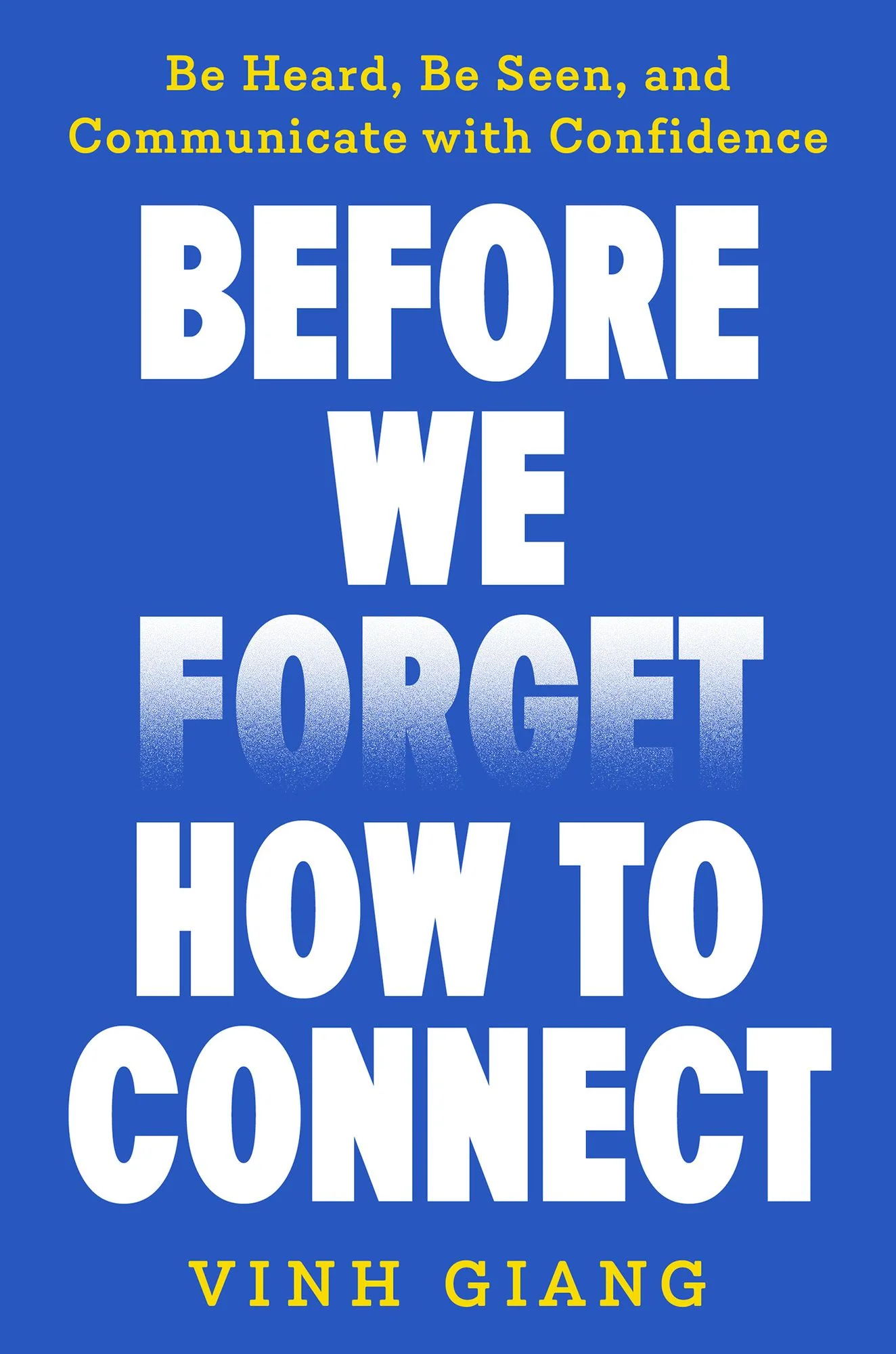
Before We Forget How to Connect: Be Heard, Be Seen, and Communicate with Confidence
What if the biggest thing holding you back isn’t your talent, intelligence, or hard work but your ability to connect?
In Before We Forget How to Connect, Vinh Giang shows that communication is not a gift reserved for the naturally charismatic. It is a skill. A set of learnable tools. And once you begin to master them, your relationships deepen, your confidence grows, and your ideas finally land the way they deserve to.
At its heart, Before We Forget How to Connect is about more than speaking well. It is about becoming more fully human in a world that is growing noisier, faster, and more disconnected. It is about remembering how to be heard, seen, and understood - and learning how to offer that same gift to others.
Resources
-
- Association for Psychological Science: Asking Questions Increases Likability
- Greater Good Science Center: What You’re Listening For (And What You Might Be Missing)
- Greater Good Science Center: Seven Tips for Better Relationship Conversations
- Yale News: At first meeting, people like you more than you think
- Greater Good Science Center: How to Be Yourself When You Have Social Anxiety
- Stanford Business School: Presence, Structure, Performance: 5 Tips to Improve Your Public Speaking
- University of Michigan: Improv course may help teens learn to tolerate uncertainty
- Greater Good Science Center: How to Overcome Your Reluctance to Ask for Help at Work
- Harvard Business School: Conveying and Detecting Listening During Live Conversation
- Harvard Business School: It Doesn’t Hurt to Ask: Question-Asking Increases Liking
- Communications Psychology: High-quality listening behaviors linked to social connection between strangers
- American Psychological Association: Get Excited: Reappraising Pre-Performance Anxiety as Excitement
- Personality and Social Psychology Bulletin: Falling Vocal Intonation Signals Speaker Confidence and Conditionally Boosts Persuasion
2 Million Readers.
1 Life-Changing Newsletter
Simple and Straight-to-the-Point...
Just Like Mel.