Episode: 369
How to Have Better Sex: Your Guide to Romance, Intimacy, & Love From the #1 Sex Professor
with Dr. Nicole McNichols

You could be having better sex.
If you’re not having sex, or sex feels like another task, this episode is for you.
Mel talks with Dr. Nicole McNichols, the University of Washington professor teaching 4,000 students a year and known as America’s #1 sex professor.
Her message: nothing is wrong with you. You were never taught how desire works or how women’s pleasure is built (the clitoris wasn’t fully mapped until the early 2000s).
You will learn simple skills for more pleasure, connection, and better sex at any age.
Listen on:




If sex improves, relationship satisfaction often improves after. Waiting for the relationship to magically fix the sex is usually backwards.
Dr. McNichols
All Clips
Transcript
Dr. Nicole McNichols (00:00:00):
We tend to think of sex as something that's just a treat, right? If you even look at the language that we use around it, it's you get lucky or, you know, save room for dessert. And, you know, the reality is that sex is something that needs to be prioritized. We understand the effects of exercise or the benefits of nutrition, but most of us don't really have an awareness of the basic benefits of sex.
Mel Robbins (00:00:25):
Today, you're getting the guide to better sex, intimacy, and love from the number one sex professor in the world. Dr. McNichols is a professor at the University of Washington who teaches the single most popular course, and today, you're getting a front row seat in her class. What is one adult sex ed fact about women's pleasure?
Dr. Nicole McNichols (00:00:50):
Only 18% of women can have an orgasm from penetrative sex alone.
Mel Robbins (00:00:57):
Only 18%?
Dr. Nicole McNichols (00:00:59):
Let that sink in.
Mel Robbins (00:01:00):
18?
Dr. Nicole McNichols (00:01:02):
18%. And it leads to a huge epidemic of people faking orgasms, especially women faking orgasms. Over 50% of women say they have faked an orgasm at some point. What is the average size of a paint? It is about the most popular sexual fantasy in America, is I am going to give you a roadmap to having amazing, incredible sex.
Mel Robbins (00:01:29):
Hey, it's Mel. And before we get into this episode, my team was showing me 57% of you who watched the Mel Robbins podcast here on YouTube are not subscribed yet. Could you do me a quick favor? Just hit subscribe so that you don't miss any of the episodes that we post here on YouTube. It lets me know you're enjoying the guests and the content that we're bringing you because I wanna make sure you don't miss a thing, and I'm so glad you're here for this episode, because this is a really good one. All right. Let's dive in. Dr. Nicole McNichols, welcome to the Mel Robbins Podcast.
Dr. Nicole McNichols (00:02:02):
Thank you, Mel. I'm so excited to be here.
Mel Robbins (00:02:04):
I'm really excited that you're here too, because I know I personally, uh, would like to be having better sex, and I'm sure as you're listening, you would like to be having better sex. And so let's start with this. Dr. McNichols, what could change about my life?
Dr. Nicole McNichols (00:02:20):
Yes.
Mel Robbins (00:02:20):
If I take everything to heart that you're about to share with us today, and I apply it to my life.
Dr. Nicole McNichols (00:02:27):
Mel, if you take all of my advice today to heart, I am going to give you a roadmap to having amazing, incredible sex. And it's not gonna be the kind of sex that you see in porn or the kind of sex that you see on shows on TV, or that makes you feel like, oh my God, that's just an unattainable goal. It's going to be the kind of sex that feels not only pleasurable, but authentically connected to who you are as a person. And I just wanna tell anyone who's listening to this podcast. This podcast episode is for you. If you're in a 20-year marriage, if you are finding your way back to each other, but don't quite know how. If you are newly single and trying to figure out what sex and dating are like now that you're in this new phase of your life, if you are having okay sex, but you just have this sense that it could be a bit better, I wanna really be able to speak to all of those people and tell them that I can give you the science-backed tools and roadmap toward cultivating a truly pleasurable sex life.
Mel Robbins (00:03:35):
Wow. Is that also true if I'm tired?
Dr. Nicole McNichols (00:03:39):
Yes. It is.
Mel Robbins (00:03:41):
Or I feel self-conscious about my body-
Dr. Nicole McNichols (00:03:43):
Absolutely. ...
Mel Robbins (00:03:44):
Or I haven't been with somebody in a number of years, you know?
Dr. Nicole McNichols (00:03:47):
It is. It truly is. And there, this is actually such an incredibly burgeoning area of research because it's become so clear just how exhausted people are, how exhausted women especially are. You have so much going on in your life between a career, your family, the two dogs, you know, the, the people who are all depending on you. And, you know, I think, and this is a message, especially for women, we're so socialized to be taking care of other people and to be attending to other people's needs. And I'm telling you that this is about reclaiming something that you really deserve and that is within your reach. A great sex life is not something that is just reserved for people who are in new relationships or have a certain sexual chemistry that's determined from the very start or that are single and have actually real time to give to it.
(00:04:44):
There really are some basic simple habits that we can talk about that will change your state of mind and allow you to achieve the type of sex life that you want that you just may not know how to get to yet.
Mel Robbins (00:04:58):
It's so interesting that we're starting here because you're right, when you are in a new relationship-
Dr. Nicole McNichols (00:05:03):
Yes.
Mel Robbins (00:05:04):
And the chemistry is dazzling.
Dr. Nicole McNichols (00:05:06):
Right.
Mel Robbins (00:05:06):
Sex is easy and it amplifies everything. And I'll just speak for myself personally, being married for 30 years.
Dr. Nicole McNichols (00:05:14):
Mm-hmm.
Mel Robbins (00:05:14):
It really does ... I, I hate to use this word.
Dr. Nicole McNichols (00:05:17):
Yes.
Mel Robbins (00:05:18):
But it starts to feel almost like a burden and you forget what an amazing intimate sexual experience can bring into your life. What does cultivating a great sex life for yourself add to your life personally that maybe we lose sight of?
Dr. Nicole McNichols (00:05:40):
Well, I'm s- so glad you brought that up because we tend to think of sex as something that's just a treat, right?
Dr. Nicole McNichols (00:05:47):
If you even look at the language that we use around it, it's you get lucky or, you know, save room for dessert. And, you know, the reality is that sex is something that needs to be prioritized. We understand the effects of exercise or the benefits of nutrition, but most of us don't really have an awareness of the basic benefits of sex. For example, we know that sex, when it's, you know, satisfying and consensual and connected, it leads to increased physical health, right? It leads to increased cardiovascular health, it protects the brain against degenerative diseases. There are even some studies that it predicts longevity. So sex is something that truly is important, but even more than that, it builds ego resilience. And what I mean by that is when you prioritize pleasure, when it becomes something that you spend time cultivating in your life, you experience this upward cycle where you gain this ego resilience.
(00:06:53):
Mm. It, it fills your bucket, so to speak. It causes you to have a broadening effect. You turn outwards, you seek more sources of social support. It allows you to think more creatively, even at a basic cognitive level. The data shows that when we experience pleasure, we're able to think more creatively and abstractly. And so we tend to think that pleasure is superfluous, but the reality is we need pleasure in our lives to be able to even just accomplish all of these things that we want to, to live the lives that we want to live. And beyond that, at a more concrete level, if we're looking at relationships specifically, we also have long-term studies looking at couples. And what we find is that, yes, you know, as most people know, sexual satisfaction and relationship satisfaction are highly correlated, but it's not the case that just improving your relationship or having high levels of relationship satisfaction are gonna naturally lead to a better sex life.
(00:07:57):
What we know is that when people's sex lives improve, when they experience an uptick in sexual satisfaction, later on, they experience more relationship satisfaction. In other words, working on your sex life will improve your relationship in an important, very authentic, powerful way that really deserves attention.
Mel Robbins (00:08:22):
What I love about this conversation already, I can't wait to trap my husband in a car. Be like, "Hey, let's listen to the Mel Robbins podcast and put this on. " Because I think this conversation listening to it with the person that you are in a relationship with, if you are in a relationship right now- Yes. ... could really open some things up. So I just wanna give a couple takeaways that I've gotten so far just at the very beginning. Number one, it is transformative just to switch your mindset from thinking about sex as a, "I should, I need to, I have to, " to just it being a conversation about pleasure and allowing pleasure in your life and prioritizing pleasure in your life.
Dr. Nicole McNichols (00:09:07):
Exactly, 100%.
Mel Robbins (00:09:09):
The second takeaway that I got already is you talked all about, what was it called, ego something?
Dr. Nicole McNichols (00:09:15):
Ego resilience.
Mel Robbins (00:09:16):
Ego resilience. And what, what does that mean exactly?
Dr. Nicole McNichols (00:09:19):
It's, it's essentially an academic term for what we think of as resiliency, meaning you're going to be faced with life's inevitable challenges. There's going to be problems that are thrown your way, but what we don't realize is that pleasure actually fuels you to be able to meet those head on. When we're given sources of pleasure, it's, those negative challenges can be right there, but we're just more creative and more likely to find the people and the ideas that are gonna help us to solve those very problems. So sex is important, yes, for your health, for your wellbeing, for your relationship, but it's also going to play a transformative part in your life-
Mel Robbins (00:10:05):
Hmm.
Dr. Nicole McNichols (00:10:06):
That is not superfluous, but is actually absolutely essential to your wellbeing.
Mel Robbins (00:10:11):
I've never actually looked at sex this way. Like, I'm having this huge aha moment about the role that pleasure plays in your life, because if you really just stop and consider what Dr. McNichols is saying, if your whole life is one giant to- do list, if it's work, if it's taking care of other people, you start to feel like that's your only value.
Dr. Nicole McNichols (00:10:33):
Exactly.
Mel Robbins (00:10:34):
When you create intentionally the space to allow yourself to feel pleasure that you deserve that as part of your life, it makes you feel like a whole person, and it also almost feels like this little space where you get to be you and you get to experience something other than all of the demands of your life.
Dr. Nicole McNichols (00:10:57):
Yes, exactly. And I'm here to tell you that all of us deserve that.
Mel Robbins (00:11:02):
Wow. And then the final takeaway that I had, and I'd never really seen this, before, is the connection between allowing pleasure into your life, creating the space for it, being intentional about it, and how that must boost your sense of self-worth.
Dr. Nicole McNichols (00:11:20):
I think all people recognize that this is an area of their lives that they would like to improve-
Mel Robbins (00:11:25):
Mm.
Dr. Nicole McNichols (00:11:25):
... but that if you're able to do the work of figuring out what turns you on, prioritizing pleasure, figuring out how to communicate that to a partner, how to keep, you know, some elements of novelty alive while still not becoming a whole different person, that that very skillset that is going to enable you to have an incredible, satisfying sex life, that's going to translate into other areas of your life. I mean, really, when you're prioritizing sexual intimacy, you're prioritizing yourself and you're developing skills that are gonna help you in just about every other area.
Mel Robbins (00:12:05):
Um, I wanna read to you from your bestselling book, You Could Be Having Better Sex. This is on page 18. Here's the reality of sex and pleasure that most people try to deny. We are not born knowing which sensations and which types of sexual activities we will one day enjoy, just as we're not born knowing which food we'll like and what kinds of entertainment we'll prefer. We learn about our sexual likes and dislikes the same way we learn about what pleases us in other areas of life through experimentation. And then you go on to say, "You may love certain techniques and sexual positions when you're younger and different ones as you age. Turn-ons and pleasure zones evolve throughout your lifetime." So what is the invitation in terms of how you want us to listen to everything that you're about to teach us?
Dr. Nicole McNichols (00:13:03):
The reality is that, yeah, we're born thinking that, okay, we should, you know, just all be really good at sex, that we should just know instantly what turns each other on, but the reality, and this may not sound sexy, is that sex is a skill, right? And it's, it's like any other skill that we have in our life, right? Trial and error, making mistakes. You know, I mean, this is why if you want to improve your sex life, and I think that for many women who are feeling like there's nothing that you can do to change it, that sex is just kind of the way it is that married sex never changes, there's so much research coming out now showing the power of a sexual growth mindset. And what that is, is the ability to lean into this idea that you need to try different things, that there needs to be communication, that it's okay if you try something that just simply epically fails and you learn to just laugh at it, right?
(00:14:07):
And so when I talk about this idea with people and, you know, especially my students, you know, they're, they're quick to be like, "Well, wait a minute, what about that guy that I met when I was back on spring break, Eduardo and, you know, he did that thing at this time." Like he, he really instantly knew what he was doing. I'm not saying, Mel, that sexual unicorns don't exist, right?
Mel Robbins (00:14:28):
Everybody wants now Eduardo's tongue-
Dr. Nicole McNichols (00:14:31):
Right.
Mel Robbins (00:14:32):
Still taught, you know?
Dr. Nicole McNichols (00:14:34):
And I'm telling you-
Mel Robbins (00:14:35):
Like, what was Eduardo doing with his song on spring break?
Dr. Nicole McNichols (00:14:38):
We need to get there.
Mel Robbins (00:14:39):
Yeah.
Dr. Nicole McNichols (00:14:40):
But I'm telling you, we can teach each other to have Eduardo's tongue. It just is trial and error. It is accessible. I want to give you Eduardo's tongue and I know that I can do that.
Mel Robbins (00:14:52):
How do you start to live with a sexual growth mindset?
Dr. Nicole McNichols (00:14:57):
You start to lean into this idea of experimentation and failure and learning to communicate through that, right? And so when we look at couples, for example- mm-hmm. ... and we ask them about, you know, well, what, what do you believe about sex? What are your attitudes? People who have a sexual growth mindset, they say, "I do believe that sex over time can change, that it can improve, that if I communicate with my partner and we learn about what turns us on, and if we engage in things like masturbation, which gets completely shamed in our culture, but is a totally necessary tool to understand your body, you can learn and you can bring those conversations no matter how awkward or scary they may seem to your partner and your sex life can improve and it won't improve overnight and it may take some time and there will be things that, you know, uh, no, actually, honey, that wasn't quite Eduardo's tongue, but let's try this instead." But you can get there, you know, whereas people with sexual destiny beliefs, which are the opposite of sexual growth beliefs they tend to think sex is what it is, right? Mm. Married sex just kinda never changes. A person has a certain level of skill, it never gets better. And those are the people that really start to struggle. And it really is that mindset that is just way more predictive of sexual satisfaction than any kind of innate skillset that we think that we're simply born with.
Mel Robbins (00:16:29):
Well, I love that because then the first step is just literally adjusting your mindset to say, "We can make this better." Exactly. "We can learn how to have more pleasure together. We can experiment and have fun." You know, for the person who's listening who really just wants more sex or better sex, what is the biggest misconception that is keeping them stuck from having more or better sex?
Dr. Nicole McNichols (00:16:56):
I think in the context of relationships, it's that an amazing sexual experience begins with feeling wildly turned on and excited the minute your partner walks in the door. But for the vast majority of us, you know, especially women who are in long-term relationships and who have a lot of things on their plate, desire might be something that kicks in only after you've started- Mm. ... touching your partner. Sometimes we need to get out there and actually be trying in action, and then we realize, "Oh, this is actually really fun. This feels really good. My mind and my body do want this. " And so in learning tools to sort of allow yourself to get into the mindset where you can be physically intimate with your partner and be touching your partner and be connected to your partner, I think people don't realize that sex can be incredible even when it comes from that place. And if you think about-
Mel Robbins (00:18:06):
That place of like, "I don't really feel like it, but I know I want better sex- Yes. ... so I'm gonna reach over and touch you even though I'm not turned on. " Yes. I think a lot of times, okay, this is probably about to turn into my own first- I love it. ... lik sex therapy session, but, you know, like a lot of times there is that ambivalence that you feel- mm-hmm. ... that you wanna be closer, but maybe you don't wanna have intercourse.
Dr. Nicole McNichols (00:18:25):
Yes.
Mel Robbins (00:18:26):
Do you see what I mean? I- Because I'm in that mode where I'm not really ... I'm, I'm, I'm tired.
Dr. Nicole McNichols (00:18:31):
Yes.
Mel Robbins (00:18:33):
But I love you and I'm trying to signal that I wanna kiss and, like, hold you for a little bit- Yeah. ... but I don't really wanna have to do all the others. You, you know what I'm saying? 100%. Is that a common concern? Yes. That you, like, do you hear that?
Dr. Nicole McNichols (00:18:46):
Oh, absolutely.
Mel Robbins (00:18:47):
That I-
Dr. Nicole McNichols (00:18:48):
I think that really the key there is building habits of being able to touch your partner in non-sexual ways on a regular basis, right? Mm. You, your phone should not be the last thing that you touch at night before you go to bed and put it down, right? There should be some kind of cuddling. It's just that physical touch and connection, but I think what happens is that if you don't have that regularly in your life- Oh. ... then every time your partner goes to touch you, you're going to kind of feel like, "Oh God, no, wait, I don't wanna, uh, I don't have the energy for this tonight," right? You almost feel yourself recoil, and that can be a horrible feeling because you know you love your partner, you know you're connected, you know you're attracted to them, and they're touching you, and suddenly you feel like, "Oh, God, this feels like there's an obligation
Mel Robbins (00:19:41):
Yes.
Dr. Nicole McNichols (00:19:41):
If I engage in this." And so I think we need to normalize cuddling each other, right? Even if it's just hugging, right? If you just simply hug your partner for 90 seconds a day, it's going to build relationship satisfaction and it's going to lead to you naturally experiencing more desire.
Mel Robbins (00:20:00):
Well, that's a great specific thing to do. Yes. If you're the person that wants to be having better sex, but you're in that mode where you don't want the touch to signal like, "It's on. "
Dr. Nicole McNichols (00:20:11):
Yes.
Mel Robbins (00:20:11):
The takeaway here is just start more non-sexual touch, more like looking at the person in the eyes, holding their hands while you're sitting on the couch, that kind of intimacy builds the bridge
Dr. Nicole McNichols (00:20:26):
Yes.
Mel Robbins (00:20:26):
That then helps you step toward the actual kind of growth mindset around sex when you hit the bedroom.
Dr. Nicole McNichols (00:20:34):
Yes, exactly. Exactly. But the other thing that I think is really important for people, and especially women to know, is normalize giving yourself the space and having patience for yourself to know, "I might not be wildly turned on right now, but why don't we try cuddling? Or why don't we try even just being next to each other, having the sides of our bodies touch while we're reading our books or, you know, watch whatever it is that we're doing." If you start doing that, and this is backed by years, decades of research, a lot of times you will find your body starting to turn on, right? You get close to your partner and you start to think, "Oh, this. I want this. This feels good." And then one things leads to another and you are having incredible sex. We need to give ourselves permission to explore the possibility of intimacy on certain evenings where we're not quite positive if it's what we're really aiming for that night, right?
(00:21:40):
Give our bodies time to turn on.
Mel Robbins (00:21:42):
Is there research around how long it takes, you know, the average person or the average woman, like, to turn on, so to speak?
Dr. Nicole McNichols (00:21:51):
I mean, one of the most common refrains is, "I need more foreplay." Right? And so, yes, you know, uh, and that revolves around this idea that we tend to treat sex according to this very heteronormative scr- script where you start kissing, you start touching, maybe there's a little bit of oral, you go to penetration, he has an orgasm and it's over, right? Very sad stress.
Mel Robbins (00:22:16):
Everyone's thinking, "Were you in the bedroom last night?"
Dr. Nicole McNichols (00:22:17):
Right.
Mel Robbins (00:22:18):
Like Dr. McNichols, what?
Dr. Nicole McNichols (00:22:19):
Exactly. Right? We need to, we need to throw that out, right? This is one of the reasons that we find a huge orgasm gap is that we rely so heavily on, you know, that idea of penetrative sex being put on a, on a pedestal. Um, it's also why when we look at queer couples, they tend to have more equal and higher levels of orgasm rate because they're not just starting from the position of, "Oh, you know, sex equals penetration and then he comes and it's over." But if we're regularly setting, you know, a part-time with our partner to allow us to transition mentally and calm our nervous systems, right? Allow our nervous systems to sync up, connect with each other, not just about our days, but about larger things happening in our lives that we're excited or anxious or worried about and really feeling seen and heard in that moment if we're setting, again, this time for intimacy, that's going to lead to much better and more frequent sex. Yeah.
Mel Robbins (00:23:31):
I mean, it makes sense. Yeah. What, what is one adult sex ed fact, Dr. McNichols, about women's pleasure that most people are never taught, but can, like, change your sex life immediately?
Dr. Nicole McNichols (00:23:42):
The reality that most people are not taught is that only 18% of women can have an orgasm from penetrative sex alone.
Mel Robbins (00:23:54):
Only 18%.
Dr. Nicole McNichols (00:23:54):
Let that sink in.
Mel Robbins (00:23:56):
18?
Dr. Nicole McNichols (00:23:57):
18%. The rest needs some kind of clitoral stimulation, either in conjunction while you're having penetrative sex or on its own. So when I teach this and show this data in my class, I have so many people on the edge of their seats, right? Women feeling normalized, right? My female students feeling like, "God, I thought I was broken that I couldn't have, you know, sex just from normal, you know, as we call it in the literature, penis and vagina sex." Um, and also men who feel like, "Oh my God, this explains it. I thought it was a failure on my part that I wasn't, you know, doing sex right, right, that I was failing." You know, but unfortunately, we don't teach people that, and it leads to a huge epidemic of people faking orgasms, especially women faking orgasms, which does not lead to anyone's pleasure at all.
Mel Robbins (00:24:57):
Is it true ... I, I read in your book that the human clitoris was only mapped out in 2015, that's just a decade ago.
Dr. Nicole McNichols (00:25:07):
It was, it was actually 2005.
Mel Robbins (00:25:10):
Okay.
Dr. Nicole McNichols (00:25:10):
But it took about 10 years for it to come into mainstream literature. Isn't that wild, Mel? I mean, if you think about it, right? I mean, and the reason why, of course, is that the clitoris' only purpose is sexual pleasure. It plays zero role in reproduction. And so historically, you know, because female sexual pleasure has been placed in this framework of not important, right, if anything threatening, it was just ignored. It was viewed as inconsequential. But luckily, in 2005, a very famous scientist, Dr. Helen O'Connell, through MRI studies, was able to map its full structure and it completely turned on our, on its head everything we know about female pleasure and everything we know about female anatomy.
Mel Robbins (00:26:03):
Wow.
Dr. Nicole McNichols (00:26:04):
Yeah.
Mel Robbins (00:26:05):
I mean, it's shocking but not. Dr. McNichols, in all of your research and your teaching and writing your bestselling book, you have identified that there are myths that people believe about sex that keep you alone every night. I wanna go through them. Myth number one, Dr. McNichols, is believing that your genitals are supposed to look a certain way and that there's a normal way for them to look.
Dr. Nicole McNichols (00:26:28):
Exactly. That is a huge myth that causes so much insecurity, right? People think that their labia are supposed to have a certain perfect ratio of the outer labia and the inner labia, which usually hang a little bit below or come peek outside the outer labia. So vulvas come in all beautiful shapes and sizes, but penises also come in all different lengths and widths.
Dr. Nicole McNichols (00:26:56):
What is the average size of a penis? It is about five and a half inches. Erect? Erect. Yes, exactly. Which is not nearly as big as what we're used to seeing in porn or on the internet.
Mel Robbins (00:27:10):
So, for somebody who's listening that has, for their entire lifetime-
Dr. Nicole McNichols (00:27:14):
Yes.
Mel Robbins (00:27:14):
... shame themselves because they believe they are too small. Right. Dr. McNichols, what do you want them to know?
Dr. Nicole McNichols (00:27:21):
I want you to know that the size of your penis does not matter at all in terms of ha- its ability to pleasure another person-
Mel Robbins (00:27:32):
Mm. ...
Dr. Nicole McNichols (00:27:32):
That you are exper- capable of experiencing just as much pleasure as any other person with a penis, and that it is not a measure of your manhood in any kind of way or form. You don't need an enormous, ridiculously huge penis to be having great sex. If you do, great. Congratulations. High five, that's awesome. But it is not a prerequisite to incredible orgasms and sex.
Mel Robbins (00:28:03):
You know, another myth, Dr. McNichols, that people believe is that if you don't orgasm fast or you take too long, that there's something wrong with you.
Dr. Nicole McNichols (00:28:13):
Yes. And so, this is particularly true, I think, among women. Yeah. First of all, if you're looking at, you know, a sexual experience, on average, a woman has an orgasm about 10 to 15 minutes in, right? For a male, it's five minutes within the beginning of penetration, right, or the beginning of stimulation. So, most women, right, in the context of partnered sex, at least in the context of, of straight sex, if they're having any kind of an orgasm from penetrative sex, is having a lot later in than it is for a man, that is normal. Just because it takes a little bit longer does not mean at all that it is less intense or less pleasurable, right? We tend to be so incredibly focused on numbers, right? If you even look at the language around sex, achieving orgasms, right? Finishing, right? We're, we're so numbers and goal oriented.
(00:29:14):
It's okay if it takes a little bit longer. In fact, that's better, right? It means that it's more exploratory, that, right? It's a longer experience. But the other thing is just coming back to the importance of the clitoris, although we find that women in having partnered sex, right, with, in the context of straight sex, will have, you know, an orgasm later in than men, when you look at the speed with which an orgasm occurs for men and women when they're masturbating, it's exactly the same. It's about four to five minutes.
Mel Robbins (00:29:49):
Okay. I just wanna make sure I heard that.
Dr. Nicole McNichols (00:29:52):
Yes.
Mel Robbins (00:29:52):
And that as you're listening or watching on YouTube, you got that. Yes. That the average length of time that it takes ... A woman to have an orgasm is about 15 minutes if you're full on intercourse. Right. But if you're masturbating- Yes. ... men and women achieve orgasm within four to five minutes. Yes. So it's because we know what we're doing.
Dr. Nicole McNichols (00:30:12):
Exactly, because we know what we're doing. And we tend to be stimulating the clitoris, right? Again, penetrative sex is incredible, but it's not the most efficient path towards orgasm, right?
Dr. Nicole McNichols (00:30:26):
It's wonderful for things to take longer, but you're not weird if you're taking longer having a type of sex that just naturally isn't designed to be stimulating the parts of you that are most important when it comes to pleasure.
Mel Robbins (00:30:42):
Well, and what's interesting is that since we began with you basically saying, "Let's flip our mindset and let's really think about your sex life as allowing pleasure in. "
Dr. Nicole McNichols (00:30:53):
Yeah.
Mel Robbins (00:30:53):
The second you focus on whether or not you're going to orgasm, now you're in the burden zone- Exactly. ... versus just being in the moment and allowing whatever it is to feel good.
Dr. Nicole McNichols (00:31:05):
And it's that kind of pressure that leads to so many women faking orgasms, right? Over 50% of women say they have faked an orgasm at some point. And when you interview them and ask for their reasons, it's because often they felt like they had to protect their partner's feelings, right? Mm. That if they didn't orgasm, that they'd be making their partner feel like it, they just weren't a man, right? Or that they just weren't, you know, a good sexual partner. And that it would lead to sort of this dynamic where y- one person felt insecure and rejected and it just leads to more and more pressure. And again, the more pressure you're putting on the sexual experience, the less likely you are to enjoy it, right? The less likely it is to be pleasurable.
Mel Robbins (00:31:57):
I think 50%'s probably a low number.
Dr. Nicole McNichols (00:32:00):
Mm-hmm.
Mel Robbins (00:32:00):
You know, if you're being honest with yourself- Yep. ... you faked an orgasm to either finish things- Yep. ... and be done with it, or because it's taking too long and now up, you're up in your head and you're not enjoying it, and now you don't want them to feel bad, so it's like an out.
Dr. Nicole McNichols (00:32:13):
The trick to pleasurable sex isn't this innate ability to have an orgasm that is just somebody's permanent skillset, right? It's through communication. It's through being able to use phrases like, "Guide me, or show me what you want, " or, "Is this feeling good?" Or, "Should I do more of this? " Or, "Show me what you like. " It's using, you know, slight shifts in position or slight shifts in, you know, initiating something that feels really good to you. It's using size and moans to, again, communicate what's working, right? And so it's shutting down honest communication if you're just shutting yourself off from your partner by faking an orgasm-
Mel Robbins (00:33:03):
Mm.
Dr. Nicole McNichols (00:33:04):
... and essentially using deception, right? And if you think about the couple that's been together maybe for 20, 30 years, and there's been a repeated pattern of faking orgasms, it can be a really hard place to all of a sudden, you know, 20 years in, say, "Honey, I've actually been faking orgasms all this time," right? And all of a sudden, it's, it's sort of this monumental time when you're like, "Oh my gosh, our sex life just hasn't been what I thought it was. " Right? Now, there is a path back from that. What is it? It's first, you need to figure out what does turn you on. You need to masturbate. You need to, whether it's on your own, in the shower with one of the amazingly creative, technologically advanced sex toys we now have available to us, you need to learn what the types of touch and sensation are that make you feel at home and connected to your body.
Mel Robbins (00:34:07):
Hmm.
Dr. Nicole McNichols (00:34:07):
You need to give yourself permission to maybe take longer, like we talked about than what the whole world has taught you is necessary and expected, right? And it's through communication, right? And this might look like having a conversation with your partner, right, where you say, "Look, I know this topic is really awkward, but it's important to us, and I want sex to be as pleasurable as it is. And so let's have an actual conversation, right?" And this is why in my book, I give all sorts of questions that couples can ask each other to try to improve the sex that's in their relationship.
Mel Robbins (00:34:49):
I have so many thoughts. I am so happy you're here because I do believe that if you listen to this conversation with your partner, it will open the door. And I applaud anybody that is willing to say out loud to somebody, "I really wanna work with you to improve this. " My husband did that in our relationship four years ago. Now, we're gonna be married 30 years this year, and I remember when he came to me and said, "You know, one of my goals this year is that we really lean in and improve our sex life." And when he first said that, Dr. McNichols, I was like, "What do you mean? What's wrong with it? D- d- d- what am I not doing? And now I have to do more." Like, it just was this ... And the poor guy is just trying to connect-
Dr. Nicole McNichols (00:35:36):
Yes.
Mel Robbins (00:35:37):
... Around something so important. And I remember feeling very much like I'm doing something wrong.
Dr. Nicole McNichols (00:35:44):
Right. And I think so many couples struggle with that. Mm-hmm. It can immediately feel like a rejection or, wait, oh my God, you mean you're, are you not happy in our sex life? I- is something missing? Is it, is it not as good as I thought it was? And so, yeah, learning to have those larger conversations where you ask each other really important questions, but you have to frame it as, "I love you, " right? This is important to us, to me, to you, right? Sexual intimacy is something I would really love to focus on, and I'm attracted to you, and I love you so much, and this is an area of our life that I feel like we should work on because it's fun- Mm. ... and because it can always get better, right? And I feel like if you're, you know, setting it up with the positive, right?
(00:36:41):
Because one thing that is so true when it comes to sexual communication is that
Dr. Nicole McNichols (00:36:47):
If you are stressing what's working, stressing what's positive, right, talking about, "Well, what's the best sex we've ever had?" Right? Or, "What helps you to feel the most turned on? " What are different types of micro novelty that we could introduce?
Mel Robbins (00:37:07):
What's a micro novelty?
Dr. Nicole McNichols (00:37:08):
Oh, micro novelty is ... So we've all heard that novelty is critical in, with, you know, keeping sex alive, um, but we tend to be scared of it, right? We think that novelty means, you know, going to the sex shop, buying the whip, getting the, the, the paddle, right? Or that we have to become almost a completely different person in order to have novelty and experience the sex life we want. But the reality is that, you know, yes, novelty is important. And the research shows that couples who introduce some form of novelty once a month or more, right, so a total of 12 times a year, we're talking, experience greater levels of sexual satisfaction than couples who engage in less novelty. So it is important. It doesn't need to look like swinging from the chandeliers.
Mel Robbins (00:38:01):
'Cause I was gonna say the, the paddles and the whips and stuff sound like macro.
Dr. Nicole McNichols (00:38:04):
Right.
Mel Robbins (00:38:05):
Novelty for me.
Dr. Nicole McNichols (00:38:06):
They're macro. You ... And, and if that's what you're into, go for it, right? By all means. I have a whole chapter in my book if you are interested in exploring that, but it could be trying a different technique, right? A different type of touch that I go deeply into, right? Read chapters two and three where I talk about all these different types of touch and technique that can be really pleasurable. It could be setting the mood in a slightly different way, right? We have research showing that couples in long-term relationships who set the mood and,
(00:38:40):
And, you know, this is sort of, you know, sweet and you can take with this with a grain of salt, but couples who say, "I love you during sex report higher levels of sexual satisfaction." Kissing, kissing more during sex increases the chances of orgasm among women and increases sexual satisfaction, right? So it might be having sex at a slightly different time of day, right? Maybe instead of saving it until the end of the day when you're exhausted or after a huge meal, you schedule it for before you go out to dinner or before you go out at night or earlier in the day, right? It could be that you've noticed that the best sex of your life happens when you're on vacation. Maybe it's, you know, making an effort to schedule more time to go away, just the two of you, or get a hotel in the city you live, why do you have to be traveling to, you know, do that even just for a single night?
(00:39:33):
Or it could be introducing, you know, a blindfold or one of these types of, you know, sensation play that doesn't involve any kind of pain, maybe a little pinwheel, maybe it's ice cubes, right? Maybe the blindfold, you know, which increases your attention to your body, the sensations you're, you're experiencing. All of these things, you know, you don't have to be, again, you know, whipping out the paddle. You can, but it's not-
Mel Robbins (00:40:02):
I mean, the sleep mask is right there next to the bed. It's right there. Probably be using it. Just have the sleep mask on. Like, when you're- Normally that signals something else. Right. But, you know, you could-
Dr. Nicole McNichols (00:40:12):
Exactly.
Mel Robbins (00:40:12):
... introduce micro novelty.
Dr. Nicole McNichols (00:40:14):
Exactly. Let's go. Maybe, okay, I think on your sleep mask, we, it could be double sided. So like one side means sleep, but the other side is your clue
Mel Robbins (00:40:22):
Sex. ... is what it means.
Dr. Nicole McNichols (00:40:24):
Exactly.
Mel Robbins (00:40:25):
Sleep versus sex.
Dr. Nicole McNichols (00:40:26):
Exactly. And, you know, the beauty of things like, uh, a mask or, you know, any kind of, when you're cutting off one sensation, you're automatically, your body is compensating by tuning into other sensations. So you are immediately going to be more sensitive to touch and you're also going to be sort of more in the present because you're going to be so focused on that type of touch because your body's relying on it.
Mel Robbins (00:40:54):
Dr. McNichols, another myth that people believe about sex is that if you fantasize about something, it must mean you really want it and you feel guilty for even thinking about it.
Dr. Nicole McNichols (00:41:04):
I really wish I could free people from the shame that they experience around their sexual fantasies. There's wonderful research on it that exists now. And one of the major takeaways is that people fantasize about really wild, diverse things, and that what you fantasize about is not necessarily what you want in real life.
Mel Robbins (00:41:33):
So Dr. McNichols, how do you want us to think about our sexual fantasies?
Dr. Nicole McNichols (00:41:39):
I want you to, first of all, normalize whatever fantasy you're having.
Mel Robbins (00:41:43):
Okay.
Dr. Nicole McNichols (00:41:43):
Right? So for those of you who are wondering, the most popular sexual fantasy in America is threesomes. So let's take that as an example, right? Okay. Multi-partnered sex. Not everyone that is having a fantasy about threesomes actually wants to have a threesome, right? In other words, a lot of people might kind of have that fantasy, it gets them turned on, maybe they even think about it when they're masturbating, but the reality of a threesome feels overwhelming, unappealing. Do you, you know, how would that even work? I mean, personally, I know with my ADHD, I don't think it would, uh, it's too much. It's I fond of that category. Yeah. Um, but it doesn't mean that it's not natural to fantasize about it. Same thing with taboo activities, right? Having sex in a public place, right? Public sex is a very common sexual fantasy. Having sex in the airplane bathroom, right?
(00:42:46):
Having sex in a situation where you might get caught, right? Very, very common. They're tied to certain interesting personality correlates, but they don't necessarily predict what we want to have happen in real life. It's not just that we're having fantasies about wild, kinky things. The reality is that all of us really want to be desired, right? Feeling like somebody else really wants you is a huge aphrodisiac, which I don't know if you've seen the show Heated Rivalry.
Mel Robbins (00:43:20):
Okay. For anybody who has not seen this show, this show, right now as we're taping this conversation, everybody's talking about it. It's about two male pro hockey players-
Dr. Nicole McNichols (00:43:31):
Yes.
Mel Robbins (00:43:31):
... who are archrivals-
Dr. Nicole McNichols (00:43:33):
Yes.
Mel Robbins (00:43:33):
... who fall crazy, madly, obsessively, in love with each other.
Dr. Nicole McNichols (00:43:38):
Exactly.
Mel Robbins (00:43:38):
I binge-watched it with my husband.
Dr. Nicole McNichols (00:43:40):
Love that.
Mel Robbins (00:43:40):
Never in a million years did I think a television series about two male hockey players falling in love and having sex would be one of the biggest turn-ons ever. Like, it's helped my sex life so much-
Dr. Nicole McNichols (00:43:55):
Yes, me too.
Mel Robbins (00:43:55):
Watching heated rivalry. I'm like why? And I was really thinking about this because I think it was observing the just desire- Exactly. ... on your knees. Take your pants off. And after 30 years of marriage watching this show, I'm like, oh my God, I remember that. Exactly. Chris? Exactly. Why, why, why does that happen? Yeah. Like what was happening in that? 'Cause if you had the same experience-
Dr. Nicole McNichols (00:44:26):
Yes.
Mel Robbins (00:44:26):
... I'm sure it is enlivening the sex lives of millions of heterosexual women, but why?
Dr. Nicole McNichols (00:44:33):
Yes, exactly. I mean, that's what's fascinating is that the main viewership of that show are heterosexual millennial women. It's a hit for heterosexual women because that show taps into our fundamental need for desire, right? If you look at those two male hockey players, it's not just about the physical sex that they're having, although to be fair-
Mel Robbins (00:45:00):
It's hot.
Dr. Nicole McNichols (00:45:00):
... it's hot, but it's also just exploding with the tension between them, them wanting to connect with each other, have sex with each other, falling in love with each other, but feeling restrained- Mm. ... from doing so. And I think it really speaks to the fact that, you know, first of all, desire and passion in romance, it's one of America's top sexual fantasies, and it feeds into this very core human motivation to want to feel wanted. We all want to feel like our partner desires us. And it's also pointing into something else really fascinating about human sexuality, which is that a lot of times, the things that we fantasize about, or the things that we can watch and get turned on by don't necessarily line up with what we want in real life. It's because we are designed as human beings to be creative in our desires and to place ourselves into imaginary situations that allow us to open ourselves to fantasies and desires and emotional states that are core to our level of wanting, but that don't translate into the details of what we want to do in real life.
(00:46:27):
In heated rivalry, there's this sense of egalitarianism. They're both rich. They're both hot. They're both star hockey players. And so seeing them together, seeing them navigate a relationship where they both have equal power, it's, you know, not a man dominating a woman. It's not a woman experiencing the need and the desire which we're used to seeing. It's showing men express that desire and longing and wanting. We don't normally get to see that.
Mel Robbins (00:47:02):
Well, that makes perfect sense because inside each and every one of us is this innate want to be desired.
Dr. Nicole McNichols (00:47:10):
Yes.
Mel Robbins (00:47:11):
And when you see people devouring each other like that and the intimacy building and the connection building, it reminds you that you want that too in your life.
Dr. Nicole McNichols (00:47:21):
Exactly. We all fundamentally want that in our life. Hated rivalry isn't just about the actual physical sex scenes, it's about that dimension of wanting. So I think for a lot of women seeing that show up in men, they relate to the wanting, but also seeing that it's something that's a universal emotion, a fundamental need, not just a gendered behavior is pretty activating sexually and mentally to a lot of us.
Mel Robbins (00:47:55):
Um, Dr. McNichols, you have another myth about sex, which is that this belief that your i- sexual identity should be fixed, that it's crystal clear to you, and that
Mel Robbins (00:48:07):
If you're still kind of figuring out your sexual identity, that there's something wrong with you.
Dr. Nicole McNichols (00:48:12):
Yes. So we now know from so much research, um, Siri Van Anders, Lisa Diamond, so many incredible researchers in this field that show how fluid sexuality can be and how multidimensional, right? Meaning that sometimes the, you know, sexual orientation that you start out having stays consistent throughout your life, but a lot of times it evolves, right? A lot of times you may not be totally sure who you're attracted to and you kind of discover it later on in, you know, adulthood or through college years. You know, there's, you know, especially so much stigma, particularly towards people who identify as bisexual, right? Because the bisexual community in general, you know, is faced with this idea of, oh, you're just weird, you haven't decided yet what you are, you're just on a pathway to being gay, but the reality is that a lot of people are attracted to more than one gender, and that's okay.
(00:49:15):
And in fact, when you look at, you know, women who identify as bisexual, they tend to have that not as, like, just this phase that they go through- Mm. ... and then later on become gay or straight, but it actually tends to be more often the case that they transition towards being bisexual.
(00:49:34):
Hmm. You know, and that's important to point out because 23% of Gen Z nowadays identifies under the LGBTQIA+ umbrella, and of that group, 80% identifies bisexual. So I think that, you know, it's time that we celebrate that fluidity, that multidimensionality. That doesn't mean that you're secretly hiding your real sexual orientation, it just means that we're complex and sometimes what we enjoy in our imagination is just what makes us uniquely human, and sometimes it doesn't translate into what we want in real life. So it's multidimensional, and it just also depends on the particular domain, fantasy, imagination, you know, what you actually want in real life. It can vary acro- across those contexts as well.
Mel Robbins (00:50:21):
I love that answer and that context and framing because it just makes you feel normal.
Dr. Nicole McNichols (00:50:28):
Yep.
Mel Robbins (00:50:28):
And it helps you put the fantasies or the things that turn you on into context of just the importance of desire and pleasure in general in your life. Yes, exactly. So helpful. Um, a final myth that you talk about related to sex is that if you are into non-traditional sexual activities or kink or whatever else, that it's weird or it's unhealthy or there's something wrong with you.
Dr. Nicole McNichols (00:50:55):
Yes. So there is unfortunately this long history of shame towards people who are kinky, right? And the idea is that if you are kinky, you must have experienced childhood abuse, right? That's a major myth, and that you are just trying to relive this abuse over and over and over again. And this myth is so per- so pervasive that there's actual s- actual studies showing that this is not the case, right? There have been studies looking at people who are kinksters and looking at their, you know, interviewing them about their childhoods. No, actually the majority were not abused as children. Um, what it is, is, you know, a need for novelty, right, and excitement. And, you know, this is, again, almost something that is being thought of as almost, you know, part of the sexual orientation research, which is that some people want connection and slowness and reassuredness and stability and security and prediction and control in their sexual experiences, and some people are just oriented to want excitement, thrill, maybe, maybe entering into a headspace that is absolutely, completely opposed to the head space and identity that you have in the rest of your life.
(00:52:17):
And that can actually be a healing thing. I want to normalize people having all different forms of sexual expressions and interests. And look, kink is something that more and more people are getting into, but again, because of the media that they see, they don't understand that it involves consent. It involves having conversations ahead of time about what you're into, what you're not into, what you wanna feel, what your safe word is. And so I want to be able to normalize that because, I mean, here's the reality, Mel, is that those lessons that we often learn from the c- community in terms of consent and communication throughout the whole experience, they're not just relevant to people who are practicing kink, they actually can help all of us. Really, it really models how consent and that ongoing checking in with a partner throughout the whole experience can make sex better.
(00:53:16):
It can make it hotter. It can add that excitement and that, and desire and that thrill. So I feel like by showing them, you know, I'm normalizing something that somebody in the audience, many are probably thinking, "Okay, wow, I've always fantasized about that and I thought I was weird or broken or wrong and we're talking about this in a really open way."
Mel Robbins (00:53:37):
Dr. McNichols, can you talk to us about the clitoris?
Dr. Nicole McNichols (00:53:40):
I actually brought some friends with me that could illustrate what we know now.
Mel Robbins (00:53:45):
Absolutely.
Dr. Nicole McNichols (00:53:46):
Okay.
Mel Robbins (00:53:46):
Let's go there, Dr. McNichols. Here we go. Let's do it. And if you're listening, um, and you're not watching on YouTube ... You, you have picked up ... This is, this is like a stuffed toy. What is that?
Dr. Nicole McNichols (00:53:59):
This is my lovely, stuffed, plushy, clitoris and bulva that shows the external structures as well as the internal structure.
Mel Robbins (00:54:11):
It looks like a purple-y clam almost. It does. With like a little baby in the middle of the clam. We're wearing like a hooded towel.
Dr. Nicole McNichols (00:54:23):
It's cute. Exactly. Oh my gosh. So I'm holding my stuffed clitoris. What I'm going to point to first is what you, Mel, pointed out as what looks like
Mel Robbins (00:54:33):
A little baby head.
Dr. Nicole McNichols (00:54:34):
A little baby head. And this is at the top of the vulva. And just to orient you, on the outside, it has what are known as the outer lips of the vagina, which are the labia majora.
Mel Robbins (00:54:47):
Okay.
Dr. Nicole McNichols (00:54:48):
And then we have inside, we have the inner labia, which are the labia minora.
Mel Robbins (00:54:54):
Okay.
Dr. Nicole McNichols (00:54:55):
Before we go any further, the inner labia are really critically important because they have tons of nerve endings in them.
Mel Robbins (00:55:03):
They do?
Dr. Nicole McNichols (00:55:03):
They do tons of nerve endings that are really related to sexual pleasure. Huh. And so people do what I call gun it for the clit in the beginning of sexual pleasure. You do not want to gun it for the clit, because the clit starting out is going to be very sensitive.
Mel Robbins (00:55:20):
Sensitive, yeah.
Dr. Nicole McNichols (00:55:21):
Yeah. And it's not gonna feel good if you kind of just immediately go there and touch it. See, the trick is you need to, first of all, embrace the idea that the full body is an erogenous zone, right? I mean, it's, feels good to be touched everywhere, but then you wanna kind of warm up around the outer labia, which has nerve endings, and then these inner labia. Now, I need to also mention something critical about the inner labia. People don't realize how important these are for sexual pleasure, and yet, in porn, we see totally unrealistic portrayals of what they look like. People are literally going into a surgeon and having their inner labia shortened because they think it'll make it look tidier and neater according to what they see.
Mel Robbins (00:56:08):
Oh my God. Uh, well, you can't even see down there, so I don't know why you'd be doing that-
Dr. Nicole McNichols (00:56:11):
I know. ...
Mel Robbins (00:56:12):
Unless you're very bendy. But-
Dr. Nicole McNichols (00:56:13):
Yes. ...
Mel Robbins (00:56:13):
I just wanna make sure you're listening. Like, just imagine it's the outer lips, it's just-
Dr. Nicole McNichols (00:56:19):
Exactly. ...
Mel Robbins (00:56:19):
That's little or depending upon your body, just the, the ones that aren't so big on the outside-
Dr. Nicole McNichols (00:56:25):
Yes. ...
Mel Robbins (00:56:26):
That are on the inside that you're talking about. So when you move up to the top-
Dr. Nicole McNichols (00:56:30):
Yes. ...
Mel Robbins (00:56:31):
of the anatomy-
Dr. Nicole McNichols (00:56:32):
Yes. ...
Mel Robbins (00:56:33):
Now we have the part that I described like a little baby head in there nestled in, but it's, that's the clitoris.
Dr. Nicole McNichols (00:56:40):
That is the, that is the external portion of the clitoris, right? External. External portion. And I think this is fascinating. It originates from the exact same embryonic tissue as the glands of the penis head.
Mel Robbins (00:56:52):
It does?
Dr. Nicole McNichols (00:56:53):
It does. Which, if you think about it, means that by ignoring the clitoris for decades, we were essentially ignoring the equivalent of the glands of the penis, and it develops from the same tissue as the glands of the penis, meaning it is just as critical to pleasure as the head of the penis. So this part is critical, do not lose sight of that. And then, Mel, there's also a very important place right between the vulva and the entrance to the anus that's kind of like a flat piece of skin that can be incredibly sensitive and responsive to erotic touch. So, you know, we kind of fall into this trap of thinking it's just about the clitoris or it's just about the head of the penis, but all of these places can be incredibly sensitive and feed into a lot of pleasure. It's just a question about experimenting and finding what feels right to you and for your partner.
(00:57:54):
But here's the thing, Mel, is that you might be thinking this, uh, you might be listening to this episode thinking, "Okay, clitoris. Got it. Underneath the clitoral hood, check. I know where that is. " But what many people don't know is that, and what was discovered in 2005, as I turn around my stock-
Mel Robbins (00:58:11):
What the hell is that? Like, I don't even know to describe what the hell that is.
Dr. Nicole McNichols (00:58:14):
These are the internal portions of the clitoris. These are incredibly important-
Mel Robbins (00:58:20):
Okay, so let me just make sure I'm following this. Yes. So first, Dr. McNichols, you said, "Don't just go right for the clitoris. There's the androgynous jo- zone all around the outside."
Dr. Nicole McNichols (00:58:32):
Exactly.
Mel Robbins (00:58:33):
Pay attention to all of that. Warm things up. Exactly. And then when you go to the actual clitoris, which is at the top-
Dr. Nicole McNichols (00:58:41):
Yes. ...
Mel Robbins (00:58:42):
Of the female anatomy-
Dr. Nicole McNichols (00:58:44):
Yes. ...
Mel Robbins (00:58:44):
Right? That it's made from the same tissue that a penis would form from. Yes. And so it has the ability to swell and become erect when stimulated. You've now turned around the little stuffed clitoris ... And now all of a sudden, you've got these, like, I don't even know what to describe that.
Dr. Nicole McNichols (00:59:07):
It's, has these external wishbone structures, right, that are extending six to eight inches down-
Mel Robbins (00:59:15):
What? ...
Dr. Nicole McNichols (00:59:15):
Inside your body.
Mel Robbins (00:59:16):
Inside your- Yes. Yes. Wait, the, when it swells-
Dr. Nicole McNichols (00:59:18):
Yes. ...
Mel Robbins (00:59:19):
It's six to eight inches into your body?
Dr. Nicole McNichols (00:59:22):
Yes, exactly. It's a lot longer than people realize.
Mel Robbins (00:59:25):
Because you only see, like, a little bit-
Dr. Nicole McNichols (00:59:27):
Yes. ...
Mel Robbins (00:59:27):
Even when it wwells.
Dr. Nicole McNichols (00:59:28):
Yes, exactly. That's incredible. It's incredible. And so what we're looking at here are the outside structures, which are the cura, and then we have within the cura, the vestibular bulbs, which are another sort of inner wishbone structure. Now, these are both going to fill with blood and become aroused and erect during sexual arousal. Okay. So you might be thinking, "All right, well, that's fascinating. I, the clitoris has internal structures, but what does that mean for pledge Sure. It means that if we think about pleasuring the clitoris, right, we've got the glands, the outside portion, but then if we're thinking about what feels good from a penetrative standpoint, we want to be able to penetrate these internal structures. In other words, if you're watching this, if you're sticking your fingers about two to three inches inside the vagina and stimulating the upper wall, two to three inches inside, you're going to be hitting against these internal structures of the clitoris.
Mel Robbins (01:00:37):
Oh, so it's not just swelling outward, it's swelling inward.
Dr. Nicole McNichols (01:00:41):
Yes, exactly. Oh. It's because all of this is inside the body, right? This is wrapping around the vagina. So-
Mel Robbins (01:00:51):
Wow. ...
Dr. Nicole McNichols (01:00:51):
You've stuck your fing-
Mel Robbins (01:00:52):
Nobody's ever explained this to me before.
Dr. Nicole McNichols (01:00:53):
I know. It's, it's critical. It's, it's critical about anatomy.
Mel Robbins (01:00:57):
What is the most common question that you get when you start talking about the clitoris and the anatomy of a woman?
Dr. Nicole McNichols (01:01:07):
How big a penis has to be to be able to, to stimulate it, I would say, is a big thing. And when I, when I talk about the, you know, fact that this is only two to three inches inside, it's showing you that you don't need some enormous porn si- sized tool to get in there.
Mel Robbins (01:01:27):
That literally for a woman, right after you enter the vagina, it's just a short amount of space- It is. ... right inside that is swelling-
Dr. Nicole McNichols (01:01:35):
Exactly.
Mel Robbins (01:01:36):
... where all of those nerve endings are.
Dr. Nicole McNichols (01:01:39):
Exactly. And so, again, so this is the vagina where this clitoris is wrapping around internally. If you are, you know, again, sticking your two fingers, anything- Okay. ... inside this, right? Okay. Where, you know, man, woman, whoever you are, and you're stimulating the top part-
Mel Robbins (01:01:56):
And Dr. McNichols- Yes. ... is literally sticking her two fingers out.
Dr. Nicole McNichols (01:02:00):
Yes.
Mel Robbins (01:02:00):
And you're now, like, lifting up.
Dr. Nicole McNichols (01:02:02):
Exactly. The way I describe it to my students, it's kind of like the Spider-Man technique.
Mel Robbins (01:02:07):
Like- Oh, you're gonna spray. You're gonna,
Dr. Nicole McNichols (01:02:10):
You're right, like this, and then you're kinda going like that. Like a waiting-
Mel Robbins (01:02:14):
Okay,
Dr. Nicole McNichols (01:02:14):
Because she's making like a come. A come hither motion. Come here, because that's kind of sexy. It's not like come over here, it's come hit.
Mel Robbins (01:02:21):
Yeah, you're like stroking it like Spider-Man.
Dr. Nicole McNichols (01:02:23):
Exactly.
Mel Robbins (01:02:23):
Okay.
Dr. Nicole McNichols (01:02:24):
Exactly. And so, you know, we used to think of this as the G-spot, right? And-
Mel Robbins (01:02:29):
Oh, that, see, I thought the G-spot was, like, way up top somewhere. Yeah.
Dr. Nicole McNichols (01:02:33):
No.
Mel Robbins (01:02:33):
Like always searching for it.
Dr. Nicole McNichols (01:02:34):
Exactly. It's right there. It's right there. What? It's just two to inch. It's ... And so most people are like, "Well, I don't have a G-spot." And they're, they're searching too far deeply into the vagina because the reality is that it's exactly, it's just two to three inches there. Wow. And it, it feels a little bit different than the other tissue in the vagina. The texture of it is a bit closer to a walnut as opposed to being smooth,
Mel Robbins (01:02:59):
Like- Wow. Okay.
Dr. Nicole McNichols (01:03:00):
Yeah. Almost like the backside of cardboard, you know how that's bumpy?
Mel Robbins (01:03:03):
Yeah.
Dr. Nicole McNichols (01:03:03):
Like if you just put your fingers over that.
Mel Robbins (01:03:05):
Gotcha. Right?
Dr. Nicole McNichols (01:03:06):
Okay. So the G spot actually has a long, fascinating political history behind it because, you know, Freud used to believe and tell all of us that vaginal orgasms, which were the kind that you had, you know, with penetration, a penis, were more mature than clitoral orgasms. Essentially, what this was suggesting is that women who had orgasms on their own, a. K.a. Masturbating, were not as emotionally evolved as people who are having orgasms with a partner, right?
Mel Robbins (01:03:42):
Yeah. And you just, you just taught us that only 18% of women- Yes. ... can have an orgasm-
Dr. Nicole McNichols (01:03:45):
Exactly. ...
Mel Robbins (01:03:46):
When there is something inserted into her.
Dr. Nicole McNichols (01:03:48):
Exactly. So, I mean, essentially, Freud was saying that 82% of us are immature simply because we can't have the kind of sex that requires a man, which if you think about it, is really kind of appalling. But here's what's fascinating is that when it, you know, for a person who is having an orgasm from internal stimulation, it's usually because it's stimulating what we now call, it's not some sort of magical spot the way we used to think- Mm. ... like the, the G-spot, it's, we call it the clitourethral vaginal complex.
Mel Robbins (01:04:25):
That's way too long. Clitoral urethral vaginal complex.
Dr. Nicole McNichols (01:04:28):
Yes, close enough. Okay. Very good. And the idea is that all these structures are related. In other words, when you're having an orgasm from internal stimulation, you're still having a clitoral orgasm. It's just stimulating the clitoris from inside.
Mel Robbins (01:04:45):
Okay. Hold on. I just wanna make sure I just caught this. So when a woman is having an orgasm-
Dr. Nicole McNichols (01:04:51):
Yes.
Mel Robbins (01:04:53):
Whether it's because a penis or another object is inside of her, or she's having an orgasm because somebody is using the Spider-Man two-finger kind of come hither wave technique-
Dr. Nicole McNichols (01:05:07):
Yeah. ...
Mel Robbins (01:05:07):
Just two inches in, or she's having an orgasm because you are stimulating the outer, the inner and the clitoral area. Whenever a woman is having an orgasm, the clitoris is the thing that is pulsing. Is that right?
Dr. Nicole McNichols (01:05:23):
Exactly.
Mel Robbins (01:05:23):
Why did I not know that? I always thought if you're inside me, then the orgasm is actually coming from somewhere else. Right. You're basically saying any of the stimulation is just to get the clitoris to go.
Dr. Nicole McNichols (01:05:36):
Exactly. Exactly.
Mel Robbins (01:05:37):
Oh my God.
Dr. Nicole McNichols (01:05:38):
Yeah. And when we f-
Mel Robbins (01:05:39):
Why did I not know that until I was 57 years old? That's biz- like, what?
Dr. Nicole McNichols (01:05:44):
Because we're women and our sexuality has historically been sidelined and viewed as unimportant because if it's not tied to reproduction, who cares? Scientists have actually put women inside MRI machines and looked at what's happening in their bodies during orgasm and-
Mel Robbins (01:06:02):
I'm trying not to imagine what that research study looks like, by the way.
Dr. Nicole McNichols (01:06:07):
It's amazing that we even have this. And whether it's stimulated from the external portion of the clitoris, the inter- vaginally, just through fantasy alone- Yeah. ... some people can even have an orgasm just from fantasy alone, it involves the exact same sequence of contractions of what we call the orgasmic platform, which are all of the muscles that are tied into orgasm. One of the most important ones is the pubococcus Igus muscle, and don't worry, that took me several years to pronounce. Okay, keep going. Otherwise known as the pelvic floor.
Mel Robbins (01:06:42):
Oh.
Dr. Nicole McNichols (01:06:42):
Right?
Mel Robbins (01:06:42):
So- That, that's the technical name of the pelvic floor?
Dr. Nicole McNichols (01:06:45):
Yeah. Yeah. So it's, it's, you know, essentially the same thing that you can strengthen by doing kegel exercises. And I'm sure most people m- might know, but in case you don't know what a kegel exercise is, it's that contraction of muscles that you do when you're trying to stop the flow of urine.
Mel Robbins (01:07:04):
Okay.
Dr. Nicole McNichols (01:07:05):
Right? And so the idea is that if you do a certain set of those, right, a couple times a day, that, that will strengthen your pelvic floor and actually can lead to more intense orgasms. And the beauty- Does that work? The, it, I think it does, right? And I think it's incredibly important, especially for women who are menopausal or postmenopausal when that tissue, you know, or after childbirth, when that- mm-hmm. ... tissue can get stretched out. Now, I do wanna point out there are certain women who have a very tight pelvic floor already who don't wanna do that exercise, but for most people, it can be really helpful. Um, but yes, what it's, it's the same contraction of muscles. So this idea, you know, I mean, I remember sitting around with girlfriends in college and thinking, "Well, you know, I can have a clival stimulation, but I, I can't have one from vaginal sex." And, you know, just thinking that it was some holy grail of a different type of orgasm, it's not.
(01:08:01):
We see blood flow to slightly different areas, but the contraction of muscles in those two dif- different types of orgasms is totally equivalent. So you are not missing out if you- I,
Mel Robbins (01:08:12):
I find that those facts to be liberating.
Dr. Nicole McNichols (01:08:15):
Yes.
Mel Robbins (01:08:15):
And very empowering.
Dr. Nicole McNichols (01:08:17):
Yes. And that is my absolute goal with teaching people about this, is that you are not missing out on some holy grail of orgasms if you can't have a orgasm just simply from penetrative sex alone.
Mel Robbins (01:08:33):
Well, it makes perfect sense-
Dr. Nicole McNichols (01:08:34):
Yeah. ...
Mel Robbins (01:08:34):
Because the orgasm is mechanically the same thing as happening-
Dr. Nicole McNichols (01:08:39):
Yes. Yes. ...
Mel Robbins (01:08:39):
Regardless of what produced it. Um, Dr. McNichols, we have a bunch of listener questions. Yes. And I wanna start with one from Karen who's 56 years old and she writes in,
Mel Robbins (01:08:50):
"Dr. McNichols, I wanna have sex, but it hurts now. I'm dry, it burns, and I'm starting to dread intimacy because I'm scared it's going to be painful. Is this just menopause? Is there anything I can do?"
Dr. Nicole McNichols (01:09:03):
It absolutely can be menopause. That sounds like menopause to me, and we are in a fabulous time right now where there has been so much more awareness brought to the impact of perimenopause and menopause. You know, it's a time when, look, levels of progesterone and estrogen are rapidly declining, and that's going to have the effect on the vagina of making lubrication harder. There can be atrophy of the vaginal walls, and yes, that can lead to sexual pain, but sex should not be painful, right? It should absolutely never be something that you're just suffering through. And so I think it's amazing that we now have, you know, the black bottle warning from HRT therapy removed, that people, you know, are taking different types of hormones. You know, I, I personally will say that I take it has been transformative in my own life, taking estrogen and progesterone.
(01:10:05):
Testosterone therapy has also been really revolutionary for women. We don't know that we have testosterone in our bodies, and actually we lose it dramatically during menopause. And by introducing just small amounts of it to get it back to where it was in our 30s and 40s, can have a huge effect on our sex drive. So I, you know, wanna be careful because I'm not, uh, I, I'm not a doc- I'm not a doctor. I'm not a medical provider. I can just speak from my experience and from what I've read, you know, myself, which is that it can absolutely be hugely helpful, as can things like estrogen creams, which can simply be applied directly to the vagina.
Mel Robbins (01:10:44):
So if you're in menopause-
Dr. Nicole McNichols (01:10:45):
Yes. ...
Mel Robbins (01:10:46):
And you're going through hormonal changes or perimenopause-
Dr. Nicole McNichols (01:10:48):
Yes. ...
Mel Robbins (01:10:49):
And you're experiencing dryness. Other than HRT, what, is there anything else like use lube, this is your body? Okay.
Dr. Nicole McNichols (01:10:56):
Yes, exactly. So there are so many beautiful types of organic, flavored name your, your, what you like kind of lube that we should all be having and displaying beautifully at our nightstands, right? And it's, you know, it's, uh, just, we've come so far in the types of lube that are available, um, that can be wonderful, right? And aren't, don't have to be messy and can be fun to use and can really just make sex. You know, in general, I tell people, the wetter, the better. So the more lubrication you can have down there, the better off you're going to be. Um, and estrogen creams too, right, that can really help to rebuild the tissue, you know, around the vulva can be helpful. When we talk about menopause and we talk about perimenopause, I wanna also just bring up that obviously, as thrilled as I am for those conversations, I don't want women to lose sight of the fact that there are other very real things happening in your sex life that could be influencing your desire, right?
(01:12:05):
So for example, if you are feeling, you know, stressed out and exhausted and overwhelmed and taking care of everybody else's needs, right, when we look at all the variables impacting women, that can have just as much of an effect on lowering your level of desire as can the hormones and equally needs to be addressed, right? Whether it is through having conversations with your partner about perhaps how to rearrange different divisions of labor in the household, right? The more you have a partner that can lean in and help you to, you know, feel like you are achieving your dreams and that you are able to have support where you need it. And, you know, even, you know, I tell people, I don't think mystery is the secret to keeping passion alive. I think it's gratitude. I think it's really being able to appreciate all that our partners do to, you know, help us, help our families, that the ways that they lean in, right?
(01:13:20):
Because so often it can be sort of these hidden culprits in your relationship, these tiny resentments that can start to grow if you feel like you're not appreciated, or if you feel like you're just simply not seen or not heard in your relationship. And we need to understand everything and be interested in everything about our partner, you know, not just what they did that day, but what they want, what they're interested in, what they're worried about, what their insecurities are, what the details are of the hobby that they're really into, what the details are of the work that they're working on. Because the more that we can see in relationships, the more we feel connected and see each other, the more we feel heard, the more gratitude we express, that is going to be a pathway, I think, into that desire that we all crave that really sets the tone for a healthy sex life.
Mel Robbins (01:14:19):
So when you say gratitude-
Dr. Nicole McNichols (01:14:21):
Yes.
Mel Robbins (01:14:22):
... are you talking to our spouse that they need to be more grateful for us because I, you know, like when you hear it and you're also the mom and the wife, and you're taking care of everything, and you're exhausted, and your hormones are all over the place, and, and, and, and, and, and, and you're last on your list, feeling grateful for your partner do- is like, "Are you kidding me? " Don't they need to be grateful for me so that I- Exactly. ... wanna have sex with you? Exactly. So talk to me about this gratitude piece.
Dr. Nicole McNichols (01:14:53):
I hope that you are listening to this with your partner because I want you to both experience gratitude, but yes, I think especially for women who are in relationships where you are working to manage everybody else's needs, maybe you have a career as well on top of that, you are, you know, thinking about the kid's parent-teacher conference that's coming up or the dog that ate the cranset last night and it's your, you know, now you've got to call the vet and figure out exactly what's going on. There's so many responsibilities, you're doing so much and to the extent that your partner, right, your husband or whoever you are with can lean in and recognize that, right? Really understand just the enormous amounts of emotional and invisible labor that you are undertaking, that is a huge aphrodisiac. That is going to help you feel needed, feel seen, feel appreciated, right?
(01:16:03):
Distance does not make the heart grow fonder, gratitude does. We need to be appreciating all that our partners are doing. And yes, of course, this goes in the other direction, right? Understanding that the men in our lives or our partners are also doing so much, are under a lot of stress, or maybe don't have the ways to find the support that they need because of this culture we live in that underprioritizes being able to take, you know, give proper attention to men's feelings and insecurities, right? He might be feeling a sense of anxiety about things that would really help him to feel more connected to you too, if he could talk about it. But the most important thing is to feel like your needs are being recognized that the amount you are doing is appreciated because when we feel appreciated, we feel seen. And when we feel seen, that turns on our desire.
Mel Robbins (01:17:09):
Uh, our next question is from Maya, 41, Chicago.
Mel Robbins (01:17:13):
"I've been single for years and it's like my sex life just disappeared. I miss intimacy, but dating feels exhausting. I feel rusty and insecure. How do I rebuild desire and confidence when it's been so long without forcing myself into hookups I don't want? "
Dr. Nicole McNichols (01:17:29):
So being newly single, I just wanna really normalize that. It can be a scary time, right? Whether you are young and still navigating sex and dating culture in your 20s or if you're in your 40s or 50s and newly single after being divorced or, you know, it can feel scary being with a new sexual partner, right? Whether it's been many, many years or if it's just an ongoing part of your life. And so understanding that when you show up sexually, first of all, with a person, again, it's having this growth mindset. You shouldn't just be assuming that the sex you're gonna be having is gonna have to instantly out of the gate be absolutely perfect. It's letting go of these ideas of perfection and normalizing, you know, maybe you feel a little bit different in your body. It's going to take a little bit of time to get back.
(01:18:27):
But in terms of this anxiety around casual sex and dating culture, I wanna speak to that specifically because we are in now, you know, I described to my students as a culture of chill. It's literally a time when it is very cool to not have ... You don't want to catch feelings, quote unquote, right? We don't wanna come across as being needy or as codependent, right? We have all of this language around what is a very basic human need, which is to simply be made to feel like our needs matter. And so when you're looking at casual sex and hookup culture in general, right, it helps to first know that it is possible to have wonderful casual sex experiences, right? It is possible, you know, when we look at the literature, you know, we, we do see that absolutely, in fact, if you're even just looking at, you know, younger people where the majority of casual sex research has been performed on, that, you know, there are about a third of people who report having great casual sex, about a third who report that it's meh, kind of good, kind of bad, meaning they felt it was exciting, it was pleasurable, but they just kind of felt maybe a little disappointed in themselves or they felt a little bit, you know, not great about the whole experience.
(01:19:56):
It felt maybe a little empty and disconnected. And then there's a whole third of people who felt like it just was a really crummy experience. Look, I think like a quarter of 40 year olds I just read are now single and, you know, if we look at, you know, the average age of marriage, it's 31, we have a lot of people in the population who are trying to navigate singlehood and casual sex and may not be ready for a long-term relationship. And so the question becomes, can we look to the data and try to understand what predicts a really positive, pleasurable, exciting sexual experience versus one that leaves you feeling empty and maybe a little bit shook, right? And what we find is, you know, a couple of interesting things. First of all, it really largely boils down to motivation. You know, in other words, if you are looking at the sexual experience and coming from a place where you want excitement and it's adventure and it would feel good and to be pleasurable and that's sort of the thrill of the chase and it seems exciting, you are probably more likely to have a positive experience.
(01:21:07):
We tend to have more negative casual sex experiences when you're doing it because you're secretly hoping it's gonna lead to more, but you don't quite know how to ask for that, right? And again, because we live in this culture, it makes you feel like you're needy if you ask ahead of time, you know, I'm not quite sure where things stand, you know, can you let me know? Or, I can't quite tell what you want. You know, I'm really into you. This is really exciting. I love spending time with you. I'm really attracted to you, but I'm not that into casual sex. So is it any, you know, can we have a conversation about kind of where we are, right? Versus, you know, also normalizing phrases like, "Are you okay if this is just for fun, right? Are you okay if this is just about a night of excitement, right?" It, in other words, part of the problem is that because we put so much shame on casual sex experiences, we need to feel like we need to hide our motivation if that's really what we're looking for.
(01:22:10):
And by acknowledging that sex can be satisfying in a variety of contexts, what we're really doing is empowering people to say, "Know what you want, right? Go after what you want. Are you the kind of person that feels like casual sex could be fun, that maybe, you know, while you're single and exploring your sexuality again and maybe looking for excitement that it could be something that's pleasurable, great, right? Don't feel shy about having it, right? Make sure that you find a partner who is, you know, emotionally there and mature and that who you really connect with, you know, or is casual sex just something that you know in the back of your head is not right for you, right? Some of us are just not wired to be having unattached, casual sex, and that is also very okay, right? You're not, you're not sex positive if you don't like hooking up.
(01:23:07):
You're not empowered if you don't like hooking up. You're not confident if you don't like hooking up. You just aren't why ... It's okay, right? So it's just about normalizing this and giving people the tools to know what they want so that you can go out and choose and only agree to the sexual experiences that truly make you happy.
Mel Robbins (01:23:31):
What I love about the question you just gave us, are you okay if this is just for fun tonight? Yeah. Is that before you ask it of the other person, you should ask it of yourself.
Dr. Nicole McNichols (01:23:40):
Yes, exactly.
Mel Robbins (01:23:41):
'Cause I do think we gaslight ourselves, women in particular, into believing that if I go along with the casual sex, if I drink and I'm down to you know what, that somehow that's gonna lead to something meaningful and long-term. Right. Now, in the research, is there any breakdown in terms of men versus women?
Dr. Nicole McNichols (01:24:04):
There are some gender differences, but they're not nearly as extreme as what the media portrays them to be. Mm.
Dr. Nicole McNichols (01:24:12):
And we see this in the literature, but we also ... I mean, I could even just tell you, when I pull the thousands and thousands of students that come through my class, and I look, for example, at that group that says the casual sex experience was amazing, there are slightly more men than women who report that, but the difference is not nearly as big as you might think, right? And one group, the data does show, is particularly good at having positive sexual, casual sex experiences. Our older women who might be newly single and maybe don't feel like they have the pressure to settle down and they've, you know, feel a bit more confident and they, they feel like they're better able to speak up, right?
(01:24:57):
And that does a couple of things because if you're in that position, you'll feel better asking for what it is that brings you pleasure. So in other words, if you are having an orgasm, if it's truly pleasurable, it's more likely to be a positive experience for you. I don't want to underemphasize or dismiss the fact that, yes, a sexual double standard still exists. Women are going to be judged more harshly. It's also more dangerous because they're physically smaller on average, for sure. Casual sex does, for that reason, carry more risks, but I think that, you know, I mean, in terms of emotional intimacy, yes, there is data showing that for women, especially when there is emotional intimacy, they tend to be more likely to enjoy sex and to have orgasms.
Mel Robbins (01:25:49):
Here's another listener question.
Mel Robbins (01:25:51):
We have two kids. We're exhausted and our house is zero privacy. By the time we get to bed, we're done. How do you rebuild a sex life when life is chaos and you can't just quote, schedule a date night every week?
Dr. Nicole McNichols (01:26:03):
I mean, isn't that the fundamental challenge? And I, I can really relate to this. You know, I've got two teenagers and 11-year-old, and I remember, especially when they were a lot younger, it's exhausting. It's hard to carve out time where it's just the two of you. And yeah, the scheduling sex and the date night, it just feels like such tired advice, right? The first thing I wanna say though is that your kids deserve to have parents that have a healthy sex life because like we talked about in the beginning of this podcast, sex and pleasure are critical for your wellbeing. The more that you can prioritize pleasure in your lives, the more sense of joy and connection that you can model towards each other, the better parents you're going to be, right? I think a big struggle parents have is that they just don't understand how important this aspect of their life is, not just to the relationship, but to their own wellbeing.
(01:27:07):
And so, yeah, it does mean figuring out not just a date night, but again, this intimacy date where you're finding what is the emotional state that I need to get into in order to feel turned on for sex. How do I like you to initiate? How do I like you to talk to me before we have sex? Are there ways that we can set the mood ahead of time? Should we be experimenting because if we're looking forward to a different type of novelty, then it could be something that kind of piques our interest and gets us excited and makes us pay attention to the moment more, right? So if you're having these conversations and engaging in the non-sexual physical touch and setting a t- a part-time when you can connect, it will happen, right? It will absolutely be something that you can just simply close the door at night and know that you're actually doing a service to your kids by showing them that mom and dad have an area in their life that is just about each other, that's just about their own relationship, their own connection, that the kids are, yes, critically important, but they don't always have to be the absolute center of your life 24 hours a day, 60 minutes out of every hour.
(01:28:31):
You can take 30 minutes for just the two of you and close the door and they will be okay. They will be better off for it and you'll be a happier person and better parent.
Mel Robbins (01:28:41):
I love that. You know, one of the things that changed my sex life with Chris was when we started having sex before-
Dr. Nicole McNichols (01:28:49):
Yes. ...
Mel Robbins (01:28:49):
We went out because I always felt bloated or a little drunk or whatever- Yep. ... when we, you know, came back from a date night. Um, and then I didn't want to, but if you have a babysitter or a sister or friend coming over anyway to watch the kids- Have them come an hour- Have them come late. ... an hour early and be like, "Okay, great. We're gonna go get ready." Yes. And then you're having secret sex- Exactly. ... which is pretty hot. Very hot. And then you have it before you feel bloated after the meal and-
Dr. Nicole McNichols (01:29:16):
Yes. And if you're a parent and have a million responsibilities, not only are you full and bloated and a little bit drunk when you get home and not as able to experience pleasure, you're also exhausted. I mean, you started out tired after that night, you're gonna be really tired. So yes, have the babysitter come an hour earlier and enjoy it then.
Mel Robbins (01:29:41):
I love that. But I love the larger context that you deserve pleasure in your life.
Dr. Nicole McNichols (01:29:46):
Yes.
Mel Robbins (01:29:46):
And it makes your whole life better.
Mel Robbins (01:29:49):
Um, this question is so relatable because it's about sex, pleasure, and how you feel about your body. And this listener writes, "After menopause and weight changes, I don't feel sexy ... Sexy anymore. I'm so in my head during sex that I can't relax. I avoid intimacy because I'm embarrassed. How do I get out of that spiral and feel desire again when I don't like my body?
Dr. Nicole McNichols (01:30:12):
This is so incredibly common and there's so much research coming out just about, first of all, how much body image can get in the way of our ability to enjoy sex. It really can, as this listener is describing, bring you out of your head. Start judging yourself from a third party perspective during sex where you're thinking about, "Oh my God, you know, my stomach, my thighs. Oh, God, what do I look like from this angle?" And this is not being helped by the media, which is showing us, again, totally unrealistic, airbrushed, AI-generated images of bodies that are not attainable for 99.99% of us. Um, and it's just creating a level of insecurity and anxiety that is literally activating the exact parts of your brain that need to quiet in order to enjoy sex. Mm.
(01:31:08):
So the question is what's the antidote? The most effective tool that you can develop to treat body image issues and their impact on your sex life is to develop a sense of sexual mindfulness. It is a practice that is similar to other types of mindfulness that you might practice in the rest of your life, but it literally means during sex, bringing attention back to your breath, bringing attention back to the sensations that are in your body, looking and focusing on exactly the sexual cues that are emanating from your partner and allowing those to guide the sexual experience. Now, just like when somebody tries to meditate, it's going to be natural while you're trying to do that for these ideas of, "Oh my God, what does my stomach look like? " Or, "What do I look like from this angle?" That's natural. Just notice those thoughts and allow them to pass out of your brain, right?
(01:32:17):
Because the reality is that the person you're having sex with, they're psyched to be there, right? They're not sitting there judging what you look like. And the reality is that you don't need to have a perfect body. You do not need to be hairless to or have perfectly sized genitals to have incredible sex. I think it's, it's hard to tell people, you know, and this is where I think the body positivity movement has been both helpful, but also let us astray a little bit in that sometimes it's not gonna feel realistic to think, "I love my body," right? "I, I love my body. I love how I look. "But I think for some woman, that's just sort of not really realistic expectation. But if you look in front of the mirror, right, and you're standing there naked, you can probably find a part of yourself that you do love.
(01:33:14):
Maybe it's your collarbone, maybe it's your lips, maybe it's your eyes, maybe it's your hair, your legs, right? Your butt. And just focus on that, right? You know, I remember after each of my pregnancies, right, I gained, like, 70 pounds for each one and your body is just fundamentally different after having kids. But for me, I know what was really helpful was instead of focusing on, " Oh my gosh, my belly, I have a pooch now and I'm heavier, "my body had just done something incredible. It had just produced a life, right? If we can start appreciating our bodies for what they do for us, they get us to the places we want to go, they allow us to live the lives that we do, like you start to have more of an appreciation for your body beyond just how it looks. You are desirable exactly the way you are.
(01:34:10):
Your body, your genitals don't need to be perfect. It is just a question of practicing mindfulness, being at home in your body, noticing those things when they get in your way, and just bringing your sensations back home where they belong.
Mel Robbins (01:34:25):
Maybe this is too pragmatic of a way to look at this, but one of the things that you've really also taught us, Dr. McNichols, is that the parts of your body that give you pleasure, they work no matter what you weigh. Yes. They work regardless of what's hanging or shaking or that you don't like. And that those parts deserve to get some attention. Exactly. Exactly. You know, so there's also this, like, focusing on 99% of your body that you hate. You got 1% that's still gonna give you an orgasm. Yeah. So give that part of your body a little bit of attention crying out loud.
Dr. Nicole McNichols (01:35:03):
Yes.
Mel Robbins (01:35:04):
Amen. Dr. McNichols, what are your parting words?
Dr. Nicole McNichols (01:35:07):
Own your pleasure and own your fundamental right as a human being to enjoy a healthy sex life and the physical connection and psychological wellbeing that brings with it.
Mel Robbins (01:35:18):
Dr. McNichols, thank you, thank you, thank you for hopping on a plane and flying across country and really teaching us and empowering us about this fundamental aspect of improving our lives, which is really seeing the critical role that pleasure plays in your life and teaching us ways that we can be in control of having more pleasure. The book is You Could Be Having Better Sex. Thank you, thank you, thank you, for teaching us how to have better sex.
Dr. Nicole McNichols (01:35:52):
Thank you, Mal. This was such an enjoyable time. I really appreciate it.
Mel Robbins (01:35:56):
Well, I can't wait to hear what you do with this conversation, and so I just wanna thank you for spending time listening to or watching here on YouTube and learning about sex, learning about your body, learning about having a growth mindset related to sex. I am so excited. I cannot wait to listen to this with my husband, Chris. I can't wait for you to share this with people in your life, but mostly I'm just excited for you to experience more pleasure in your life because you deserve it and now you understand the critical benefits of it. And in case no one else tells you, I wanted to be sure to tell you that I love you and I believe in you and I believe in your ability to create a better life. And what I'm convinced of because of Dr. McNichols is that pleasure is a very important part of your life getting better, and now you got the roadmap for experiencing more of it.
(01:36:49):
Alrighty, I will see you in the very next episode. I'm gonna welcome you in the moment you hit play. And thank you. Thank you for watching all the way to the end. Didn't you love Dr. McNichols? Oh my gosh, they did not teach a class like this when I was in college. I'm so glad that you watched all the way to the end. Thank you for sharing this with people that you care about. Thank you for sharing this with women in your life. Every one of us deserves this information, and I love how the conversation was all about pleasure and how it makes your life better. And one more thing. I know you're thinking, okay, Mel, shut up. What video should I watch next? First of all, I gotta say, if that subscribe button is lit up, hit it. Okay? Hit it, because that's one way that you can show me and my team that you really appreciate us bringing you these world-renowned experts for free.
(01:37:37):
It's free to subscribe, it's the best way to support us, and that way you're not gonna miss a thing. All right, next video, right here, and I will welcome you in the moment you hit play.
Key takeaways
You deserve pleasure that feels real, and connected.
Sex is a skill you practice with experimentation, communication, and even failure; a growth mindset turns “this is it” into “we can get better.”
When you prioritize pleasure, you build ego resilience that helps you meet life’s challenges, think more creatively, and feel more like a whole person again.
Start with non-sexual touch: cuddling, hand-holding, or a 90-second hug, so your partner’s touch stops feeling like an obligation and starts feeling safe.
You don’t need to be wildly turned on first; for many women, desire shows up after touching, kissing, and letting your body warm into connection and pleasure.
Guests Appearing in this Episode
Dr. Nicole McNichols, PhD
Dr. Nicole McNichols, PhD, is the #1 sex professor in the country and a University of Washington professor who teaches the most popular class on campus: human sexuality.
- Follow Dr. McNichols on Instagram, TikTok, & LinkedIn
- Visit Dr. McNichols’ website
- Sign up for Dr. McNichols’ newsletter
- Check out her Psychology Today blog
-
You Could Be Having Better Sex: The Definitive Guide to a Happier, Healthier, and Hotter Sex Life
You know sex matters—to your health, your happiness, and your relationships. You know it’s supposed to be fun, connecting, and fulfilling. But maybe you’re not having as much of it as you’d like. Or it feels routine, awkward, or disconnected. Maybe you’re unsure what you want, how your body works, or how to ask for more. Or maybe you’re doing “everything right” and still wondering: Is this really all there is?
You’re not broken—and you’re not alone.
Drawing on the latest research, candid real-world insights, and years of teaching the nation’s most popular human sexuality course, Dr. Nicole McNichols dismantles the myths and taboos that hold you back and replaces them with practical tools and insight that spark real transformation. The result is a comprehensive, shame-free framework for understanding desire, building confidence, and creating deeper intimacy.
You Could Be Having Better Sex will inform, empower, and inspire you to:
Reignite desire in a long-term relationship
Navigate hookup culture without going insane
Add novelty without losing your sense of self
Explore what kinds of touch bring you the most pleasure
Get practical tools for asking for what you want—sexually and otherwise
and much more!
Empowering and enlightening, You Could Be Having Better Sex is your ultimate guide to a more passionate, authentic, and deeply connected sex life.
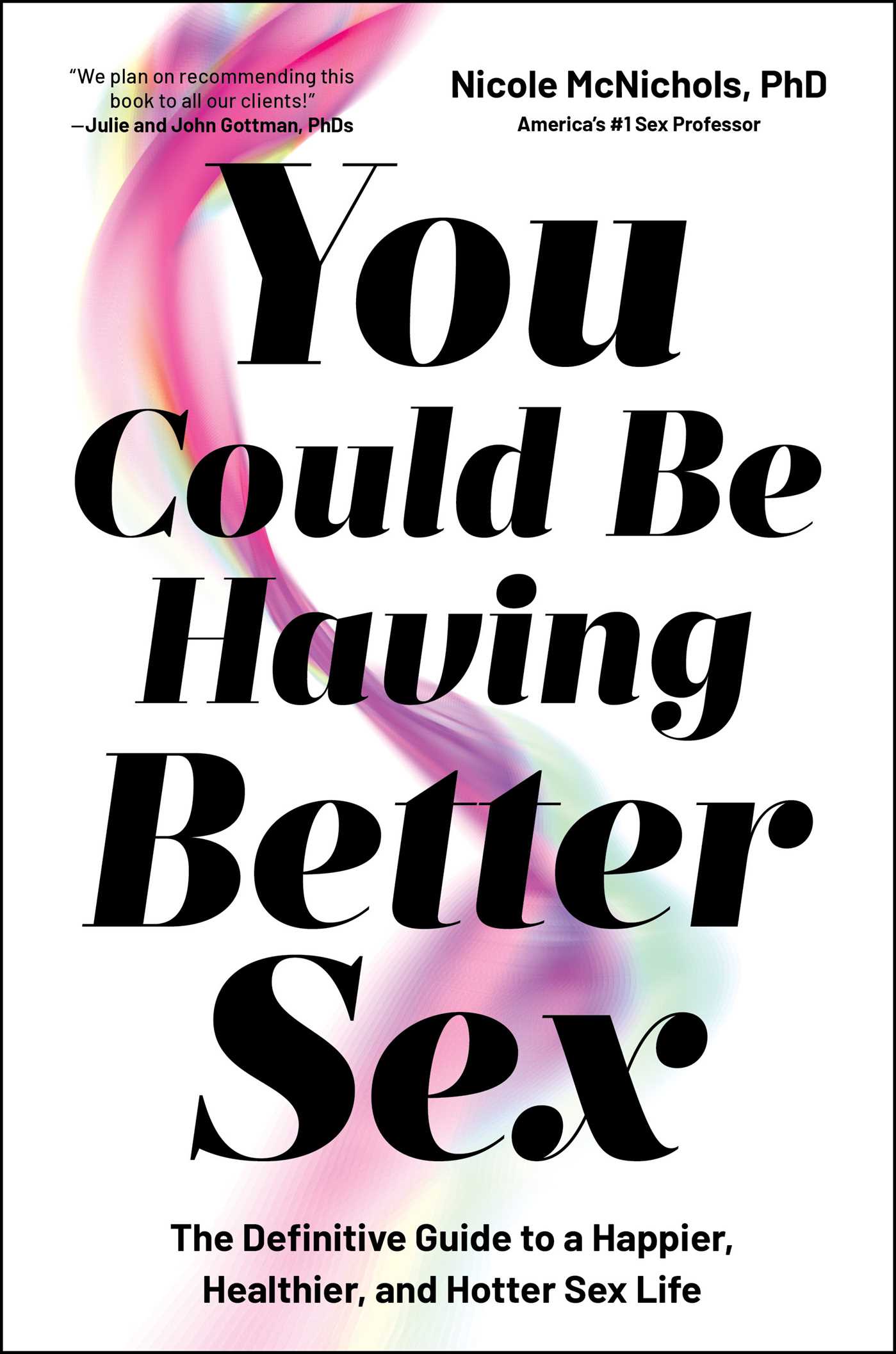
Resources
-
- Scientific American: The Clitoris, Uncovered: An Intimate History
- Sexual Medicine: The lifelong orgasm gap: exploring age’s impact on orgasm rates
- Greater Good Magazine: How to Bring More Self-Awareness to Your Sex Life
- International Society For Sexual Medicine: How long does it take a woman to reach orgasm?
- International Society For Sexual Medicine: Does Size Matter? Genital Self-Image Plays a Role in Female Genital Cosmetic Decisions
- Archives of Sexual Behavior: Women’s Sexual Satisfaction, Communication, and Reasons for (No Longer) Faking Orgasm: Findings from a U.S. Probability Sample
- The Journal of Sex Research: Sexual Growth and Destiny Beliefs and Couples' Well-Being
- Current Sexual Health Reports: Sexual Fluidity in Male and Females
- Queen’s University: Mapping Your Sexuality
- Oprah Daily: The Grown Woman’s Guide to Kink
- Archives of Sexual Behavior: The Psychology of Kink: A Cross-Sectional Survey Study Investigating the Roles of Sensation Seeking and Coping Style in BDSM-Related Interests
- Psychology Today: Why People Have Sexual Fantasies They'd Never Act Out
- Women’s Health Network: Health benefits of masturbation
- The Journal of Sexual Medicine: Brain Activity Unique to Orgasm in Women: An fMRI Analysis
2 Million Readers.
1 Life-Changing Newsletter
Simple and Straight-to-the-Point...
Just Like Mel.