Episode: 382
The Gut Health Episode: What a Harvard Doctor Wants You to Know
with Dr. Trisha Pasricha, MD

Your gut is trying to tell you something. A Harvard doctor explains what it means and what to do.
If you’ve ever felt bloated, uncomfortable, or just “off” and wondered if it’s normal, you’re not alone.
In this episode, Harvard-trained gastroenterologist Dr. Trisha Pasricha breaks down what your gut is trying to tell you, and what most people get wrong.
You’ll learn what’s normal, what’s not, and how your digestion connects to stress, mood, and overall health, with simple, science-backed ways to finally understand and support your body.
Listen on:



The hardest moments in your life can help you reimagine who you are.
Dr. Maya Shankar
All Clips
Transcript
Dr. Trisha Pasricha (00:00:00):
Here's a number that made me realize that we have a gut health crisis hiding in plain sight. 40% of Americans say that their bowels disrupt their daily lives.
Mel Robbins (00:00:09):
40%?
Dr. Trisha Pasricha (00:00:11):
15% of Americans have irritable bowel syndrome. Three out of four Americans can't poop in a public restroom. One out of three struggle to go to the bathroom on vacation.
Mel Robbins (00:00:22):
I have wanted to do an episode on this topic for years, gut issues, bloating, constipation, gas, IBS, and yes. You and I? We're going to talk about poop. Oh yes, we're going there. Today's guest is one of the world's leading experts on the gut-brain connection and how your body influences your mental health stress and decision-making. I'm talking about Dr. Trisha Pasricha. Dr. Pasricha is a board certified neurogastroenterologist, a physician scientist, and an assistant professor of medicine at Harvard Medical School. What is the gut specifically?
Dr. Trisha Pasricha (00:01:05):
Your gut is a brain. You will think about the gut just as a digestive organ, and it is so much more than that. What if it is gut dysfunction that's responsible for our anxiety? What if it's gut dysfunction that causes depression? What if it's gut dysfunction that causes neurodegenerative disorders? And that completely changed our field and it's still shaping medicine today.
Mel Robbins (00:01:28):
Okay. Now here's a question.
Dr. Trisha Pasricha (00:01:29):
Yeah.
Mel Robbins (00:01:30):
Oh God, I can't believe I'm going to ask you this.
Dr. Trisha Pasricha (00:01:32):
I'm so excited.
Mel Robbins (00:01:38):
Hey, it's Mel. And before we get into this episode, my team was showing me 57% of you who watched the Mel Robbins podcast here on YouTube are not subscribed yet. Could you do me a quick favor? Just hit subscribe so that you don't miss any of the episodes that we post here on YouTube. It lets me know you're enjoying the guests and the content that we're bringing you because I want to make sure you don't miss a thing. And I'm so glad you're here for this episode because this is a really good one. All right, let's dive in. Dr. Trisha Pasricha. I'm so excited that you are here.
Dr. Trisha Pasricha (00:02:13):
Thank you so much for having me, Mel.
Mel Robbins (00:02:15):
Oh my gosh. Okay. We are going to dig into this. I cannot wait. I really can't wait to talk about poop. I know that we're going to get into that a little bit later, but I'd like to start by asking you, how would my life be different? If I take everything that you're about to teach us today to heart, I apply it to my life, I share it with my friends. What's going to change about my life?
Dr. Trisha Pasricha (00:02:37):
Your life is going to change in two big ways. First, you're going to stop thinking about your gut as a digestive organ. You're going to start thinking about your gut as a brain because that's what it is. Your gut is a brain. It has more nerve cells than the entirety of your spinal cord. It is creating all the same neurotransmitters like dopamine, like serotonin. And it is constantly sending signals up to the brain in your head through this information super highway called the vagus nerve. And also, so many of the diseases that we're most afraid of from certain cancers to Parkinson's disease, these can all start in the gut. Once you realize that, everything changes because then you can realize you can change your health not 10 years from now, but today you can start to take control of your health through your gut, and that gives you real control.
(00:03:29):
The second thing that's going to change for you is that you're going to realize this whole time your symptoms were never all in your head. All of those GI symptoms, the bloating, the trouble with digestion, the going to the bathroom, none of that was ever just stress. And I think the reason that so many people for so long haven't been believed is because some people aren't as familiar with all of the data and all of the research that I'm going to share with you today. And once you have that knowledge and that validation, it's going to give you power back and agency to get the help that you need.
Mel Robbins (00:04:05):
Wow. So Dr. Pasricha, let's just start with the basic level. What is the gut specifically?
Dr. Trisha Pasricha (00:04:16):
Yeah. Let me bring out this model here.
Mel Robbins (00:04:18):
Okay.
Dr. Trisha Pasricha (00:04:19):
Let's walk through it.
Mel Robbins (00:04:20):
Okay. So she's pulling out ... Okay, now we're all in medical school, everybody. You've pulled out a plastic model of a human being. And basically what I'm looking at, if you're listening, we're going to narrate this for you. We have a model that shows the insides of a human being. I recognize the lungs. I see a bunch of squiggly stuff, which I guess are intestines, but Dr. Pasricha is going to really narrate this for us.
Dr. Trisha Pasricha (00:04:46):
Yeah. And first thing I'm going to do is actually I'm going to take the lungs out. I'm going to take the heart out just so we can see the better though. I promise you I'm not that heartless.
Mel Robbins (00:04:54):
No pun intended. Okay. So now I'm seeing ... Whoa, what am I seeing?
Dr. Trisha Pasricha (00:04:58):
Yeah.
Dr. Trisha Pasricha (00:04:59):
So what I'm going to walk you through is the gut. The gut is our way of referring to the gastrointestinal tract. That is everything from the mouth all the way back to the anus.
Mel Robbins (00:05:09):
Okay. Hold on a second. You've already taught me something. When I hear the word gut, I think from my belly button to my private parts. I think about the part that swells. I think about the part that hangs out over my pants. I think about just that section. So the first thing that you want us to really reframe is that when you use the word gut, at least medically speaking, it's the mouth and all the things that connect your mouth all the way through until it goes out the other side.
Dr. Trisha Pasricha (00:05:37):
That is the entirety of the gastrointestinal tract. So everything that's part of that really, really long, complicated tube, that's your gut.
Mel Robbins (00:05:44):
Huh.
Dr. Trisha Pasricha (00:05:46):
So let's walk through it. So suppose you take a bite of food. It goes through your mouth here. And now follow along. It goes through this tube at the back of your throat. Do you see this muscle? That long tube is called the esophagus.
Mel Robbins (00:05:55):
Okay.
Dr. Trisha Pasricha (00:05:56):
And it goes from the esophagus down.
Mel Robbins (00:05:57):
You know what's interesting?
Dr. Trisha Pasricha (00:05:59):
Yeah.
Mel Robbins (00:05:59):
I don't know if you feel this way as you're listening to this episode right now, but I've always thought the esophagus actually goes down the front in front of
Dr. Trisha Pasricha (00:06:14):
Not so.
Mel Robbins (00:06:14):
Do you see what I'm saying?
Dr. Trisha Pasricha (00:06:15):
No, it's so. It's hiding out in the back there. So I had to actually remove the heart for you to be able to get a good look at it.
Mel Robbins (00:06:20):
It's behind the heart?
Dr. Trisha Pasricha (00:06:20):
Yeah, it's in the back of your chest.
Mel Robbins (00:06:21):
For some reason, I thought it was in front of it. Is that because if it hurts, you feel it in the front of the chest? It's weird.
Dr. Trisha Pasricha (00:06:27):
Yeah. When you get heartburn, it's all kind of in that same area because the esophagus travels through your chest cavity on its way down to the abdominal cavity. And then when you have heartburn, you're sort of referring it to that general area and you don't know exactly where it's coming from. Is it the back of the front? You perceive it as just being from your chest, but actually your esophagus is hiding all the way in the back.
Mel Robbins (00:06:47):
Wow.
Dr. Trisha Pasricha (00:06:48):
I'm going to take this liver out here too, just so you can see better where the esophagus is going. So goodbye liver.
Mel Robbins (00:06:53):
Okay. So it's behind the liver.
Dr. Trisha Pasricha (00:06:55):
So it goes all the way back and then it connects here to your stomach. So this organ here is your stomach. That's where the food gets broken down and acidified and broken into these really small pieces. From the stomach, that piece of food is going to enter the small bowel first. That is this long, windy tube that goes all the way around and is kind of bunched up in your abdominal cavity. That's where all the nutrients get absorbed. So everything that your body wants, everything that it needs.
Mel Robbins (00:07:20):
Why is it called the small bowel? Because it looks pretty big, like long.
Dr. Trisha Pasricha (00:07:23):
Yeah, you're right. It's long, but it is smaller in caliber. The large bowel, sometimes called the colon, is this larger C-shaped organ here. So it is shorter than the small bowel, the colon, but it's wider.
Mel Robbins (00:07:38):
Okay. I just want to describe this for you in case you're listening because I'm standing here or sitting here rather kind of surprised because I thought the intestines ... If you think about your intestines, you think all this squiggly stuff, right? So you know what's interesting is it looks kind of like a brain. The intestines really have the same macaroni shape.
Dr. Trisha Pasricha (00:08:00):
You're starting to get it. Yeah.
Mel Robbins (00:08:01):
As the brain, but here's where you got me and I'm surprised. The colon isn't just the tail end of the macaroni. The colon is going up and around all of the small intestine. I thought it was just like the last foot or the last little section. I thought, really?
Dr. Trisha Pasricha (00:08:23):
Yeah, it has a long way to go. And that's because one of the jobs of the colon is that it sucks water out of, at this point, the waste that's there because everything that you don't ... Again, you've absorbed the nutrients you need in the small bowel. Now it's the waste that reaches the colon. All the water's getting sucked out. So as it goes along this way, it's getting drier and firmer and harder. Eventually now- Oh, we know that. It makes its way to the back, all the way to the back to your pelvis. So this is a female model. I'm going to hold this up. This is a cross section of your pelvis, a female pelvis. Okay? So this is your bum. Right here is the colon, the last part of the colon called the rectum. So this is where all that food you've eaten that has now become waste, that has now been fermented by your microbiome.
(00:09:06):
It hangs out here in the rectum until you're ready to release it back into the free world.
Mel Robbins (00:09:10):
A lot of times we're ready. I know we're going to get into this. A lot of times we are ready for it to be released, but it is not releasing. And I know we're going to talk about all of this.
Dr. Trisha Pasricha (00:09:18):
And thank goodness for those sphincters.
Mel Robbins (00:09:20):
The sphincters are the-
Dr. Trisha Pasricha (00:09:21):
The sphincters that hold it tight. You have control over your external sphincters. So if you say we are not ready, you can- You're clenching. Shut the door. Yes. You can shut that door most of the time.
Mel Robbins (00:09:30):
Yeah, there are times where you can't.
Dr. Trisha Pasricha (00:09:32):
And then you can see. So this is the back of your colon and the part that's called the rectum. For in women, we have our uterus here and then our bladder up front. So it's all the way at the back.
Mel Robbins (00:09:41):
Wow. So how long should it take for the piece of food? So I had scrambled eggs this morning.
Dr. Trisha Pasricha (00:09:50):
Yeah.
Mel Robbins (00:09:51):
So how long should it take for the eggs that I ate to go ... If things are working as they should, how long should it take from chewing it up and swallowing it for it to make the exit?
Dr. Trisha Pasricha (00:10:07):
It should exit your stomach, that first part within four hours.
Mel Robbins (00:10:11):
Four hours.
Dr. Trisha Pasricha (00:10:12):
Yep. And if it's softer, easier to move through, doesn't have to do a lot of hard breaking down fibrous foods. If it's something soft like eggs, it'll move through the stomach even quicker. But from the point from when it exits the stomach until you decide to release it into the world again, that process can take days. Because for a lot of people, it moves through the small bowel over the next day or two, hangs out in the colon. But we have control over that final step. And there's some people for any number of reasons who are going to hold onto it a little bit longer than others. So it can take a day, two days, sometimes even longer.
Mel Robbins (00:10:44):
Wow. But it's out of the stomach.
Dr. Trisha Pasricha (00:10:45):
Within hours.
Mel Robbins (00:10:46):
Within hours.
Dr. Trisha Pasricha (00:10:46):
Yeah. And sometimes even again, within 30 minutes, if depending on what you've eaten.
Mel Robbins (00:10:50):
Huh, that is absolutely fascinating.
Dr. Trisha Pasricha (00:10:54):
The thing about this though is that if you think about the gut just this way, and this is the way that I think a lot of us have learned about the gut in school, you will think about the gut just as a digestive organ, and it is so much more than that. So the gut is also an immune organ. 70% of your body's immune system is here in the gut.
Mel Robbins (00:11:13):
What does that even mean?
Dr. Trisha Pasricha (00:11:14):
It means that all 70% of the immune cells and the protective barrier for you against everything the outside world is throwing at you is in the gut. So it's one of the most important defenses you have against the outside world. And I think people don't appreciate that.
Mel Robbins (00:11:29):
So the flu's going around, right? You're breathing in air or there's maybe some pollution. You're breathing in air. You're standing next to somebody who's smoking. You're breathing in the ... It's going in through your mouth, right?
Dr. Trisha Pasricha (00:11:44):
Yeah.
Mel Robbins (00:11:44):
And so are you saying that from your mouth all the way down the esophagus into the stomach, the small intestine, the colon, that that is protecting you from whatever was in the outside world that you then either breathed in through your mouth or you ate in food that might have some sort of cat. Is that what you're saying?
Dr. Trisha Pasricha (00:12:07):
That's exactly right. And a lot of what we eat is obviously not sterile. We're putting all kinds of different things into our body. We cook it. It's relatively clean, but it's obviously got so many different things from the outside world, chemicals, bacteria, whatever it is, someone is stopping you from getting sick most of the time, and that's your gut. When it comes to respiratory infections, a lot of the immune response does start in the lungs and it starts elsewhere. But think about a lot of our respiratory illnesses like flu. So many people get diarrhea with the flu because your gut does get activated and it's part of the response. That's right.
Mel Robbins (00:12:41):
Wow. Okay. So is the immune piece of the gut, is that simply protecting you from what's in the gut or does it also talk to the rest of your body?
Dr. Trisha Pasricha (00:12:52):
It talks to the rest of the body. So it helps coordinate the entire response. But you can think about it like we think of the skin as being that first barrier against the outside world, but really the gut, if you look at the cross-sectional area of your gut, I mean, you pointed out this small bowel, it's huge. If you think about it, if you were to spread it all out, it's huge. It is in contact all the time with things that we've come from the outside world. And so it's protecting you against the outside world. The gut is also doing more. It's also producing hormones.
Dr. Trisha Pasricha (00:13:20):
And so it's responsible for the hormones that regulate your blood sugar, for example, and also influence your mood. And then the other big thing, which I talk about all the time, is that your gut is a brain. It is the home to the enteric nervous system.
Mel Robbins (00:13:36):
Enteric nervous system.
Dr. Trisha Pasricha (00:13:37):
Enteric nervous system. You've probably heard of the central nervous system, that's the brain in your head, but your gut has its own nervous system. Millions of nerve cells that are in communication with each other, they're in responding to signals from the outside world, and then they're communicating with the brain in your head through this long ... I want you to imagine a long, windy nerve coming down from the brain, making its way to every organ inside your chest cavity, your abdominal cavity, and all through your gut. That's the vagus nerve.
Mel Robbins (00:14:05):
So Dr. Pasricha, you're talking about it being the second brain and that the gut and the brain are in constant communication through all of these things that are called the vagus nerve. But can you talk about the science and when researchers and medical experts realize there is a two-way communication and how that connection gets formed in a person?
Dr. Trisha Pasricha (00:14:35):
Yeah. We've known that the gut and the brain have been in communications for over a century. If you go back to the 1890s, 1890s, you'll see in doctor's journals, they were talking about how it seemed like things like emotional stress seemed to cause this response of all places inside the gut. And there was a famous set of experiments that was done in the 1950s at Cornell, and the researchers had participants talk about really stressful emotional experiences. So they would talk about an argument they had with their spouse or the financial troubles they were having. And while they were discussing these psychologically stressful events, the researchers used a prototype of a colonoscope. So they looked directly at the colon from the inside. And as these people were talking, they would see the colon start to spasm and squeeze and move. And these people would experience stomach cramps and gut cramps.
(00:15:26):
And I think that tracks with certainly what I experienced in real life, if I'm having an argument with my husband, which doesn't happen that often, but if I'm having that, I sometimes feel cramped in my stomach. It's a very unpleasant feeling. The problem is that for several decades, that was the way we framed the gut-brain connection entirely. We thought about that gut-brain connection as the brain talking down to the gut. And it wasn't until the 1980s, 1990s that my field, which is neurogastroenterology, the study of the gut-brain connection really crystallized. And that's when people said, wait a minute, this vagus nerve, this large nerve that's the conduit between the brain and the head and the brain and the gut, most of the signals, 80% of those signals, they're not going from the brain and the head down to the gut. They're going from the gut to the brain.
(00:16:15):
So if most of the communication on the vagus nerve is happening from the gut to the brain, it completely flipped the script.
Mel Robbins (00:16:23):
What does it mean to you that 80% of the messaging begins in our guts telling our brain something?
Dr. Trisha Pasricha (00:16:33):
It makes me wonder, and this is what researchers then started to ask, what if we had it backwards? What if it is gut dysfunction that's responsible for our anxiety? What if it's gut dysfunction that causes depression? What if it's gut dysfunction that causes neurodegenerative disorders? And that completely changed our field and it's still shaping medicine today.
Mel Robbins (00:16:56):
Wow. I mean, that's a both radical and a crazy, amazing thing to believe. I mean, I think it's true. I really do.
Dr. Trisha Pasricha (00:17:09):
It's more than a belief. I mean, thank God. At this point, we have decades now of data that's showing that this is true.
Mel Robbins (00:17:14):
Well, I think it's something that's super amazing to consider because that means there are other ways that you can treat those symptoms or really go after those conditions and feel better in your life.
Dr. Trisha Pasricha (00:17:31):
Yeah, that's exactly right. I mean, if your whole life you've been told that your gut symptoms are due to stress, they're due to your anxiety, they're due to your depression, then you're left only with this set of tools and medications and treatments that are going to address the brain in your head. That's all you have. So you're going to be taking things like antidepressants, anti-anxiety medicines, maybe you'll do cognitive behavioral therapy. All of these tools are important and they have a really important place in treatment of these disorders. However, once you realize that the gut can be the source of the problem, it opens this door to this whole other toolkit of treatments that will primarily target the gut to interrupt that vicious cycle. So it gives you options back.
Mel Robbins (00:18:15):
And even if it's not the actual source, it certainly is contributing to the extent to which the symptoms feel even worse.
Dr. Trisha Pasricha (00:18:25):
Absolutely. I mean, we don't think of the gut-brain connection as just the brain talking to the gut or just the gut talking to the brain. We have seen so many times it's a vicious cycle. If you have horrible gut symptoms as many people are living with every day, that can give you anxiety, and then the anxiety can fuel the gut symptoms and vice versa. And it's not sometimes just intervening at the level of the brain and the head that can stop them. Sometimes you need to stop the upstream source and shut off the faucet, and that's looking at the gut.
Mel Robbins (00:18:55):
Well, what I love about this is that if you're somebody that really struggles with anxiety or you're a ruminator and you're constantly up in your head or you're feeling extremely depressed right now, going up in your head and wrestling your thoughts feels like an overwhelming thing to do. Knowing that you're going to talk to us about ways we can take better care of our gut that are clinically and research backed in terms of helping alleviate those symptoms, that's amazing.
Mel Robbins (00:19:24):
So from a medical standpoint, when I say I have a gut feeling or I've got butterflies in my stomach, what does that mean? What's the science behind that?
Dr. Trisha Pasricha (00:19:38):
Yeah, that's real physiology. Those aren't just metaphors. So stress, fear, excitement, these can all trigger our amygdala. That's a certain part of the brain that's an important emotional processing hub. It causes the amygdala to signal to another part of the brain to release a hormone called corticotrophin releasing hormone or CRH. CRH just two things. It acts on the stomach to slow it down, and then it moves down to the colon and it speeds it up. So that's why when we are on a first date, we might feel butterflies in our stomach or when we have to give a presentation right before we suddenly have to go to the bathroom- Why does that happen? Right now, right?
Mel Robbins (00:20:22):
Yes. Why does that happen? Why do I always have to pee or go number two right before I'm about to give a speech or I'm about to walk in here and do an interview with you, which why do I have to go to the bathroom night now?
Dr. Trisha Pasricha (00:20:35):
Yeah. Well, early in my career, I discovered one of the mechanisms by which this happened. So what I did was I used a machine called an electrogastrogram. It's very similar to an EKG, which people use to measure the heart rate. And so the heart beats at this regular rhythm of 60 beats per minute or so. Well, it turns out your stomach actually has its own rhythm and it's contracting at a regular rate of about three beats per minute. But what I found is that when you're telling a lie, that regular rhythm of three beats per minute, it goes into total chaos. It doesn't contract anymore at three beats per minute. It enters this chaotic rhythm called arrhythmia where there's no discernible pattern. And it turns out that that discovery where you could actually potentially use your stomach as a lie detector, it got an asteroid named after me.
(00:21:21):
But more importantly, it taught me something really profound about the gut and the brain, which is this, the gut can respond to external information often so much quicker than your conscious brain can process.
(00:21:40):
And some people call that a gut feeling, but here's what we get wrong about gut feelings. We often assign gut feelings, we label them as being good or bad inherently. And a gut feeling is neither good or bad. It's a scientific phenomena, it's a physiological signal, and it's simply a message. And that message is this, the stakes of the situation are higher than you realize. That's the message. It's not good, it's not bad. And we are the ones who give it this label and assign it some prophetic value that it's telling me something. But actually, I think if we're looking at this just on a scientific level, one of the most powerful tools we can use and something that we should learn is that instead of just impulsively acting on what we're calling a gut feeling, we should learn to pause, listen to that gut feeling, and instead of asking, is this good or bad, ask yourself, what am I missing about this situation?
(00:22:41):
What is my gut perceiving that my brain and my head has not yet understood? Let me give you two examples. Great. So suppose you're a leader in your group and someone's presenting a new proposal and that proposal sounds great on paper and everyone in the room, they're nodding along, they like it. You suddenly get this tightening in your gut. Popular culture would say, "Oh, that's a gut feeling. It's a bad gut feeling. There's something off about this proposal." Yes. You should reject it.
Mel Robbins (00:23:08):
Yes.
Dr. Trisha Pasricha (00:23:09):
And maybe the proposal is horrible. I'm not sure, but I think it would be premature to say that. What you should wonder and consider is what if you're getting a gut feeling that's responding not to some inherent risk, but to novelty? What if this proposal is challenging your way of thinking in a way you've never done before? Maybe that's a wonderful thing.
Mel Robbins (00:23:28):
I love this idea that whenever you get a gut feeling, don't immediately go, "Oh, there's a gut feeling, good or bad." What I'm hearing you say is when you get a gut feeling, it's like ding, ding, ding, pay attention.
Dr. Trisha Pasricha (00:23:42):
That's right.
Mel Robbins (00:23:42):
There's something that I need to pay attention to. What's the second example?
Dr. Trisha Pasricha (00:23:48):
Well, suppose we're on a date.
Mel Robbins (00:23:49):
Yes.
Dr. Trisha Pasricha (00:23:49):
And you've met this new man.
Mel Robbins (00:23:51):
I love what you're wearing, by the way, on this date.
Dr. Trisha Pasricha (00:23:53):
I appreciate you. The date is already going so well.
Mel Robbins (00:23:56):
Cool suit. She looks amazing. Okay.
Dr. Trisha Pasricha (00:23:59):
Thank you. So date is obviously going well. Very. They're complimenting you. Yes. And the conversation's going fine. And then maybe suppose that moment in the date comes where your hand reaches out, their hand reaches out, fingers touch fingers.
Mel Robbins (00:24:13):
Tingly.
Dr. Trisha Pasricha (00:24:13):
Yep. Except nothing happens. Suppose you touch each other and that's it. You don't get butterflies in yourself.
Mel Robbins (00:24:20):
Oh, you don't get butterflies.
Dr. Trisha Pasricha (00:24:22):
Yeah. Now, of course, here we go. Pop science jumps in and says, "Oh, there's no spark. There's no chemistry." He's not the guy. She's not the girl. And you might assign a lot of value to that absence of a gut feeling and say, "You know what? The spark just wasn't there. It's not worth it. "
Mel Robbins (00:24:37):
I think a lot of people do.
Dr. Trisha Pasricha (00:24:38):
Totally. And what I'd like to remind you is that the physiology, again, your gut is not telling the future. It is not a good or bad thing when you have that feeling or when you don't have that feeling, because what if what is happening in that moment is simply that you feel safe, that you feel completely regulated. Is that not a wonderful thing? And maybe this guy is not the right guy for you. I can't tell you that your gut is not telling you that. It's asking you to maybe go on one more date, maybe gather more information and see if he's the right guy, and he may still not be.
Mel Robbins (00:25:15):
There's actually a lot of research around what they call the slow burn relationship where there's not a ton of sparks in the beginning, but the more time you spend with somebody, the more you realize it's the calmness and this state of just being okay that is really the beautiful thing. And a lot of us race towards that excitement thing and read it as a good thing. And maybe a lot of the excitement thing sometimes is actually your body going, "Oh, this is just like the other six people that ghosted you. Please don't lean into this."
Dr. Trisha Pasricha (00:25:52):
Yeah. And you don't know. This person could be different because just remember your gut, it's not trying to write the story for you. It's simply asking you to read your own story more closely.
Mel Robbins (00:26:03):
I love that. So no more, I got a gut feeling I'm doing it. It's I got a gut feeling, oh, I got to pay attention. And based on what's happening, do I do it? Do I not? Boom.
Dr. Trisha Pasricha (00:26:15):
Gather more information. Don't act impulsively. Just take a beat.
Mel Robbins (00:26:20):
Now that we've talked about the gut, how many people have issues with the gut? How widespread is it? And can you list off some of the common things that people can struggle with when it comes to the gut?
Dr. Trisha Pasricha (00:26:34):
Yeah. Well, here's the number that made me realize that we have a gut health crisis hiding in plain sight. 40%.
Mel Robbins (00:26:41):
40%.
Dr. Trisha Pasricha (00:26:42):
40% of Americans say that their bowels disrupt their daily lives. 40%. So that means all of us know somebody, love somebody. Maybe we are somebody who's dealing with this every single day. And that's just the tip of the iceberg. 15% of Americans have irritable bowel syndrome. Three out of four Americans can't poop in a public restroom. One out of three struggle to go to the bathroom on vacation. One out of 10 live with chronic unexplained pain every time they eat, one out of 10. And the kids are also not all right. In my own lab, we've found that college students, about a quarter of college students spend more than 10 minutes at a time trying to have a bowel movement every time they go. And the crazy thing here is that most of these people would not identify as being sick. They wouldn't think necessarily that they have a problem.
(00:27:40):
They kind of would've normalized all these symptoms, and that is the entire problem. The problem is that we are not having a loud enough conversation about our gut health and acknowledging what all of us are going through. And I think part of that is due to the fact that most of what we learn about having a bowel movement comes from what our parents taught us when we were toddlers potty training. And what they taught us is pretty similar to what your grandparents taught them. And at some point we have to ask ourselves, can it really be true that grandma's method was a hundred percent flawless? There's nothing else the science can teach us about how to have a better bowel movement. And when I started my GI clinic soon after I was done training, one of the most common questions that fully grown adults would ask me was just this, "Are my bowel movements normal?" And if that's the question that we're all asking as adults, it taught me that we've just been winging it for way too long and we all think everybody else has it under control, but clearly the data shows us otherwise.
Mel Robbins (00:28:45):
Okay. I want to just dig in there just a little bit.
Dr. Trisha Pasricha (00:28:48):
Please.
Mel Robbins (00:28:48):
Because how do you want us, Dr. Pasricha? When it comes to gut health and the whole system from your mouth all the way to the exit and all of the important functions that happen there from hydration to nutrients to immunity to hormone creation, which impacts your mood to all this unbelievable stuff that is happening in the gut, how do you want us, medically speaking, to actually think about our bowel movements? What is it? Because this might be too much information, but every one of us has a bowel movement and you have to turn around to flush the toilet. And I know I'm not the only person that looks down to see what's happening down there, but I don't know what I'm looking for and I don't know how to even think about the information that could be there to tell me something. Because now all the big tests that everybody's doing to figure out your full longevity and all this stuff, you got to poop in a dish and scoop it out and all. So we're testing it, but I'm glad we're talking about this because I think those numbers are jaw dropping. 40% of people are dealing with this, 50 15% of people have IBS. Three out of four people cannot go number two in a public bathroom. In fact, I was having a conversation this morning with a couple colleagues, both of whom admitted they don't go number two at work.
Dr. Trisha Pasricha (00:30:13):
Yeah. And we're at work, what, eight, 12 hours a day? I mean, think about how many-
Mel Robbins (00:30:18):
No. And I think most of us think it's psychological, but I don't, maybe it's not. And I think it's insane that one out of three people can't go to the bathroom when they're on vacation or traveling when you're supposed to be relaxed. I know lots of people like that who will literally be traveling. And it's been seven days since I've gone number two.
Dr. Trisha Pasricha (00:30:41):
100%. Yeah. Well, I-
Mel Robbins (00:30:44):
Okay, so let's talk about the ... Is it data? Why is this important when it comes to gut health?
Dr. Trisha Pasricha (00:30:50):
Yeah, I think you're spot on. I don't think you need a lot of these third-party tests that will claim to look at all these different things in your stool when you just need to turn around and take a look. Because every time you go to the bathroom, it's kind of like getting a little report card on your health. And so you can take a look and learn so much information just by what you're seeing and what you know about that bowel movement. So I'm glad that you look, Mel. Okay. I find it so odd when I ask my patients, "Well, what did your poop look like? " And they say, "I don't look."
Mel Robbins (00:31:21):
I think they're lying. Even to you as the doctor.
Dr. Trisha Pasricha (00:31:25):
What are we here for then? And so you have to look. When you look, here's what I want you to be on the lookout for. The shape, the consistency of the stool gives you a lot of information about how quickly that stool has been able to move through your colon. The color we're going to get into, that gives you a lot of information. How you felt, make note of that. How did you feel when you had a bowel movement? Were you in pain? Were you uncomfortable when you had a bowel movement? Did you feel better after you had one? Did you feel bloated in between? You can gather lots of different information from what it looks like, how you felt, and then you can use that information to make some changes.
Mel Robbins (00:32:05):
What do you want to say to somebody who has chronic constipation and they're a clincher about the reality of that this might ... Because none of us have been trained to poop. And if you really think about it, one of the things I was thinking about is I all of a sudden felt bad as a mom because I'm thinking about those diapers that you change where your sweet little baby's there and you're like, "Oh, what is this? This is like, oh my gosh, mustard poop has felt terrible." And so our reaction to it also creates this embarrassment and shame around something that's so normal.
Dr. Trisha Pasricha (00:32:45):
I'm so glad you said that. From day one, we treat our bodies, our bowel movements as this nefarious entity. It's so embarrassing. It's so yucky. It's so icky. You shouldn't make poop jokes. It's so horrible. And we internalize that from when we're kids. And so suddenly after we're done potty training, nobody's checking in on you again to make sure you're doing it right. We go to the dentist a couple times a year and they're like, "Hey, did you do two minutes each side? Make sure you get your gums. Are you getting the back of your tongue?" Who's asking you what you do when you shut the door to have a bowel movement? After you're done potty training, nobody's checking in. And it's so common that I have patients who come to my clinic and it's actually the case that they've been dragged in by their partner and their partner will be like, "Every time I say we need to go somewhere," they'll be like, "Oh, just five minutes." And they know it's going to be 60 minutes later that they come out.
(00:33:36):
And what I want to say to you is that if you're somebody who has been struggling, you've tried what you feel like is everything. You've tried the fiber, you've tried the MiraLAX, you exercise, you think you've done what you can. Maybe you've even tried a prescription medicine and it's not working. Consider that you could be in that one and three, which is so common.
Mel Robbins (00:33:55):
That's 33%. There are four of us in this studio right now.
Dr. Trisha Pasricha (00:34:00):
Well, that should be four of us with constipation. Four of us with constipation then it's going to be-
Mel Robbins (00:34:04):
Yes. Well, I'm sure I'll just speak for all of this. We're all constipated today. At least one of us has a mechanics issue.
Dr. Trisha Pasricha (00:34:09):
Absolutely right.
Mel Robbins (00:34:10):
That's incredible.
Dr. Trisha Pasricha (00:34:12):
And the beauty of it is unlike a lot of medical conditions where the solution is going to be, I'm afraid you need this medication, you're going to have to take it every day, you might need to take it at the same time every day. It becomes part of your lifestyle. The solution to this is a certain kind of physical therapy called biofeedback. That's the kind of therapy that's been proven. We're talking about eight to 12 weeks is what the studies have shown that 80 to 90% of people get better. But if you want to know a quick fix, if you're not ready for the PT.
Mel Robbins (00:34:40):
Yes.
Dr. Trisha Pasricha (00:34:41):
What one really important study found is that one out of six people who seem to have pelvic floor dysfunction like this, one out of six, the entire problem could be solved just by raising their knees above their waist when they had a bowel movement, using something like a stool, a stack of books, a pair of nice stilettos, raise their knees above their waist.
Mel Robbins (00:35:02):
I'm going to put my heels on and go number two, Chris.
Dr. Trisha Pasricha (00:35:06):
It'll help.
Mel Robbins (00:35:06):
Yes. Well, it's funny you say that because every time our adult kids are home, I walk into my own bathroom and the garbage can is right in front of my toilet because they have moved it from the side to put it in front to put their feet up. Of course, they don't put it back, but that's because they're
Dr. Trisha Pasricha (00:35:26):
Onto it. ...
Mel Robbins (00:35:27):
That Actual, the mechanics of the knees being up.
Dr. Trisha Pasricha (00:35:32):
So I want you to picture. So again, this is the cross section of the female anatomy. So what I'm pointing out to you is this is the rectum and this is the end of the colon.
Mel Robbins (00:35:39):
And it's kind of curved. As it comes down.
Dr. Trisha Pasricha (00:35:41):
Now imagine that there's a rubber band around this last part of the tube that is choking it shut. We have a muscle, the pubo rectalis muscle that chokes that muscle closed. That's a good thing. This muscle saves our butt.
Mel Robbins (00:35:54):
Well, that's how we don't poop our pants, right?
Dr. Trisha Pasricha (00:35:57):
Thank you. Exactly. However, we can't have a good bowel movement and relax that muscle so it opens up that tube sitting in this 90 degree chair-like position that we have in our modern toilets. The best way to open up that tube is to squat. And squatting is something that we used to do thousands of years ago, but we've changed those mechanics. And obviously squatting is a difficult thing for a lot of people to do. And I'm not asking actually, I don't squat, but I do raise my knees above the waist and you can just do that with something as simple as a stool.
Mel Robbins (00:36:28):
Yeah, sure. Don't you think your home should be a reflection of who you are? Of course it should. That's why you need to know about our sponsor, Ashley. Ashley has styles that balance timeless appeal with modern trends that will help you bring your personal look home. In fact, I was looking at the Ashley website because I know you're going to go, well, Mel, what do you like? The Crystalland Collection. It's a modern farmhouse look that feels warm and inviting, but it's so clean and elevated. I love clean and elevated with beautiful light brown wood tones, black hardware accents, and the dining room table's super cool. It expands from 80 to 98 inches. It has this removable leaf. It seats up to 10 people. And if you look at the table, you can picture holiday dinners, family gatherings, friends, making all kinds of memories. And every Ashley piece is thoughtfully designed, built to last. So your home doesn't just look good. It works like it should. Plus, Ashley provides fast, reliable, white glove delivery right to your room of choice, making the entire process simple from start to finish. Visit your local Ashley store or head to ashley.com to find your style.
(00:37:36):
So what are the symptoms or the things that people complain about? Because when we say gut issues, especially now that you're talking about mouth to the rear end, I would love to hear what are people coming in and actually complaining about that you can normalize? And then we can talk about the symptoms that you should never ignore. And then we can talk about the symptoms that are simply what you're always going to experience until you understand what your body's trying to tell you.
Dr. Trisha Pasricha (00:38:06):
Yeah. One of the most common things that people come to my clinic complaining about is that they struggle to have a bowel movement. And that can mean a lot of different things. Some people can say, "I go to the bathroom every single day." Great, but it takes me 20 minutes. I'm straining. It's hard. How long should it take? Less than five. Ideally, less than one minute. It should be an in and out job.
Mel Robbins (00:38:29):
Wow.
Dr. Trisha Pasricha (00:38:30):
Yeah. But if you're having a bowel movement every day, you might be told, you might believe that that makes me normal, but it's uncomfortable for you and you're spending 20, 30 minutes at a time, that's not normal. People complain about having discomfort, bloating, pain, cramps until they're able to have a bowel movement. And then for some people, the bowel movement helps those symptoms get better. Sometimes that's only momentarily, and then they come right back. And then they're there and they're there and they're building until the next bowel movement. Sometimes people complain about a lot of urgency. They're just interrupted by, they're at work, they're out with friends, and suddenly out of nowhere, they have to go to the bow and you have to do it now. There are a lot of people, one out of seven people, okay, I want to just internalize this number.
(00:39:15):
One out of seven people poop their pants regularly in America. That's what the studies have shown. Wow. So people feel so isolated sometimes and embarrassed and ashamed when they have bowel accidents. It's actually more common than you think, and a lot of people are struggling and dealing with it. Even if nobody brings it up at your book club, a lot of people in that room will have experienced what you're experiencing. Sometimes people talk about that. Bloating, just plain old bloating, which is so uncomfortable. It's this feeling of distension that you eat just a little bit, but you feel so full and you feel gassy. That's a big complaint. And then there's another group of people who, it's not so much having a bowel movement that's a problem, but eating is the problem. It feels like everything they eat causes them discomfort or even pain, maybe a little nausea, and they're not sure.
(00:40:03):
They've tried everything. They've tried to eliminate all different kinds of foods. They've gone on all the different kinds of diets and they can't seem to pinpoint why. What is it about food that's giving them trouble? These are the kinds of people who come into my clinic. And of course, as I said, a lot of them have anxiety and depression. Certainly a lot of them stress fuels these problems and makes them worse, but oftentimes it's not the stress that's the primary problem.
Mel Robbins (00:40:27):
Or the anxiety or the depression.
Dr. Trisha Pasricha (00:40:29):
Exactly.
Mel Robbins (00:40:29):
It's that your gut is going haywire and you're not quite sure how to address it. And there are things that you're about to show us based on the research and based on your clinical practice that will help us address it.
Mel Robbins (00:40:41):
What gut symptoms should you never ignore because they signal that something bigger could be happening?
Dr. Trisha Pasricha (00:40:48):
Yeah. Let me tell you about two. And this is one that I want people to pay attention because I think this could really save a life. So the things that I worry about first for colorectal cancer and something that I'm worried about a lot, I think every scientist in the country right now and in the world thinks is one of the most important scientific problems of our day is why are more and more younger people getting colorectal cancer? And so they did a study where they looked at what are the four most common symptoms of early onset, meaning before the age of 50 colorectal cancer. But these also apply to colorectal cancer at any age. And so these four symptoms are, one, abdominal pain, two, rectal bleeding. Three, iron deficiency anemia. This is a blood test that tells us that your red blood cells have become smaller and that's due to iron loss.
(00:41:39):
This is really important in women because when women have iron deficiency anemia and it can feel like fatigue, you're tired, you get the blood test. Oftentimes people will say, this has to be due to your period because we lose a lot of iron. We lose blood with our periods. If you have these other symptoms or you're like, wait a minute, but my periods are kind of light. I really want you to pause and not brush this aside. And then the fourth symptom is the most important and also the most vague. So it's what makes it really complicated is any change in your bowel habits, meaning new diarrhea, new constipation, some change to the pattern. Maybe suddenly your bowel, your poop went from being really thick to really, really thin. Anything that's new for you that seems to stick around, get attention. Because this study found that people who have three or four of the four symptoms I just mentioned, they had a sixfold higher likelihood of having colorectal cancer than people who had fewer.
Mel Robbins (00:42:37):
Sixfold?
Dr. Trisha Pasricha (00:42:38):
Sixfold.
Mel Robbins (00:42:39):
So you've got stomach cramps?
Dr. Trisha Pasricha (00:42:40):
Stomach abdominal pain.
Mel Robbins (00:42:42):
Abdominal pain. You have bleeding from your rear end.
Dr. Trisha Pasricha (00:42:45):
Yep.
Mel Robbins (00:42:45):
You have iron deficiency and you have a change in what is historically your rhythm. And how long would you see that change stick around, like a week?
Dr. Trisha Pasricha (00:42:57):
Yeah, I would go get help for any of these symptoms, no more than one or two weeks if it's persisted. And there have been some really high profile cases of celebrities who have said, the only sign I had was that fourth one, just that something changed in the pattern and I thought it was like my coffee or something else, but then I changed the coffee and it didn't go away. If you're worried, if something's off, don't wait, don't brush it aside as normal. Do not be embarrassed by it. Just run it by your doctor.
Mel Robbins (00:43:24):
Dr. Pasricha, why do you think there is this very troubling trend of so many young people not only getting, but dying of colon cancer?
Dr. Trisha Pasricha (00:43:33):
Yeah, it's an important question. It's a big question. We used to think about cancer in general as being a function of our genetics and smoking, but we've stopped smoking so much as a society. And obviously our genetics aren't changing, but what can change with generations is something called epigenetics or changes to our genes that occur on top of the actual gene itself that can be due to influences from our environment. So as these cases have been rising, we're arriving more and more at the conclusion that there has to be something in our environment that is changing. And that environment could be the air we're breathing, it could be chemicals we're introduced to. It could also be the foods we're eating.
Mel Robbins (00:44:14):
Yeah. Don't you think it's ultra-processed foods and all the chemicals then crap that's in food that's packaged and the people are, especially here in the United States?
Dr. Trisha Pasricha (00:44:21):
I really do. And there have been some major studies that have linked colorectal cancer specifically at a younger age to ultra process food consumption.
Mel Robbins (00:44:31):
Is the rise in colon cancer in younger patients, is that higher in a country like the United States where you have horrible regulations when it comes to ultra-processed foods?
Dr. Trisha Pasricha (00:44:45):
It's a global trend, and that's what's really worried. And of course, the rise of ultra-processed foods has not just been isolated to the United States that's been happening all over. What we've also found, and they've done some really big studies here at Harvard in the Nurses Health Study, they found that people who drink more, for example, sugar-sweetened beverages, as children, as teenagers, they're more likely to develop early onset colorectal cancer once they become younger adults. And we've been drinking more and more of these sugar-sweetened beverages as a society. We've seen that trend happen over time since the 1980s, alongside with ultra-processed foods. And so it's probably a combination of a lot of different things. I also, I tell all of my patients, especially when I'm making this diagnosis that, first of all, cancer is not your fault. It is never someone else's fault. Cancer is the result of so many things, some of which we have control over or some control over, many of which we do not.
(00:45:39):
And sometimes you say to yourself, "It can't be ultra processed food." I hear this a lot. It can't be alcohol. It can't be ultra processed food because
Mel Robbins (00:45:45):
How can I not, honestly.
Dr. Trisha Pasricha (00:45:47):
People will say, "Well, my aunt drank seven drinks a day or whatever." And she lived to be the age of 90. And what I try to explain to people is that think about cancer as building a tower of building blocks is how I explain it. Some people start out life with five blocks stacked against them and it only takes 10 to get cancer. You, your aunt may have started out with just one or two blocks. And then suppose you eat a lot of processed meats every day. There's one more block. You grow up in a town where air pollution is really severe. There's another two blocks, and then suddenly you've hit 10 blocks and somebody who's had other patterns of behavior, they're more sedentary than you, whatever it is, they never hit that 10 block threshold. And it feels unfair. It feels hard to imagine why, but it's simply because we're starting at different places.
(00:46:38):
And a lot of the risk factors for colorectal cancer and these cases that we've been seeing rising, they start in our childhoods. They start at a time when we may or may not have had that kind of control over our lives.
Mel Robbins (00:46:48):
Yeah. Wow. So your bestselling book, you've been pooping all wrong, How to Make Your Bowel Movements a Joy. Congratulations. It focuses on how much you can learn by just focusing on your bowel movements. So can you explain to the person listening all the things that you can learn about your health just by turning around and taking a look at the information that is in the toilet pole?
Dr. Trisha Pasricha (00:47:16):
Yeah. Like I said, that information that you get just by looking is like a report card on your health. Your poop, just having a look and just thinking about that experience of when you had the bowel movement will tell you about the food you've eaten, the quality of the food that you've eaten. It's going to tell you about inflammation and possibly infections or the kinds of inflammation that come from our environment and our food. It's going to tell you about how the brain in your gut is working. You're going to get information by asking yourselves, how often did I go in one day? How did I feel when I went? Was it hard? Did I strain? Is the consistency rock solid or is it soft and floating? All of these pieces of information tell you about how your gut is functioning as a brain, as an immune organ, as a hormone producing organ, and that has an influence on your entire health.
Mel Robbins (00:48:08):
I am so excited to talk about our bowel movements.
Dr. Trisha Pasricha (00:48:11):
Me too.
Mel Robbins (00:48:11):
Let's start with what is normal, Dr. Pasricha, and
Mel Robbins (00:48:16):
What is not normal when it comes to poop?
Dr. Trisha Pasricha (00:48:19):
For me, a normal bowel movement has to do just two things. One, it should be effortless. You shouldn't have to be straining. You shouldn't spend 20 minutes in there sweating, straightening your eyeballs out. Two, it should occur at a socially appropriate time.
Mel Robbins (00:48:34):
What does that mean, socially appropriate?
Dr. Trisha Pasricha (00:48:36):
Meaning you shouldn't be worried about going out to have lunch with your girlfriends. You shouldn't be at work panicking when you're in the middle of a meeting and then not being able to give your presentation because of this. You'll notice for me, I didn't say your bowel movement has to be once a day. And that's what everybody seems to have in their mind that once a day we have it in our minds that this is holy, this is the only path to God. It doesn't have to be that way. There is a whole range of what would be considered normal in terms of frequency.
Mel Robbins (00:49:03):
Okay. And what is that range?
Dr. Trisha Pasricha (00:49:04):
So my colleagues at Beth Israel did a study where they looked at this national sample of Americans who though they had normal bowel movements and just said, "Well, how many times are you going? " And it turns out anywhere from three times in one day to once every three days is in the range of normal. Okay. So if you fall in that happy, comfortable range, I am really happy for you if you are comfortable. It turns out too that if you're meeting your fiber goals, which for women over 50 is 21 grams a day or under 50, 25 grams per day, you're going to start to have fluffier, more frequent bowel movements. It's not going to be once a day and you should embrace that new you. It's okay.
Dr. Trisha Pasricha (00:49:45):
Let me show you a couple models.
Mel Robbins (00:49:46):
Okay.
Dr. Trisha Pasricha (00:49:47):
Okay.
Mel Robbins (00:49:47):
Oh my God. Right here. Okay. Now, if you're listening, Dr. Pasricha is holding up poop, but I have to give a shout out to our team.
Dr. Trisha Pasricha (00:49:58):
Oh my God.
Mel Robbins (00:49:59):
Because our team-
Dr. Trisha Pasricha (00:50:00):
Creative geniuses.
Mel Robbins (00:50:02):
Ordered Play-Doh, and I cannot believe how realistic this is. It's almost like I can smell it. On the right, you're seeing a log that is ... This is embarrassing. You're seeing a log that's maybe ... It's like a bratwurst. It's about the size of a fat hot dog. And you can see there are lines in it. So it's almost like parts of pieces of poop have come together to create the rotworst. And then the other one, because there's two here, is about four inches long, but it has a sharpened tip, and then it's got a thicker end. So it's more like one of those things you'd throw into a pool that sink to the bottom that kids die for a torpedo.
Dr. Trisha Pasricha (00:50:50):
Yeah. Okay. Yeah. I think what you're describing ... First of all, beautiful description.
Mel Robbins (00:50:55):
Thank you. Let's move the model over so that those of you on YouTube can really see this. And if you're listening, just keep listening. I'm going to narrate. If you want to see what this all looks like, the link to the YouTube version of this is also in the show notes so you can find it. Or just Google Mel Robbins and Dr. Pasricha. There we go.
Dr. Trisha Pasricha (00:51:16):
I think most people would consider this type of bowel movement to be normal, to be the ideal. And this one right here, the smooth sausage, some people call that a wipeless wonder. Yeah, I think that's nice. I think it's great when you have this bowel movement. I don't think that's the only path to God. Like I said, I think when you have more fiber in your diet, you start to get fluffier and fluffier and that's okay.
Mel Robbins (00:51:43):
So is that what you would consider ... Is the smooth torpedo shape, is that evidence of somebody who's got a lot of fiber, that's a fluffy bowel movement?
Dr. Trisha Pasricha (00:51:52):
This is a lovely poop.
Mel Robbins (00:51:54):
So these are good. You're giving this an A. Either one of these are acceptable.
Dr. Trisha Pasricha (00:51:59):
You totally. You get an A for this. You also, in my books, could make an A or an A minus if it's even softer. I can see why the T might not have been able to really show softer stool in their clay model.
Mel Robbins (00:52:12):
What do you mean? It's got some water with it?
Dr. Trisha Pasricha (00:52:14):
Yeah, a little bit less formed, a little bit more floaty, a little softer. You could still get an A for those too. It's when it's pure liquid or it's just really frequent that I think we can all agree that's not ideal. But if there's some shape to it and it's even fluffier than this beautiful sausage, you're still winning.
Mel Robbins (00:52:36):
Do you want it in one piece? Is that a thing that is important or is it okay if it's in a couple?
Dr. Trisha Pasricha (00:52:41):
I think if it comes out in a few small pieces, that's okay. When it comes out in one long piece like that, what it's telling you is that you were able to efficiently expel it and all the muscles in your pelvic floor were moving in this nice coordinated dance to get it out in one try.
Mel Robbins (00:52:58):
Okay. So hold on a second. So when you have one of those ones, it's like, oh my God, that came out of me. You feel like you've lost a couple pounds.
Dr. Trisha Pasricha (00:53:05):
And you've stuffed the toilet.
Mel Robbins (00:53:07):
Yes.
Dr. Trisha Pasricha (00:53:07):
Does
Mel Robbins (00:53:07):
That mean that from the mechanics of it, you've actually emptied out the length of the rectum because they're always kind of satisfying.
Dr. Trisha Pasricha (00:53:21):
You should have been a gastroenterologist. But yeah, if it's long like that, it means it didn't have time to sit and collect in your rectum and form this larger clump. So it just means it's coming out more quickly, more efficiently. It's not a bad thing. I mean, your rectum is built to accommodate increased spaces for more poops. So that's fine, but it means that you caught it at the right time, it's passing through, you gave it a little push and it all just came right out. Now on the other hand, I'm going to show you another set of models that you're-
Mel Robbins (00:53:51):
That's falling right off. I would tip that one just like that. There we go.
Dr. Trisha Pasricha (00:53:56):
Let me show you the other amazing model that your team put together.
Mel Robbins (00:53:59):
Oh my God. These are rabbit pellets on the bottom. So little pieces that are very, very hard. And then the one on top, so it says lots of little pieces. We've all had those. And then there's one on the top that looks like pieces that are just barely held together. And these guys are hard as rocks. These are the chunky pebbles.
Dr. Trisha Pasricha (00:54:25):
Yeah. I've almost never met somebody who has one of these, the chunky rabbit pellets and felt like they had a good poop.
Mel Robbins (00:54:32):
Never. They're not satisfying. If you just drop a couple of those in, you're like, "I'm not done. Hopefully I'll be back here in an hour or two, but that's not even an appetizer."
Dr. Trisha Pasricha (00:54:42):
That's a C minus. Okay. Yes. I don't know if you're going to pass, but-
Mel Robbins (00:54:45):
What is that telling you? When you have those little, it's like beep, beep, and you're like, "That's it?"
Dr. Trisha Pasricha (00:54:50):
Yeah, it can tell us one of two things. One, what we know absolutely is that this poop, the one that's the rabbit pellet has been sitting in your colon longer than any of these other poops because that is your colon's whole job. It sucks water out of it. So the longer poop sits in there, whether it's because you decided this was not the right time to go to the bathroom, I'm on a hot date, I'm going to hold it until tomorrow. Well, the poop that you need to have tomorrow is going to look very differently than the poop you would've had today because you've held it in and now more and more water is going to get sucked out and it's going to look differently.
Mel Robbins (00:55:24):
So if you're a person, you're one of those, you said, Dr. Pasricha, that three out of every four people do not go number two at work. If you're somebody that's clenching all day at work, which could be 10 to 12 hours, you got to be in your own bathroom.
Dr. Trisha Pasricha (00:55:43):
Yeah.
Mel Robbins (00:55:44):
Are you causing yourself to have harder poop because you're not allowing your body to just do what it needs to do?
Dr. Trisha Pasricha (00:55:51):
Yeah. I mean, when you feel that call, that's usually your body's way of saying, "Hey, I'm helping you. I'm doing some of the work right now. Your muscles are contracting. It is providing you the propulsion." If you ignore that call, and this is why, I mean, one of the most fundamental things I teach people is don't ignore the call. Go, bring some nice bathroom spray with you if that's what bothers you, but go at work. It's good for you. If you ignore it, you try to go later that night. Now you don't have that urgency because you've suppressed it. Your colon is not doing that work for you, so you've got to do all the work yourself by doing a harder and harder Valsalva, by straining.
Mel Robbins (00:56:28):
Because it sucked all the water out of it.
Dr. Trisha Pasricha (00:56:31):
And now you are looking at a different poop than you had 12 hours ago. It was already going to be hard. It's going to be way harder now.
Mel Robbins (00:56:38):
Huh. And what is the one on top that is kind of in a log shape, but it's hard pellets together?
Dr. Trisha Pasricha (00:56:44):
I've seen some people who think that they're living their best life and this is how they poop every day, and it could be normal.
Mel Robbins (00:56:49):
Oh, I hate those because they come out in chunks. I hate those.
Dr. Trisha Pasricha (00:56:52):
Yeah. Yeah. Everyone's a little different, but this one to me, if you were to say, "Oh yeah, I do this every other day and I feel fine in between." I'd let you live your best life. I wouldn't interrupt that, but this one I'd like to have a little longer conversation about.
Mel Robbins (00:57:06):
Now, this may be getting too graphic, but I do have some questions.
Dr. Trisha Pasricha (00:57:09):
I'm a GI doc.
Mel Robbins (00:57:10):
Okay. So what if you go number two and the bowel movement has one section that's darker brown, and then it kind of has the umbrell effect of changing color. Does that make sense?
Dr. Trisha Pasricha (00:57:30):
Perfect sense.
Mel Robbins (00:57:30):
I know you're a GI doc. You know all about this stuff. Okay.
Dr. Trisha Pasricha (00:57:34):
Yeah. Well, let me tell you a fun fact. We think that we're pooping just whatever we ate. Most of your poop, they've confirmed this on electron microscopy is your bacteria.
Mel Robbins (00:57:45):
Ew, what?
Dr. Trisha Pasricha (00:57:46):
I know. I know. So take a look next time you're in there and say hello. It's your microbiome that you're pooping. The majority of it is not what you ate. You've absorbed all the good stuff.
Mel Robbins (00:57:54):
Wait a minute. So when I have ... But unless there's corn, because you see the corn in your occasionally.
Dr. Trisha Pasricha (00:57:59):
Yeah, all of a sudden-
Mel Robbins (00:58:00):
Why does corn make it through?
Dr. Trisha Pasricha (00:58:02):
Yeah. Everything you can't absorb, we cannot absorb and digest and break down corn. It's fiber. Why? Because it's fiber.
Mel Robbins (00:58:09):
Am I not chewing it enough?
Dr. Trisha Pasricha (00:58:11):
You can chew your heart's content, but we don't contain the enzymes and the machinery to break down fiber. Now, listen, that's a good thing. We need to eat more fiber because all the fiber that we're not absorbing, we are giving as a gift to our microbiome and they love it. They thrive off of the corn, off of the cruciferous vegetables, all the high fiber foods. And it's not a surprise to me that sometimes those little chunks and pieces come out and we say, "Oh, there must be a problem with my digestion." No, no, no. It's normal. Even bean shells, these things are all normal. When I do colonoscopies on people, half the time I can tell them what they had for dinner two nights ago. You can see bits of it, especially if they've eaten a lot of salad or something like that. That's normal.
(00:58:55):
What we poop, first of all, the brown color, that comes from bilirubin. That's something that we produce as part of our digestion that gives it that brown color. At different time points, it's going to be a little more concentrated than others. And at different time points as it's moving through your colon, more and more water's going to be sucked from one end, a little bit less from the other end. The bacteria is going to concentrate on one side. So it's okay to see a little bit of a gradient. That's just how your body moves things along.
Mel Robbins (00:59:24):
Got it. Let's talk about color.
Dr. Trisha Pasricha (00:59:26):
Please.
Mel Robbins (00:59:29):
All right, we can move the poop. Good job, team. That looks so realistic. I feel like I can smell poop.
Dr. Trisha Pasricha (00:59:34):
I know. I don't even feel good wiping this down.
Mel Robbins (00:59:36):
Woof.
Dr. Trisha Pasricha (00:59:37):
Okay. So you want to talk about color?
Mel Robbins (00:59:38):
Yeah, let's talk about color.
Dr. Trisha Pasricha (00:59:39):
Alright. So I've got a set of Pantone color cards for you. Okay, Mel?
Mel Robbins (00:59:44):
Okay.
Dr. Trisha Pasricha (00:59:44):
I'm going to hand these over to you.
Mel Robbins (00:59:45):
Okay. Okay. Yep. I got-
Dr. Trisha Pasricha (00:59:47):
Have a look at them.
Mel Robbins (00:59:48):
Yes.
Dr. Trisha Pasricha (00:59:49):
These are colors that people have actually told me they've seen in their poop before, so I want you to flash them over to me.
Mel Robbins (00:59:55):
Wow.
Dr. Trisha Pasricha (00:59:56):
And let's talk about if they're normal or not normal.
Mel Robbins (00:59:59):
All right. I'm going to describe them.
Dr. Trisha Pasricha (01:00:00):
Yeah.
Mel Robbins (01:00:01):
So apple green, I'm looking at an apple green pantone. So imagine a granny Smith apple.
Dr. Trisha Pasricha (01:00:09):
It kind of matches my suit doesn't it?
Mel Robbins (01:00:11):
Yes. That to me looks like the kind of diarrhea a baby has after they've had breast milk.
Dr. Trisha Pasricha (01:00:17):
Yeah. I mean, this is a lovely beef colic shade. I would say first of all, Mel, everyone's allowed to have a weird colored poop every now and then.
Mel Robbins (01:00:26):
Well, if I saw that as an adult, I would think something's very wrong.
Dr. Trisha Pasricha (01:00:31):
If you see this shade, it's a little bit green, maybe a little yellow, and you have other symptoms. For example, you have a fever, you have diarrhea, so it's coming out quickly, frequently, it's liquidy. This is a problem and you should talk to your doctor about it. If you've been eating something high in chlorophyll, maybe your greens powders, people actually can get the occasional green colored poop. If it's rare, you don't necessarily need to panic about it. If you know what you're eating that has changed the color, no need to panic. But if you do have other symptoms, diarrhea, fever, talk to your doctor.
Mel Robbins (01:01:03):
Oh, that is a color that you have if you have the flu.
Dr. Trisha Pasricha (01:01:06):
Yeah, exactly. That's right. Yes,
Mel Robbins (01:01:08):
Because things are moving quickly
Dr. Trisha Pasricha (01:01:10):
Through
Mel Robbins (01:01:10):
Your system typically when it's that color.
Dr. Trisha Pasricha (01:01:12):
That's right. You tend to get diarrhea, especially with flue.
Mel Robbins (01:01:15):
Okay.
Dr. Trisha Pasricha (01:01:15):
Cool.
Mel Robbins (01:01:15):
Alright. So this one is a pantone red plum that I'm going to hand over, and that looks like I've just eaten a beautiful beet salad.
Dr. Trisha Pasricha (01:01:23):
I was going to ask you if you had beets last night.
Mel Robbins (01:01:25):
Yes. Yeah.
Dr. Trisha Pasricha (01:01:26):
If you have this color and you've had beets, you're good. You don't need to necessarily panic. Unless you're feeling dizzy or lightheaded. If you haven't had beets and you see this color and it's kind of a maroon color, you should absolutely talk to your doctor because this is bleeding until we prove otherwise.
Mel Robbins (01:01:41):
Oh, whoa.
Dr. Trisha Pasricha (01:01:42):
So blood can show up in our poop in any number of forms. It can be a nice bright red. It can be black. It can be this maroon color. When it's maroon, it tends to mean that the bleeding may have come from a little bit higher up in our colon. The bright red is a little bit lower down, but this is still an emergency.
Mel Robbins (01:01:59):
So any amount?
Dr. Trisha Pasricha (01:02:02):
I mean, if it's something that you're used to seeing, you and your doctor have already decided this is hemorrhoids, you've gone through it, it comes back, it feels the same. All right, just let them know non-urgently. But any amount, I would talk to them, especially if you have other symptoms like feeling dizzy, feeling lightheaded.
Mel Robbins (01:02:19):
Okay. So this next pantone is called Lightest Sky. And this looks like one of those white walkers from Game of Thrones. This is what I would call zombie, horrifying, like goose poop. It's like really grayish white.
Dr. Trisha Pasricha (01:02:37):
It does look like the kind of stuff that my dog used to eat. Just like the zombie walkers, you should run and not walk. This is actually an emergency.
Mel Robbins (01:02:45):
I've never seen white poop.
Dr. Trisha Pasricha (01:02:47):
Yeah, I hope you never do, but people see it. And-
Mel Robbins (01:02:49):
What does it mean?
Dr. Trisha Pasricha (01:02:50):
Remember how I told you that our poop is actually only brown because we have bilirubin.
Mel Robbins (01:02:57):
Yes.
Dr. Trisha Pasricha (01:02:57):
If we took that bilirubin away, this is the color our poop would be. We'd like this pale clay. What? Isn't that surprising? Isn't that bizarre?
Mel Robbins (01:03:04):
It's bizarre.
Dr. Trisha Pasricha (01:03:05):
It's clay colored if we took the bilirubin out. So when we see this color, it tells us there's something blocking our bilirubin. It could be a gallstone. It could be something more worrisome, even like a cancer. If this has been going on for one day, two days, call your doctor immediately because this could be a big emergency.
Mel Robbins (01:03:23):
That's what color would be?
Dr. Trisha Pasricha (01:03:25):
Yeah.
Mel Robbins (01:03:25):
Well, because I'm going to talk-
Dr. Trisha Pasricha (01:03:26):
Isn't it kind of lovely?
Mel Robbins (01:03:27):
Well, it's a lot prettier than, but you'd have to have a different colored toilet paper because you wouldn't know if your poop was white whether or not you got it all. But here's what I'm going to tell you. You want to know why I thought poop was brown?
Dr. Trisha Pasricha (01:03:39):
Tell me.
Mel Robbins (01:03:40):
Because I thought when you eat all of this random stuff and you blend it all together, it just naturally blends to just a really bleck kind of color. I don't know that it's true when you look at the actual science of colors. If you mix them all together, they turn into poop brown. But that's just why I thought when you eat everything, it just reduces to a brown color.
Dr. Trisha Pasricha (01:04:04):
I think that's what a lot of people think, but I think we're forgetting that, again, we're actually absorbing all of this.
Mel Robbins (01:04:10):
What does bilirubin do? Why is it in there?
Dr. Trisha Pasricha (01:04:12):
It helps with digestion. It helps break down with the food or helps break the food down. So it does help you with digestion. You need those bile salts that are in there. But we're absorbing, hopefully, most of the colorful nutrients that are in our food. And what's left is the stuff we can't eat and then our bacteria. And that's really what makes up this nice clay colored poop.
Mel Robbins (01:04:33):
Okay. This next one is Pantone 5125. They didn't name this one, but it looks like eggplant. It looks like a beautiful, shiny, purple eggplant. And I don't think ... Well, I feel like I may have seen a little, but it's probably the beet. It probably was not that purple specifically.
Dr. Trisha Pasricha (01:04:52):
I've definitely seen one or two of these in my lifetime. Okay. This is one of the ones-
Mel Robbins (01:04:57):
You're talking a whole long log of that?
Dr. Trisha Pasricha (01:05:00):
Or pieces of it. Everyone's allowed to have, I think, one or two purple poops in their lifetime.
Mel Robbins (01:05:05):
Really?
Dr. Trisha Pasricha (01:05:06):
Maybe more, maybe less. It can be due to something called the anthocyanins, which are this pigment and certain nutrients in berries, for example. Those can give you a purple poop. They can give you a bluish tinge poop even sometimes. And actually, they're there in red wine too. If this is a pattern though, we do want to make sure we're not confusing the color for something that's a little bit more maroon-like, which makes us a little more worried for blood.
Mel Robbins (01:05:30):
Because that's blood.
Dr. Trisha Pasricha (01:05:31):
Yeah. But if you're like, "I just ate two cups of blueberries in my smoothies yesterday. I'm seeing this one purple poop." I'm okay with that.
Mel Robbins (01:05:38):
Okay.
Dr. Trisha Pasricha (01:05:39):
Because
Mel Robbins (01:05:39):
You kind of can go, "Oh, the dragon fruit. Oh, the beets."
Dr. Trisha Pasricha (01:05:42):
This makes sense.
Mel Robbins (01:05:42):
Oh, the blueberries. Okay. But if that comes out of nowhere.
Dr. Trisha Pasricha (01:05:45):
Yeah. If it comes out of nowhere, and again, it's also, think about it as part of the pattern. If you're having lightheadedness, if you have any pain, any other warning sign with a new colored poop, that should prompt you to say, "Let me just want to talk."
Mel Robbins (01:05:59):
So what does that tell you though?
Dr. Trisha Pasricha (01:06:00):
Usually if this is-
Mel Robbins (01:06:02):
What does that mean if you are having purple poops?
Dr. Trisha Pasricha (01:06:05):
It's two things. It's either something in what you ate, like these anthocyanins, something in the food, or we want to make sure it's not blood.
Mel Robbins (01:06:12):
Okay, got it. All right. This next one is called Fiesta. And so this is like a orangish reddish, not like fire engine red, more like cherry orangy red, like a fiesta.
Dr. Trisha Pasricha (01:06:28):
It's a fiesta, although it's not a fiesta because if you see this, you should go to the emergency room.
Mel Robbins (01:06:32):
What does that mean?
Dr. Trisha Pasricha (01:06:33):
This is bright red blood usually. And it usually means that it's coming from close to the exit hatch. So you're bleeding from the last part of your colon, maybe from hemorrhoids. It can also be due to something called diverticular bleeding, which are these small outpouchings in the colon that can bleed.
Mel Robbins (01:06:50):
So how much of that color in a log or pellet or whatever, how much ... Well, because occasionally you might have a little streak there. 100%. And it happens once, and I'm assuming it's not that often that somebody has an entire Fiesta hotdog coming out, but I don't know.
Dr. Trisha Pasricha (01:07:13):
Well, I would say that anytime you see a Fiesta, it's just bright red. Even if it's a little bit, you have to run it by your doctor.
Mel Robbins (01:07:20):
Okay. Now here's a question.
Dr. Trisha Pasricha (01:07:21):
Yeah.
Mel Robbins (01:07:21):
Oh God, I can't believe I'm going to ask you this.
Dr. Trisha Pasricha (01:07:23):
I'm so excited.
Mel Robbins (01:07:31):
Should you go get a sandwich baggie or a dog bag and grab it and bring it with you if you're going to go to the doctor or the hospital?
Dr. Trisha Pasricha (01:07:46):
Well, it's like I always say-
Mel Robbins (01:07:47):
Because we do that for the vet, but I don't know that I would ever think to do that myself. But if you're seeing one of these colors, would you appreciate that if when I showed up we actually had the thing?
Dr. Trisha Pasricha (01:07:59):
I love when my patients take a picture.
Mel Robbins (01:08:03):
Okay.
Dr. Trisha Pasricha (01:08:04):
You don't have to bring in the poop. A picture, it didn't happen. So take a picture, get the color. You don't have to bring in a sample, but the color, often your word is enough, but sometimes seeing the color can help me say, okay, this is probably more upper GI bleeding versus lower GI bleeding, helping make a decision about it. But if you see this, and I want to just make sure I'm clear, bleeding can be due to hemorrhoids, which are very common, very disruptive. We don't want them, but they're not necessarily killers. But rectal bleeding is also one of the four signs of early onset colorectal cancer. And that's why I'm telling you, even if you see just a little streak, make sure we just double check and know that it's hemorrhoids.
Mel Robbins (01:08:47):
Okay. I got you. Okay. Take the photo. I'm going to leave the poop in the toilet. Okay. I got that. Okay. All right. Pantone, pirate black is just like a jet black, which I thankfully have also never seen.
Dr. Trisha Pasricha (01:09:01):
Yeah, thank goodness. So jet black is really worrisome.
Mel Robbins (01:09:04):
It means you're dying because you're dying from the inside out. Is that what that means?
Dr. Trisha Pasricha (01:09:09):
Woah woah woah.
Mel Robbins (01:09:09):
Okay. Okay. Well, I don't know. I'm like, if that came out of me, I would be like, I am rotting from the inside out.
Dr. Trisha Pasricha (01:09:15):
It can be a big emergency. So this is not one that we say, "Oh, let's just see what happens over the next couple of days." This is one that you go talk to your doctor because this is a situation when you see jet black, that is the color that your blood turns when it acidifies, when it mixes with the acid in your stomach. So a dark, tarry black, especially if it's sticky, like it's sticking to that toilet bowl, that makes me worried that it's coming from blood. It's coming from blood higher up in your gut where it's got touch the acid. It can though a nice pirate black stool can come if you've been taking iron pills. Iron pills can turn your poop black.
Mel Robbins (01:09:50):
Oh, no kidding.
Dr. Trisha Pasricha (01:09:50):
Yeah. And ironically-
Mel Robbins (01:09:51):
When should you take iron? I'm so confused about iron.
Dr. Trisha Pasricha (01:09:54):
I know.
Mel Robbins (01:09:54):
Are you supposed to take it with food in the morning and the evening? Does your poop get harder? I mean, I started taking iron. Now we're going to turn this into my own personal session here, but I started taking iron because a lot of women are iron deficient. A lot of us in menopause are, and it really screwed up my routine in the bathroom.
Dr. Trisha Pasricha (01:10:14):
I know. Iron does constipate you. That's one of the most common side effects of iron pills. So usually I tell people ... Actually, there's two things I tell people about iron. One, you don't actually have to take it every single day to replete your iron stores. You can take it every other day and you actually end up getting the iron you need because you can only absorb so much at once. And sometimes every day is actually overkill. That can help with the constipation. But I also usually tell people at the same time, take a fiber supplement or do both because it'll help with the absorption.
Mel Robbins (01:10:42):
Yeah. Okay, great.
Dr. Trisha Pasricha (01:10:43):
Yeah.
Mel Robbins (01:10:44):
This last one, pantone caramel. This does look like a nice milky caramel color here.
Dr. Trisha Pasricha (01:10:51):
Yeah. Isn't she a thing of beauty?
Mel Robbins (01:10:53):
Yes. Is that the color we're going for?
Dr. Trisha Pasricha (01:10:55):
This is a nice color. I mean, I think you can have different shades of brown, but I think we can all agree this is a pretty one.
Mel Robbins (01:11:01):
Okay. So anything from say caramel to dark chocolate, we're in the zone?
Dr. Trisha Pasricha (01:11:07):
Totally in the zone. Just be on the lookout. When you get too dark chocolate that you're not veering towards pirate black.
Mel Robbins (01:11:14):
Got it. Okay. Wow. This is so helpful.
Dr. Trisha Pasricha (01:11:17):
The more you know.
Mel Robbins (01:11:18):
Yes.
Mel Robbins (01:11:19):
I've heard you talk about the five-minute toilet rule. What is that?
Dr. Trisha Pasricha (01:11:23):
Yes. People should not spend more than five minutes at a time in the bathroom.
Mel Robbins (01:11:29):
If you're in there for five minutes, you've got your knees up on the stool or feet up on the stool.
Dr. Trisha Pasricha (01:11:34):
Yep.
Mel Robbins (01:11:34):
You're trying to relax into it and nothing's happening. Just pull up the pants and come back later.
Dr. Trisha Pasricha (01:11:40):
Yeah. And this is really hard because we're all in there with our smartphones, right? Yes. And the reason this is important, last year I did this study in my lab where we looked at people coming in for their screening colonoscopies. And so we're taking a look directly with our eyes, with our scope to see what's going on in their bodies. And we asked them right before they went in all about themselves. How long do you spend in the bathroom? Do you take your smartphone in the bathroom with you? Well, how much fiber do you eat? How much do you exercise? What we found is that people who take their smartphones into the toilet with them, they are more than five times as likely to spend more than five minutes at a time in the bathroom, and they are at a 46% increased risk of having hemorrhoids.
(01:12:21):
We saw them with our eyes.
Mel Robbins (01:12:22):
You're kidding me.
Dr. Trisha Pasricha (01:12:23):
Yeah. And what we think is happening is that, I mean, we get distracted with our smartphones when we're trying to go to sleep, when we're waiting in the line. Why would we not be getting distracted beyond belief in the bathroom when we bring our smartphones in? And what that's doing is making us sit for longer than we intended on this seat that has an open bowl. So there is no pelvic floor support. And our hemorrhoids are actually just engorged veins. That's all they are. And so as we're sitting there in that vulnerable, unprotected way, those veins are just passively filling. And if we do that and we put that pressure on our pelvic floor for longer and longer periods of time, over days, over years, this becomes our pattern. We think that's how we get hemorrhoids.
Mel Robbins (01:13:05):
Holy cow. So that actually makes sense. So let me just make sure I'm following this.
Dr. Trisha Pasricha (01:13:10):
Yep.
Mel Robbins (01:13:11):
So hemorrhoids, and explain to the person listening who's never had a hemorrhoid because there was a person in our family that got one for the first time and it was a whole ... Somebody should do a sitcom episode about it and preparation H and the panic about what one should do with it and the horror to understand that mom and dad actually had preparation H already in the house. This is normal. People get these things. And so you have to put that up there. What? And so I always thought a hemorrhoid was like irritation of the skin from something, but you're saying it's actually the veins around your exit that are filling.
Dr. Trisha Pasricha (01:14:06):
It's just your body. But yeah, there's two kinds of hemorrhoids.
Mel Robbins (01:14:09):
Okay.
Dr. Trisha Pasricha (01:14:10):
All right. So there's internal hemorrhoids. Those are just inside the sphincters. You often can't feel those. We know you have them when we do your colonoscopy. There's also external hemorrhoids. Those are the kinds that you can feel and they're the really bothersome ones that can be itchy, they can be irritated, inflamed. They're very sensitive to touch. And then there's actually a cousin of the first kind, which is an internal hemorrhoid that gets so heavy, it pops down.
Mel Robbins (01:14:37):
Oh, it hangs out.
Dr. Trisha Pasricha (01:14:38):
You can hang out and people-
Mel Robbins (01:14:39):
It's like an utter.
Dr. Trisha Pasricha (01:14:40):
Yeah. People know they have those because they can kind of push them in and out.
Mel Robbins (01:14:44):
What do you do?
Dr. Trisha Pasricha (01:14:46):
Well, there's lots of different things you can do. One, you should start eating more fiber. That's always going to be my answer to most everything we talk about. But you sometimes can actually get a simple outpatient surgical procedure if it's the kind that has popped out to say hello and you need to push it back in. But for the kinds that are just irritated, itchy, started on the outside, something like Preparation H or these mild steroid creams can really help get you through it. And then sits baths. Sits bats are just a fancy way of saying, sit inside a bath of warm water and give that inflamed area a little bit of time to heal. Do those a couple times a day for a couple days.
Mel Robbins (01:15:20):
Now, Dr. Pasricha, you also talk about being very intentional about toilet paper, which seems weird, but you say it matters a lot. Why?
Dr. Trisha Pasricha (01:15:29):
Yeah. Well-
Mel Robbins (01:15:31):
Because my husband and I have this fight because I think there's two types of toilet paper. There's a type that's stiff and abrasive and that frankly feels kind of cheap. And then there's the kind that feels puffy and fluffy, but the problem with that one is it leads all kind of lint all over the place, but it's more comfortable. So what do you want us to know about toilet paper and that it's actually mattering a lot?
Dr. Trisha Pasricha (01:15:55):
I think what you're talking about is the difference between two ply, just this guy.
Mel Robbins (01:16:00):
Two ply.
Dr. Trisha Pasricha (01:16:01):
And then one ply.
Mel Robbins (01:16:02):
Yeah. Puffy and thin. Expensive, cheaper.
Dr. Trisha Pasricha (01:16:05):
Yeah. Yeah. And I don't know who needs to hear this right now.
Mel Robbins (01:16:09):
I do.
Dr. Trisha Pasricha (01:16:09):
Okay. I want you to repeat after me, Mel.
Mel Robbins (01:16:12):
Okay.
Dr. Trisha Pasricha (01:16:12):
Okay. I am worthy.
Mel Robbins (01:16:14):
I am worthy.
Dr. Trisha Pasricha (01:16:15):
I am enough.
Mel Robbins (01:16:17):
I am enough.
Dr. Trisha Pasricha (01:16:18):
I deserve two ply toilet paper.
Mel Robbins (01:16:21):
I deserve two ply toilet paper. I
Dr. Trisha Pasricha (01:16:24):
Mean, look at this. This is one ply. All right. This is pathetic. You don't need this on the most delicate part of your body, and that's your rear end. The tissue down there is so thin, so delicate. Do not give it this pathetic one ply. And furthermore, if you start to date somebody new, you go over to their house, you like them, and then you go inside their bathroom for the first time. And horror, upon horrors, you see this inside their bathroom, you got to run for the hills.
Mel Robbins (01:16:54):
That's a red flag.
Dr. Trisha Pasricha (01:16:56):
We've talked about red flags. Forget about a gut feeling. If you see this, how are they going to ever fall in love with you because they don't even love themselves?
Mel Robbins (01:17:04):
Well, they don't know.
Dr. Trisha Pasricha (01:17:05):
They don't.
Mel Robbins (01:17:06):
And that's why you're here. See, I didn't even know this.
Dr. Trisha Pasricha (01:17:08):
People think that they're getting one ply because it's a little cheaper, but the fact is when you use one ply, you have to bunch up such a thick wad that you are breezing through that pathetic, thin roll more so than just-
Mel Robbins (01:17:20):
It's true. You just less. You use less. Yes. I also feel richer when I buy two ply. It just feels like more ... It doesn't even necessarily have to be. It just feels like fancy toilet paper. I mean,
Dr. Trisha Pasricha (01:17:31):
It's the least you deserve, but I will say my dirty little secret about this, which is actually quite clean, is that I don't think toilet paper is the answer here.
Mel Robbins (01:17:39):
Uh-oh.
Dr. Trisha Pasricha (01:17:40):
I think what we really need is bidets.
Mel Robbins (01:17:42):
Okay. Yeah.
Dr. Trisha Pasricha (01:17:43):
And I know a lot of people in this country are not ready for that conversation.
Mel Robbins (01:17:47):
Explain what a beide is for somebody who doesn't know because that was another eye-opening experience recently when we went to a very nice hotel and one of our kids were like, whoa, this thing just sprayed me. What was that?
Dr. Trisha Pasricha (01:18:00):
Yeah, a bidet is going to change your life.
Mel Robbins (01:18:02):
Okay.
Dr. Trisha Pasricha (01:18:02):
It changed a lot. In the US, they surged in popularity during the pandemic and people's lives changed, but other countries are way ahead of us on this. So a bidet, the simplest form of a bidet is simply a nozzle that sprays your exterior clean. That's all it can be. Now, that's one end of it. These simple nozzle attachments are pretty cheap. You can install them yourself. On the other end, there are beautiful luxury bidets where you have a heated seat.
Mel Robbins (01:18:33):
Well, then I'm going to spend more than five minutes in there. If I've got a heated seat, that's a problem.
Dr. Trisha Pasricha (01:18:38):
It also has an air dryer built in, different sort of frequency and intensity of the water. All of this is for external use only, by the way. But bidets, clean your bum in a way that toilet paper can't. So somebody did this study back in 2023. There was a study that showed that your hands, when you wipe after having a bowel movement, have more microbes on them than people who use a bidet.
Mel Robbins (01:19:03):
Really? Even if your hands don't touch your butt, they just touch the tissue paper?
Dr. Trisha Pasricha (01:19:07):
You think that's what's happening.
Mel Robbins (01:19:09):
Two ply. Even with two ply.
Dr. Trisha Pasricha (01:19:09):
Well, actually, I don't remember what ply it was, but the point ... But toilet paper is not as clean as we think it is. And I mean, think about it this way, and I know every parent can relate to this. Suppose you somehow get a little bit of poop on your hand, a little bit of poop on your arm. Would you in that moment consider it acceptable to just smear it off with a little paper towel and go about your day? No. No. You would absolutely put, I hope you would absolutely put some running water on that thing and make sure it was clean. But for some reason, again, with the most delicate tissue in our body, we think wiping's okay.
Mel Robbins (01:19:46):
Let me ask you a question.
Dr. Trisha Pasricha (01:19:47):
Yeah.
Mel Robbins (01:19:48):
Is there a wiping technique?
Dr. Trisha Pasricha (01:19:50):
I think women are sometimes taught that it should be front to back, and that's the idea is that we don't want to mix the bacteria from our rear end upfront to decrease the risk of UTIs, urinary tract infections. There have been some studies that show that that's the case. The best way to wipe upfront is a gentle dab. And I think that if you have the ability to do that in the back, that's the best way too. A gentle dab keeps you from creating these microscopic tears, smearing it in. I really think that sometimes when we're just scraping our bums, a lot of people have sensitivity in that area. So people who have fissures, who have hemorrhoids, women who are postpartum, I tell all of my postpartum patients this, just a gentle dab is all you need.
Mel Robbins (01:20:32):
So Dr. Pasricha, what are the biggest gut health miss that social media is pushing that you're just like, I am so sick of seeing this?
Dr. Trisha Pasricha (01:20:41):
Yeah, there's two big ones for me. One is leaky gut.
Mel Robbins (01:20:45):
Okay.
Dr. Trisha Pasricha (01:20:46):
Leaky gut started as a very sound scientific phenomena in neurogastroenterology. This is what we study. What we study is increased intestinal permeability, and that's where this idea of leaky gut first started. So increased intestinal permeability is simply this. Our guts are aligned with these cells on the surface, and those cells are usually pretty tightly close together, but different things happen throughout the day that cause the junctions between those cells to just slightly open up. When they open up, other cells can travel through back and forth, chemical signals can move. That's happening to all of us. We have increased intestinal permeability multiple times during the day. Stress can do it. What we eat can do it. Infections can do it. This is happening all the time. There are very few known from start to finish situations where we can, at this point, conclusively say part of the problem and the mechanism was the increased intestinal permeability in this medical condition.
(01:21:46):
So for example, one of those is liver fibrosis, liver disease, alcohol increases intestinal permeability, and then those chemicals and toxins hit your liver and cause damage. That's probably one of the cleanest stories in GI that we have for what increased intestinal permeability does. Okay. It has been implicated in irritable bowel syndrome and there's some emerging data there. However, when you go on social media, you'll hear these people who will say, "Do you have brain fog? Are you bloated all the time?" Sounds like leaky gut. And everyone will say, "Wait a minute. Yeah, of course I brain fog. I am bloated all the time. I've never heard of this thing called leaky ... Is that what this is? Because these are symptoms, bloating, brain fog that are notoriously difficult to understand, difficult to treat, difficult to get help for. And now somebody's offering you an answer, which is leaky gut, which is the bane I think of every gastroenterologist's existence when we hear that brought up.
(01:22:39):
Not because it's not real, not because intestinal permeability is real, but because that's not the root cause. People treat leaky gut as the root cause of their problem. And the second half of that real will be like, and this is my three-step supplement that will fix your leaky gut. And actually, what you want to ask yourself is, what is it about my lifestyle that might be increasing intestinal permeability? Is that thing in any way linked to the problems that I have? Because I've seen these cases, Mel, where somebody will come in to me having self-treated for leaky gut for a year and the entire time what they had was celiac disease, which also causes brain fog, which also causes bloating. And I hate to see us miss a medical diagnosis that we know how to treat that we can diagnose because we've sort of attached onto something we've seen on social media.
(01:23:26):
So leaky gut, that's a big one for me as a gastroenterologist. Second is probiotics. There's this idea out there, you would think this based on the marketing, that every gastroenterologist wants everyone to be on a probiotic, that we all need probiotics for your health, these supplements. That's not true. In fact, the American Gastroenterological Association does not recommend probiotics for most medical conditions.
Mel Robbins (01:23:50):
Really?
Dr. Trisha Pasricha (01:23:51):
I know. I know. It comes as a shock because you always see recommended by most gastroenterologists or all gastroenterologists recommend. That's not the case. It's not because I'm going to tell you, if you've come to me and you've been taking this probiotic for years that you've loved, you digest better, you poop now once a day easily, that your probiotic is not working. It could be working, but we don't have enough robust data to say in whom it's always going to work consistently that we can make a good recommendation for it and feel ethical about doing that. Here's the thing that I think people don't understand about the microbiome. So if you think about your microbiome as a garden and the microbes that are living there, they are like flowers or maybe they're like weeds and probiotics are supposed to give you in theory the good bacteria, meaning the bacteria that we've seen in some studies that seem to be associated with health.
(01:24:44):
And then there's some bacteria we label as bad because they seem to be higher in people who have diseases. The problem is that we actually don't know if something that we're labeling as a bad bacteria or good bacteria is the cause of that condition or is the cause of your health. Because what if the bacteria we're seeing that we're calling bad are actually just the bacteria that are naturally growing in response to the fertilizer you're giving it, and they're actually trying their best to help you, but that's just what grows in that environment. And the problem is not that you need to sprinkle probiotics on them, but you need to focus on prebiotics. Prebiotics are like the fertilizer and the conditions that allow certain kinds of bacteria to grow. And that's things like fiber. It's the things that you don't digest that become the food for those bacteria.
(01:25:32):
So sometimes the solution is not necessarily a probiotic supplement, but to say, what have I fed my gut microbes today? Have I given it a high fiber meal? Have I had fruit today? I've had vegetables. Have I eaten something fermented? And sometimes that's the way that you can nudge the bacteria populations in your gut one way or another.
Mel Robbins (01:25:52):
Amazing. Now, Dr. Pasricha, as a neurogastro researcher and medical doctor, what is one thing that you stopped doing that has had a huge impact on your gut health?
Dr. Trisha Pasricha (01:26:05):
I stopped pretending like I was going to get enough fiber through my diet. And I'm a gut health researcher, like you said, and I think about my gut health way more than most people. And so I thought for a really long time that I should, I have to get all my fiber needs, which for women, over 50 is 21 grams per day for under 50, 25 grams per day, that I should get it through my diet, that I should be making these beautiful bento box lunches with this colorful five different vegetables and fruits. And it would happen for me several days a week and then it just wouldn't. I have two kids. I have three jobs. I'm just a normal person who's trying to get through the grocery store, cereal aisle like everybody else. And then some days I would just find myself with my husband leaning over the kitchen sink, picking off the macaroni of my kid's plate and just saying like, okay, I'm full.
(01:27:02):
Let's call it a day right here. And that's what we did. And when I kind of let go of being so virtuous about how I was going to meet my fiber needs, I said, okay, let us just plan on me not meeting my fiber needs through my diet. What am I going to do then? And then it clicked. And then I found the laziest possible solution to just give my gut the exact thing that it needed. And so I started taking a fiber supplement. So I take psyllium every day. Psyllium is this powder. It's a plant-based fiber supplement. I mix it into my coffee. It's a soluble fiber. I'm mixing it in the liquid that I'm drinking anyway. You do have to drink it quickly and it does need to be taken with water. The reason you have to drink it quickly is because it's a soluble fiber that turns into a gel.
(01:27:46):
That's what also makes psyllium so wonderful. The cardiologists have loved psyllium for even longer than we have in gastroenterology because it can help lower cholesterol and we have that in my family, but it's also a shape shifter. So if you have diarrhea, cilium will add a little bulk to your stool. If you have constipation, it'll soften it up. So it's great for your gut, your bacteria like it. It was just this shortcut that freed me up and is a no-brainer because I'm not adding any extra time. One teaspoon of psyllium gives you about four grams of fiber. So if you have two teaspoons, you're like a third of the way there. So even on the days when I'm meeting my fiber goals, I just get an A+ on my report card because I exceed them that day. And on the days that I don't, I still get an A+ because I've met them because I'm just doing the laziest possible thing and it works.
Mel Robbins (01:28:32):
Sounds like the smartest possible thing. Dr. Pasricha, what are your parting words?
Dr. Trisha Pasricha (01:28:39):
I want people to remember that the gut is a brain. Remember that. We treat the brain in our head like it is the most important organ in our body, and we do everything to protect it. But if you think about your gut as a brain and that's what it is, then you should treat it like your most precious organ. If you were going to go play football, there is no way your mom would let you run out there without a nice thick helmet every single day. You would wear a helmet if you rode your bike in downtown Boston traffic to work, but ask yourself, "What have I done to protect my gut today?" And not only that, not only do we not really protect it, but we treat its distress signals as inconvenient and we brush them aside. And it's not a coincidence at all that so many of the things that I tell my patients are good for their gut health, minimizing ultra-processed foods, cutting down on alcohol, eating more fiber, that's incidentally the same list of things that will reduce your risk of dementia.
(01:29:42):
That's not a coincidence. Once you realize that your gut is a brain, then treating it as the most precious organ of your body is not optional, it's foundational to your entire health.
Mel Robbins (01:29:55):
Dr. Pasricha, I have loved meeting you. I have loved This conversation, I not only enjoyed it and enjoyed laughing, but I learned so much that I didn't know and I feel just empowered. So I just want to thank you. Thank you for the work that you're doing. Thank you for the way in which you teach. Thank you for the research that you are doing in your lab that is so cutting edge and exciting. And I am just grateful that you're here. So thank you.
Dr. Trisha Pasricha (01:30:26):
Thank you for having me. Thank you for letting me share this with everyone.
Mel Robbins (01:30:29):
Of course. And I got a huge shout out to our team for the Play-Doh Poop. And I also want to give you a shout-out for spending time together with us and for listening to something that really is important. I was astonished. Weren't you to hear those numbers, the number of people that are struggling with this aspect of your life? And here's what I learned. There are simple things that you can do immediately. Now that you understand this, there are things that you can do immediately that will help you change this aspect of your life and your health for the better. Thank you for being generous with this, with your family. This is going right in our family group chat at the Robins household. And in case someone else tells you today, I wanted to be sure to tell you as your friend that I love you and I believe in you.
(01:31:14):
And I believe in your ability to create a better life. And every single thing that Dr. Pasricha told you today and taught you today and all the research that she shared today will absolutely help you have a better life and a better bowel movement. And that's going to make your life better. Alrighty. I will welcome you into the very next episode, the moment you hit play. I'll see you there. And thank you. I am so excited that you were here for this. Thank you for sharing this with your family. Thank you for sharing this with all your friends. I learned so much. This was so cool. And I know you're thinking, all right, Mel, Shush, what's the next video? I love this. We're on a roll. Let's keep going. If you loved this, you definitely are going to watch this video next, and I'll be there to welcome you in the moment you hit play.
Key takeaways
When you reframe your gut as a second brain, you start seeing your symptoms as real signals, not noise, and that shift gives you control over your health today, not years from now.
You’ve been told your symptoms are stress, but your gut is sending real signals through the vagus nerve, and ignoring them keeps you stuck without the tools to actually fix what’s wrong.
Your gut feeling isn’t a prediction or truth, it’s a signal that the stakes are higher than you realize, and the real move is to pause and ask what you’re missing.
When you ignore the urge to go, your body keeps pulling out water, making stool harder, and forcing you to strain, which slowly creates the exact problems you think are normal.
If you’re spending 20 minutes forcing a bowel movement, that’s not normal, even if it’s daily, because your body should work with ease, not require effort and discomfort every time.
Guests Appearing in this Episode
Dr. Trisha Pasricha, MD
Dr. Trisha Pasricha is a Harvard-trained gastroenterologist, researcher, and gut health expert focused on the gut–brain connection and digestive health.
- Follow Dr. Pasricha on Instagram & TikTok
- Check out Dr. Pasricha’s website
- Explore Dr. Pasricha’s research at The Institute for Gut-Brain Research
- Read Dr. Pasricha’s Ask a Doctor Column in The Washington Post
-
You've Been Pooping All Wrong: How to Make Your Bowel Movements a Joy
Welcome to the easy-to-digest user’s manual for your body’s unsung hero: the gut. Leading Harvard gastroenterologist, Dr. Trisha Pasricha takes us on a riotous deep dive into our own bowels with new insight from neuroscience, enteric biology, and physiology for an actionable framework to make pooping a breeze.
No one would expect you to have stunning teeth if you were never shown a toothbrush. You would struggle to fall asleep if you never knew how to turn off the bedroom lights. But no one talks about the fundamentals of pooping, and so many—even the highest of achievers—spiral into a quagmire of poor habits and toilet-anxiety.
You’ve Been Pooping All Wrong will teach you:
What is a “normal” bowel movement? What do different colors mean? Is there a wrong way to sit? Is there a better way to wipe?
The intricate connection between your brain and your gut: Why do you suddenly need to find the restroom right before your turn at karaoke and why does stress make you constipated?
How to harness your gut’s microbiome to boost your health: How does your lifestyle influence your microbiome and how can your microbiome, in turn, reshape you?
The three P's of having a perfect poop: A simple framework to transform your bowel habits based on years of gastroenterological expertise.
And much more…
Here, you’ll learn the tools to achieve bowel consistency, ease, and—yes—joy so that your gut flows on autopilot and you live your life without obsessing about the toilet: in short, poophoria.
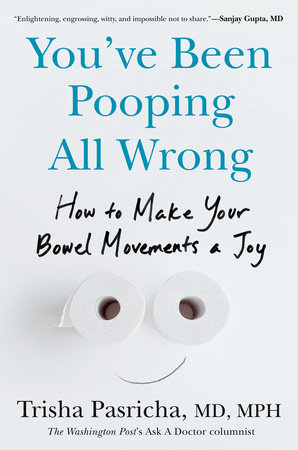
Resources
-
- Journal of Clinical Investigation: Neurodegenerative disorders and gut-brain interactions
- Harvard Health: Stress and the sensitive gut
- University of Chicago Medicine: Stress-related stomach pain: When to see a doctor
- Healthline: The Healthiest Way to Wipe Your Butt After a Bowel Movement
- Cleveland Clinic: What Does My Stool (Poop) Color Mean?
- Frontiers in Psychiatry: Vagus Nerve as Modulator of the Brain–Gut Axis in Psychiatric and Inflammatory Disorders
- Physiological Reviews: The enteric nervous system
- CNN: Using the phone while you poop greatly raises hemorrhoid risk, new study says
- American Gastroenterological Association: New survey finds forty percent of Americans’ daily lives are disrupted by digestive troubles
- Mayo Clinic: Colon cancer
- JAMA Oncology: Ultraprocessed Food Consumption and Risk of Early-Onset Colorectal Cancer Precursors Among Women
- Journal of the National Cancer Institute: Red-flag signs and symptoms for earlier diagnosis of early-onset colorectal cancer
- Cleveland Clinic: Psyllium Powder for Suspension
- Gastroenterology: AGA Clinical Practice Guidelines on the Role of Probiotics in the Management of Gastrointestinal Disorders
- HealthDay: Path to the Truth May Lead to the Stomach
2 Million Readers.
1 Life-Changing Newsletter
Simple and Straight-to-the-Point...
Just Like Mel.