Episode: 391
Stanford Nutrition Researcher: Eat THIS to Transform Your Health, Stay Young, and Live Longer
with Dr. Lucia Aronica
You have more control over your life and future than you think – and it’s sitting on your plate.
Food isn’t just fuel — it’s priceless information for your genes.
In this episode, Stanford University epigenetics scientist and nutrition researcher Dr. Lucia Aronica explains how everyday foods can shift your energy, metabolism, focus, cravings, inflammation, and the pace of aging.
You’ll get her Stanford framework for eating your way to younger genes, anti-aging kitchen hacks, and the truth about dark chocolate.
Dr. Aronica says your genes are not your destiny. And after this conversation, you’llm feel empowered to make eating decisions that put you in control of how you feel right now and how you age in the years ahead.
You can rewrite your health story, one bite at a time.
Listen on:




Starting today, your fork becomes more powerful than your family history.
Dr. Lucia Aronica
All Clips
Transcript
Mel Robbins (00:00:00):
If you want to know exactly what foods slow down aging naturally, this is an invitation to sit down with an extraordinary scientist who's not only going to teach you that change is possible. She will show you how to eat in order to live longer, look younger, and feel better than ever.
Dr. Lucia Aronica (00:00:18):
Tomorrow, you'll wake up different and you realize I'm not just eating, I'm rewriting my future because food isn't just fuel. It's the pencil that rewrites your genetic instructions. Starting today, your fork becomes more powerful than your family history.
Mel Robbins (00:00:44):
Dr. Lucia Aronica is a scientist and professor at Stanford University School of Medicine, where she specializes in epigenetics.
Dr. Lucia Aronica (00:00:53):
Your doctor probably told you to eat the rainbow, but here's what your doctor may not realize. Which color represents a different signal.
Mel Robbins (00:01:04):
No way.
Dr. Lucia Aronica (00:01:04):
You have red foods like tomatoes that boost your SPF by 40%. Garlic, if you crush it or chop it, this creates a listen, the epi nutrient we need. Broccoli, this provides sulforaphane. This activates more than 200 protective genes, but there's a problem.
Mel Robbins (00:01:30):
What's the problem?
Dr. Lucia Aronica (00:01:31):
There's actually ...
Mel Robbins (00:01:35):
Please help me welcome Dr. Lucia Aronica to the Mel Robbins podcast.
Dr. Lucia Aronica (00:01:39):
Thanks, Mel, for having me. I'm absolutely excited about our conversation. I love the way you make science relatable.
Mel Robbins (00:01:48):
Thank you. I really have a crush on your brain, so now I'm blushing. Here's where I want to start. How could my life be different? If I take everything that you're about to teach me today and I take it to heart, I apply it to my life, what might change?
Dr. Lucia Aronica (00:02:05):
Tomorrow, you'll wake up different.
(00:02:08):
You look at your eggs, your broccoli, your coffee, and you realize I'm not just eating. I'm rewriting my future because food isn't just fuel. It's the pencil that rewrites your genetic instructions. Starting today, your fork becomes more powerful than your family history. Right now, you may see diabetes in your mom, heart disease in your dad, anxiety in yourself, and think, "I'm stuck. That's just my genes." But in reality, genes are only 25% of your health story, and you are rewriting the other 75% right now with every choice and every meal. And the best part, you'll never need another diet again. You'll transform your relationship with food so profoundly that processed food won't even register as food anymore, and you'll stop treating your body like a garbage can. Today, we are putting that pencil back in your hand, and you are going to rewrite your health story into a masterpiece.
Mel Robbins (00:03:52):
Dr. Aronica. You came to play. Holy cow. You will see the fork as the pencil to rewrite your future. You will be able to use food to change 75% of what determines your health. I can't wait to get into all of this research around food and how it unlocks potential in your genes and can change your health forever. So you are an epigenetics scientist. What is epigenetics and why should we be as excited about it as you are about what you're about to teach us?
Dr. Lucia Aronica (00:04:36):
The Greek prefix, epi, means on the top. So epigenetic marks are molecular switches sitting atop your genes and turning them up or down, just like a volume knob on a stereo. This also explains why you go through transformations throughout your life. Puberty, aging itself, losing weight, gaining weight, building muscles. All these transformations underlie epigenetic mechanisms. And here's why you should be excited. Most of these marks are written in pencil, not in pen. Every day they are rewritten by enzymes. We scientists actually call writer and eraser enzymes. And guess who controls these editors? Every single thing you do. What you eat, how you move, how you handle stress. These send signals to the writer and eraser enzymes. And that's why in epigenetics, you are not just a passive reader of your genetic code, but an active writer of your health story every day with every choice.
Mel Robbins (00:06:18):
You hooked me right in the opening couple words. So I want to make sure I really understand this because a lot of us blame our genes for a lot of things. Oh, well, my weight, aging, energy, stress, my mom had diabetes. As if everything is set in stone, there's nothing you can do.
Mel Robbins (00:06:38):
So maybe why don't we start with, well, what actually are genes and what do they do and what's set in stone and what isn't?
Dr. Lucia Aronica (00:06:46):
Okay. So genes are recipes for proteins, the building blocks of everything in our body. These recipes are written in DNA and variations in the DNA sequence determine durations in the function of these proteins that can affect the way we respond to nutrients, the way we look, even our predisposition to disease. But, and here's where people get confused about genetic risk. Not all genetic variants are created equal. You hear people say genes load the gun and lifestyle pulls the trigger. And here's where epigenetics comes in. A landmark study published in 2016 in the new England Journal of Medicine.
Mel Robbins (00:07:53):
That's a good one.
Dr. Lucia Aronica (00:07:54):
That's a very good one. Showed the power of lifestyle over genes. So 55,000 people with an increased risk of genetic risk for heart disease. If they had a good lifestyle, so healthy food, exercise regularly, no smoking, they cut their risk in half. And those with good genes, but a bad lifestyle, got heart disease anyway. So really the genetic risk is written in pencil and you hold the pencil and the eraser too.
Mel Robbins (00:08:49):
This is so exciting. And it's also a little confronting because if you're the kind of person that was like, "Well, heart disease runs in my family die." That doesn't mean that's not true, but Dr. Aronica's here to say, "Hey, I have the research and you just said it. " This tendency in your family for these things to happen to people that you're related to does not determine your destiny. That in almost every single instance, you hold the pencil and based on the changes that we're going to talk about today, these changes are so powerful that they can activate a different destiny for you moving forward.
Dr. Lucia Aronica (00:09:28):
You got it.
Mel Robbins (00:09:30):
Wow. This is so cool.
Mel Robbins (00:09:33):
What would you say to somebody who has just struggled, for example, for a really long time to lose weight or to feel good or to not feel so anxious or depressed or whatever, and they're skeptical because just nothing's worked for them?
Dr. Lucia Aronica (00:09:54):
I would say you're not stuck. You are just holding the wrong pencil. Maybe you think you have tried everything, but here's what I want you to know. Every time you went on your diet, so you lost weight and gain it back. Your cells created what we call an epigenetic memory of weight gain. So it's like a problematic software update. The genes that keep you lean like those that burn fat get turned down.
Mel Robbins (00:10:34):
Well, because we don't need them because we're not doing anything, right?
Dr. Lucia Aronica (00:10:37):
Exactly. And the one that make you fat, the inflammatory genes wake up. And so your fat cells literally remember being fat and fight to get back to that new normal. That's why it's so easy to gain back weight, but there's hope. At Stanford, we showed that if you lose weight and you keep it off for six months, actually your fat cells unlearn that memory. They start the process of reraising that memory. So turning up the genes that burn fat and down the inflammatory genes. Now, I know what you're thinking. I can stick to a diet for six days, six months sounds too much to me. Well, I think most people white knuckle their way through protocols they hate and they never try to make the process enjoyable. As an Italian, I believe that pleasure isn't the enemy of health. It's your compass to find it.
(00:12:10):
Change requires consistency and you can't be consistent with something you hate, but you can be consistent with something you love. And in Italy, when we eat, we take our time, we share conversations, we sip a glass of wine, we activate multiple pleasure pathways, and health becomes as natural as breathing. So here's what I want you to do. I want you to not just eliminate processed food, but replace it with something you genuinely love. Something that make you say, "Oh, this is what I've been missing." It can be replacing the instant noodles for a juicy piece of salmon or that Oreo cookie with some sweet berries. Just find your own version of pleasure. In six months, your fat cells won't just forget they were fat. They will remember what it really feels like to be joyfully healthy.
Mel Robbins (00:13:37):
I just got something. Oh my gosh. Okay. So I have made health my number one goal this year, and I've been listening to all the experts that come on this podcast. I not only am interviewing people, but I am absorbing all of this. And so I've been focusing on resistance training. I've been focusing on whole foods. I've been prioritizing high quality protein, really changing lifestyle. I can't believe over the last six months to a year, I feel like a different person from the inside out. And you just explained why. Because by changing these lifestyle levers that really do change the way your genes express, you are changing yourself from the inside out.
Dr. Lucia Aronica (00:14:22):
Exactly. These aren't just healthy habits. They are cellular signals.
Mel Robbins (00:14:28):
Cellular signals to a different life. This is so cool.
Dr. Lucia Aronica (00:14:33):
Why did you want to get in and how did you get into this? I'd never even heard of epigenetics until a year ago.
Dr. Lucia Aronica (00:14:40):
Two things.
Mel Robbins (00:14:41):
Okay.
Dr. Lucia Aronica (00:14:42):
Tradition and tragedy.
Mel Robbins (00:14:44):
Oh.
Dr. Lucia Aronica (00:14:45):
Tradition, growing up in an Italian kitchen, food has always been medicine to me.
Mel Robbins (00:14:54):
Yes.
Dr. Lucia Aronica (00:14:54):
In Italy, food isn't just fuel. It's connection, tradition, and pleasure. And then through my work, I then discovered the molecular mechanisms behind this, really showing that food is the pencil that rewrites our genetic instructions. And then a tragedy. I lost my father when I was 14. He was a dedicated physician, always putting his patients first, calm, strong, and watching him fade away. I decided I wanted to continue his legacy of helping people heal, but I decided to do it with science, not with medicine. I wanted to help other doctors like him find better approaches to lifestyle medicine. And so every paper I write, every student I teach is my father's legacy living on. But then my mom taught me the other half of the equation. Here's a photo of her. At 84, she's the picture of true longevity for me. She's not a hardcore biohacker following complicated protocols.
Mel Robbins (00:16:31):
Well, who the hell has time for that?
Dr. Lucia Aronica (00:16:33):
Yeah. She doesn't wake up at 5:00 AM in the morning to eat the gym or bounce from cold plunge to sauna or take a hundred supplements. She dresses elegantly. She's joyful. She takes time to eat savoring her food, and she knows she is our queen, our flower and our rock. And this joy and purpose fills her life. She embodies something that many longevity gurus forget. Aging isn't just biological. It's psychological and social and pleasure is part of the equation. And that became the foundation of everything I teach.
Mel Robbins (00:17:42):
If you're listening, Lucia's mom is wearing this beautiful navy blue dress with a bright red sash and it's got flowers on it. She's got this beautiful flour, red flour necklace at the center of her ... She's like vibrant and her smile is bright and her eyes are bright. And I can't believe she's 80 in that photo.
Dr. Lucia Aronica (00:18:06):
84.
Mel Robbins (00:18:06):
- Let's give her credit for all the years.
Dr. Lucia Aronica (00:18:09):
Birthday. Happy birthday.
Mel Robbins (00:18:11):
Happy birthday to your mother.
Mel Robbins (00:18:14):
You teach a framework at Stanford that is called Eating Your Way to Younger Genes. Let's just start with what does eating your way to younger genes even mean?
Dr. Lucia Aronica (00:18:26):
Yeah. So I've established the first program and course in nutritional epigenetics at Stanford. And I teach a framework that is called epi nutrition.
Mel Robbins (00:18:41):
Epi nutrition.
Dr. Lucia Aronica (00:18:41):
Yeah. So how to eat to improve gene expression for a healthier, longer life.
Mel Robbins (00:18:50):
Well, you know what I'm going to say to them? I'm going to say, Dr. Aronica passed me the fork.
Dr. Lucia Aronica (00:18:57):
Here's the fork. I'm going to explain you how this works.
Mel Robbins (00:19:02):
Oh, I can't wait.
Dr. Lucia Aronica (00:19:03):
Exactly. So the concept, the main concept is that food isn't just fuel, it's the pencil that rewrites your genetic instructions. And my favorite example is the queen bee. Have you ever heard of this story? No. Okay. Uh-uh. So the queen bee lives 20 times longer than the other bees in the beehive, which are called worker bees. She's also larger and fertile, whereas the workers are sterile and yet queen and worker bees are genetically identical.
Mel Robbins (00:19:47):
No, they're not.
Dr. Lucia Aronica (00:19:48):
Yes, they are.
Mel Robbins (00:19:49):
Wait, queen bees are genetically identical to a worker bee?
Dr. Lucia Aronica (00:19:53):
Yes. Same hardware, different software. And what writes the different software? Royal jelly, a substance that the queen larvae eat as they develop. And these works as the epigenetic queen maker.
Mel Robbins (00:20:12):
Wow.
Dr. Lucia Aronica (00:20:13):
It turns on the genes that make the queen a queen. Now, what's exciting is that we humans have nutrients that work like our royal jelly, and I call them epi nutrients.
Mel Robbins (00:20:32):
Okay.
Dr. Lucia Aronica (00:20:32):
They are two main categories. The first category, metal donors. So think of them as the structural material, the ink to write healthy genetic instructions. There are five main metal donors, methyonine in all protein-rich foods.
Mel Robbins (00:20:54):
Okay, so protein.
Dr. Lucia Aronica (00:20:55):
Yeah, protein-rich foods. Then you have folate in green, leafy vegetables, liver and legumes. Then you have B12 from animal protein. Then choline from eggs and liver primarily, and beeting from beets, spinach, quinoa, and shellfish. Without this, your genes literally run out of ink. Then we have the second category.
Mel Robbins (00:21:31):
Okay.
Dr. Lucia Aronica (00:21:33):
I call this epi bioactives.
Mel Robbins (00:21:36):
Okay.
Dr. Lucia Aronica (00:21:37):
These are the signals to the rider and the razor enzymes. So these regulate the epibiotics really tell your writer and the razor enzymes what to write and where. So examples of baby bar. We have colorful pigments from colorful fruits and veggies. For example, tomatoes, carrots, broccoli, even chocolate and coffee. Then we have omega-3 fatty acids from fatty fish and post biotics from fermented foods. Things like yogurt to kombucha, sour craut, kimchi. Epi-nutrition is a beautiful friendship between animal and plant foods. You need both. You need the ink. And as we will see later, animal foods are really necessary to provide B12 and cooling, so a type of ink. Then you also need the signals, the AP bioactives that are primarily represented by plant foods together with omega trees from fatty fish.
Mel Robbins (00:23:00):
Graduation is a big deal. In fact, my husband and I have seen all three of our kids graduate, and it's one of the most emotional and proud moments that you're going to have as a parent. I remember sitting there watching all three of them. You get a lump in your throat because in one second, you're seeing the little kid version of them, and then in the next second, you're watching them step into adulthood. It's emotional. And it's also that moment when you realize, wow, they're still going to need some real support. Apple gift card is such a great graduation gift because it gives the graduate in your life options when they need the most. They can use it for the tech that they need for school or for work. Apps are going to keep them organized, focused, and on top of life, fitness subscriptions. And then there's all the stuff that helps them recharge, music, movies, podcasts, entertainment. I've learned something or two after doing graduation three times. If you're guessing about what to give them, you're wasting money in time. Instead of an engraved pen or a coffee mug that says the future looks bright, give them something they can use their way when they need it. Visit applegiftcard.apple.com to find the perfect graduation gift today.
Mel Robbins (00:24:11):
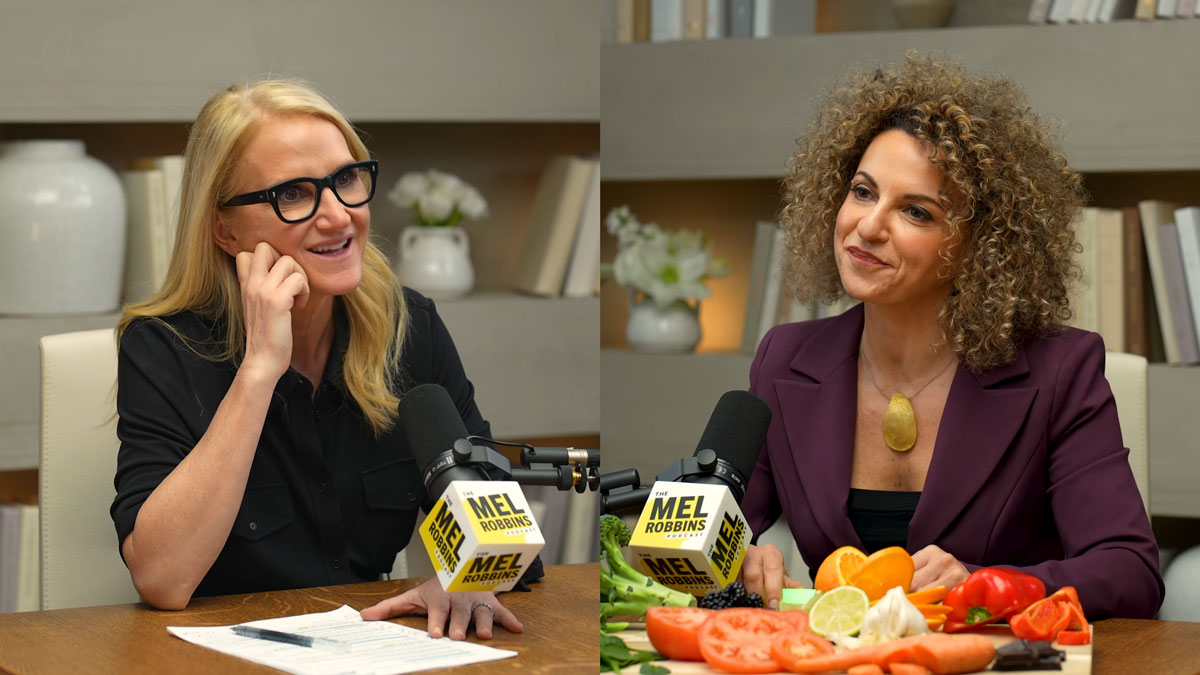
I want to walk through the specific types of food in this framework so that I really understand and so does the person that is listening or watching. And if you're listening, we're going to really describe what's happening. So I'm going to ask our executive producer, Tracy, to come in. Oh my gosh, this looks delicious. Thank you, Tracy. If you could describe, I'm seeing red, pepper, chocolate, carrots, tomatoes, garlic, lime, orange, blackberries, broccoli, spin. This looks like a rainbow.
Dr. Lucia Aronica (00:24:42):
It's a rainbow. So your doctor probably told you to eat the rainbow.
Mel Robbins (00:24:48):
Yes. Fruits and veggies.
Dr. Lucia Aronica (00:24:49):
Yeah. But here's what your doctor may not realize. These pigments aren't just antioxidants. They are epi nutrients that regulate your rider and eraser enzymes, and each color represents a different signal.
Mel Robbins (00:25:10):
No way.
Dr. Lucia Aronica (00:25:11):
Yeah.
Dr. Lucia Aronica (00:25:12):
So for example, you have red foods like tomatoes that provide ligopeine for cardiovascular benefits.
Mel Robbins (00:25:20):
Tomatoes and the fact that it is an epi nutrient means that when you are enjoying a beautiful, red, juicy, amazing tomato, you are not just eating food. You are sending a signal to your DNA about your heart health and about what else?
Dr. Lucia Aronica (00:25:50):
Your skin and everything. The two areas of research are really cardiovascular and skin.
Mel Robbins (00:25:57):
Okay.
Dr. Lucia Aronica (00:25:58):
So clinical trials have shown that, for example, lycopene can really reduce LDL oxidation, which is the process that makes LDL cholesterol truly dangerous. It can also work as an internal skincare. So it actually boosts your SPF, your internal SPF by 40%.
Mel Robbins (00:26:25):
A tomato?
Dr. Lucia Aronica (00:26:26):
Yes. How is basically increasing your DNA repair and also actively inhibiting the breakdown of collagen and the formation of aged spots. And now there is however a problem to see these benefits, these benefits start at with 10 milligram of lycopen in clinical trials that use pills. Now, this is equivalent to eating 20 pounds of raw tomatoes a day, but there is a trick. If you cook those tomatoes in olive oil or in any type of oil like Italian grandmothers used to do, then you can boost the absorption of lycopene.
Mel Robbins (00:27:23):
Wow. Just by cooking the tomato?
Dr. Lucia Aronica (00:27:26):
Just by cooking, but this is just step one.
Mel Robbins (00:27:28):
That makes me happy because I'd rather have it on pasta than I would've.
Dr. Lucia Aronica (00:27:32):
But it is just step one because then when you add olive oil, you boost the availability by an additional 70%. Why? Because licopen is liposoluble and so it can't be absorbed without fat. And so basically by cooking your tomatoes into a paste with olive oil, you can cover, you can reach that 10 milligram of lycopen with just three tablespoon of tomato paste and olive oil.
Mel Robbins (00:28:08):
That's incredible. You know what? I got to hand it to you. When I asked you how my life would change, you said you will never look at food the same again. I actually don't. And we're just getting started.
Mel Robbins (00:28:21):
Let's talk about the carrot. What happens to you or what is the benefit from an eponutrient standpoint when you eat carrots?
Dr. Lucia Aronica (00:28:31):
Yeah. Carrots and all orange foods, even pumpkin contain carotenoids. These carotenoids also are, first of all, a percursor to vitamin A production, and they also work as internal skincare for you. Then we have green foods like spinach that provide folate for DNA repair and broccoli. That's my favorite.
Mel Robbins (00:29:02):
Now, why do you love broccoli?
Dr. Lucia Aronica (00:29:04):
Okay. Because broccoli and other cruciferous vegetables in the same family, so we are talking about brussel sprouts, irugula, kale. This provides an epinutrient called sulforaphane. Sulforaphan isn't an antioxidant itself. It's better. It's the boss of your body's own antioxidant army. It switches on a genetic master switch called NRF2. This activates more than 200 protective genes involving detoxification, inflammatory defense, antioxidant defense. And this is the best part of While direct antioxidants like vitamin C disappear in a few hours, sulforaphane switches on those genes for up to three days. Wow. So it's enough to eat cruciferous veggies two, three times a week to keep your antioxidant genes switched on.
Dr. Lucia Aronica (00:30:24):
But there's a problem.
Mel Robbins (00:30:25):
What's the problem? Because it sounds pretty good if I'm eating the boss of the army.
Dr. Lucia Aronica (00:30:30):
The problem is that there's actually no sulforaphane in this broccoli.
Mel Robbins (00:30:36):
Did I buy the wrong kind?
Dr. Lucia Aronica (00:30:38):
You need to chop it or chew it. And here's why. Think of sulforaphane as a glow stick for your genes.
Mel Robbins (00:30:52):
Professor is in the house. She's holding a gold stick if you're listening.
Dr. Lucia Aronica (00:30:56):
So those light up tubes, you bring at concerts. When you break them to compound mix, starting a light reaction and sulforaphane works the same way.
Mel Robbins (00:31:14):
When I chew broccoli, it activates the sephoraphane inside the broccoli.
Dr. Lucia Aronica (00:31:20):
Exactly. And this is exactly what happens. A compound called glucoraphanin mixes with an enzyme called my rosinase and boom, this creates sulforaphane. So the problem is that most people buy frozen broccoli and frozen broccoli is quickly blanched, so quickly boiled before freezing, and this destroys my rosinase. So no my rosinase, no glosstic reaction, no sulforaphane is like buying a broken glow stick. Or they throw broccoli directly into the boiling water. Same problem. My rosin is dice and you don't get sulforaphane. So that's why I have three tricks for broccoli.
Mel Robbins (00:32:15):
Okay. So we can trick you. You can cook it the way you're talking about to make sure. You know what I love about this? I will never eat broccoli again without seeing glowy sparkle things all around. It's so amazing to know what's happening. So here are the three tricks.
Dr. Lucia Aronica (00:32:34):
For fresh broccoli. Yes. Chop it 40 minutes before cooking. Wait. Because during that time, my rosiness catalyzes the reaction and produces more sulforaphane. For frozen broccoli.
Mel Robbins (00:32:55):
Can I ask a question though? Yeah. So the reason why this works, I'm guessing, is it because the chopping mimics what you're doing when you chew it? Yes. And so the chopping is mixing everything up, but you got to let it sit for 40 minutes because it needs time for the glow to glow.
Dr. Lucia Aronica (00:33:15):
Yeah. And you can just even 10 minutes help.
Mel Robbins (00:33:19):
Okay.
Dr. Lucia Aronica (00:33:20):
40 minutes is based on experiment. Scientists that measure this. And the smaller the pieces, the more the sulfur of it.
Mel Robbins (00:33:29):
Well, that makes a lot of sense. And what I love about that is I can chop the broccoli, set it aside, because then I got to cook the tomato and the olive oil. I'm tracking here. Here we go. Okay.
Dr. Lucia Aronica (00:33:39):
I love it. I love it.
Mel Robbins (00:33:40):
Okay.
Dr. Lucia Aronica (00:33:40):
Then if you buy frozen broccoli, you can rescue that with mustard. Add like a teaspoon of mustard powder or a tablespoon of prepared mustard of every three ounces of cooked broccoli. Why? Because mustard is also a cruciferous vegetables. So provides the myrosinase enzymes that has been killed.
Mel Robbins (00:34:10):
So it's sort of like when you add stir in the mustard to cook broccoli, it's almost like the glow stick. The mustard is activating the core ingredient that the broccoli has.
Dr. Lucia Aronica (00:34:20):
Exactly. No, you can put it after cooking.
Mel Robbins (00:34:23):
Yeah.
Dr. Lucia Aronica (00:34:23):
And this has been measured by scientists at the University of Redding. So this is not just a trick made up.
Mel Robbins (00:34:32):
Well, you don't strike me as the kind of person that makes anything up.
Dr. Lucia Aronica (00:34:36):
And then there is the third trick. If you really want to maximize sulforaphane, grow your own broccoli sprouts. They have up to 100 times the glucorphanin, the precursor compared to mature broccoli. So just one ounce of broccoli sprouts equals three pounds of broccoli. And it's so easy. In five days, they are ready and they're really an epigenetic medicine.
Mel Robbins (00:35:11):
Okay. Let's move on to the blackberries.
Dr. Lucia Aronica (00:35:14):
Okay. The blackberries provide entocyanins. These are epinutrients for cognitive benefits. In general, they are anti-inflammatory. So they have multiple benefits, but clinical trials shows benefits, particularly for cognition. And garlic. Garlic works similarly to broccoli. This is also glow stick for your genes. Yeah, because when you chop or chew garlic-
Mel Robbins (00:35:48):
Chew.
Dr. Lucia Aronica (00:35:49):
Some people chew it, but if you crush it or chop it, two compounds mix. Elein and alinase, the enzyme, and this creates ellicine, the epinutrient we need. And elecine has multiple benefits. It decreases LDL by 10%. It's anti-inflammatory benefits. It boosts immune function. Now, even here, there's a problem. It's the same problem.
Mel Robbins (00:36:22):
Well, because I don't want to eat it raw. That's a problem.
Dr. Lucia Aronica (00:36:24):
The problem is alinase is also sensitive to heat just like garosines.
(00:36:29):
So here's what you do.
Mel Robbins (00:36:30):
What do we do?
Dr. Lucia Aronica (00:36:31):
You crush garlic. It's better if you crush it actually with the flat part of the knife.
Mel Robbins (00:36:38):
Oh, so if you're not a cook, let me explain what that means. So you know when you peel the garlic and you chop, chop, chop. What she's saying is take the whole clove and smash it flat with the flat end of the knife or a spoon or a wooden spoon or something like that. What does smashing do that chopping doesn't?
Dr. Lucia Aronica (00:36:54):
Yeah. So they both destroy the plant cell walls, making those compounds mixed together, but crashing destroys more and more destruction, more ellicine.
Mel Robbins (00:37:08):
Okay.
Dr. Lucia Aronica (00:37:09):
So both work.
Mel Robbins (00:37:10):
But you said, does cooking it in olive oil change that or does it hold on to the ...
Dr. Lucia Aronica (00:37:18):
Yes, you don't want to go. So you first crush it, then you wait five minutes, just five minutes for garlic because this gives enough time for the reaction to maximize the production of alcine. And then you have two options. Either edit raw at the end of cooking, that's the maximum ellicine or cook it for two to five minutes medium heat in olive oil, not water because if it's water, it reaches into the butter and you lose most of it.
Mel Robbins (00:37:50):
Okay.
Dr. Lucia Aronica (00:37:51):
Yeah. So two cloves a day and you are good.
Dr. Lucia Aronica (00:37:55):
Let's talk about chocolate. Okay. This isn't a guilty pleasure. It can be epigenetic medicine if you choose the right one. So chocolate provides a type of epinutrients called flavonols with metabolic cognitive benefits. And now the problem is that most commercial chocolate is Dutch processed, so washed with alkali to make it smoother, so reduce bitterness and make the color look darker, which looks more premium. Now, this process destroys 90% of flavanols.
Mel Robbins (00:38:50):
Wow.
Dr. Lucia Aronica (00:38:51):
So you really want to look for non-alkalized or non-Dutch processed chocolate.
Mel Robbins (00:39:00):
So do they label it somewhere?
Dr. Lucia Aronica (00:39:01):
Yes.
Mel Robbins (00:39:02):
It'll be labeled Dutch processed if it is Dutch processed.
Dr. Lucia Aronica (00:39:05):
Yeah, it should be on the label. Now, my favorite way of incorporating chocolate in my life is going, so it's eating either cacao powder or cacao beans. This is where you maximize the flavanos and minimize the calories. You just need one to two tablespoon of raw cacao powder or 10 to 20 grams of cacao beans. These are delicious. If you lightly roast them in the oven, they're just fantastic.
Mel Robbins (00:39:47):
I didn't even know there was such a thing as a cacao bean, but now I'm going to be looking for them. I also finally see bell peppers. You got a bright red one right there.
Dr. Lucia Aronica (00:39:54):
Yeah. Bell peppers also provide lycopen and they are a great source of vitamin C. But here, be careful. Don't buy them frozen because then they will lose 50% of their vitamin content.
Mel Robbins (00:40:12):
Is there anything else you want to say about all this stuff?
Dr. Lucia Aronica (00:40:14):
Just remember, the point isn't picking your favorite color, is mixing them up.
Mel Robbins (00:40:21):
The rainbow.
Dr. Lucia Aronica (00:40:22):
Yeah, because only when you eat the rainbow, you are really protecting your genes from all angles.
Mel Robbins (00:40:29):
I love that. Royal jelly. We're activating the queen bee mode in our jeans. We're going to remove this food. So Trace, why don't you come on in and grab all this for us. That glow stick was amazing.
Dr. Lucia Aronica (00:40:43):
Okay.
Dr. Lucia Aronica (00:40:45):
Now I would like to focus on choline.
Mel Robbins (00:40:48):
Great.
Dr. Lucia Aronica (00:40:49):
Because actually I need to spell it every time. It's C-H-O-L-I-N-E.
Mel Robbins (00:40:59):
Choline.
Dr. Lucia Aronica (00:41:00):
Yeah. That's how forgotten this essential nutrient is. 90% of people are deficient without even knowing it. We need 450 to 550 milligram, which is equivalent to roughly four eggs a day.
Mel Robbins (00:41:24):
Four eggs a day.
Dr. Lucia Aronica (00:41:26):
Four egg yolks. It's in the yolk, really. And most of us get barely half of it. A gap that is affecting our liver, our brain, and our genes, because choline is first, it's part of every single cell membrane in your body. Then in the brain is used to produce acetyl, choline for memory, focus, movement. And then in the liver is used to package fat and export it out. So you develop fatty liver without calling. And for your genes is the ink to write the instructions. Now, during pregnancy, the demand skyrockets. In our recent research with Dr. Randy Gertal is the godfather of nutritional epigenetics. We discuss how colon during pregnancy can truly program a child's health for life. So when pregnant women, it take more than double the recommended amount of colon. So 930 milligram instead of 450, then their children have higher cognitive abilities and lower anxiety even seven years later.
Mel Robbins (00:43:03):
Really?
Dr. Lucia Aronica (00:43:03):
Yes, because colon provides the ink to also regulate genes that are involved in our stress response, including dose controlling cortisol. Now, I know what you're thinking. How can I get colon? So I did-,
Mel Robbins (00:43:23):
Exactly what I was thinking. You're not only an epigenetis, you're a mentalist because you're reading my mind.
Dr. Lucia Aronica (00:43:29):
So I've developed something that I call the four yolk formula. So try to get the equivalent, the colon equivalent of four yolks a day yo reach-
Mel Robbins (00:43:45):
How the heck do I do that?
Dr. Lucia Aronica (00:43:46):
Yeah.
Mel Robbins (00:43:47):
And is that going to kill my cholesterol?
Dr. Lucia Aronica (00:43:49):
No. Okay. We need to debate that myth. The cholesterol from your diet doesn't equal the cholesterol in your blood. Your liver produces 80% of the circulating cholesterol. And if you eat more, the liver produces less. It's like a thermostat, automatically adjusting. In our own research at Stanford, when people tripled their cholesterol consumption in the context of a weight loss diet, and also they actually increase their saturated fat consumption, their blood lipids improved. The problem wasn't the cholesterol, it was the donuts. So now only about 25% of people are high responders, which means they eat more cholesterol and they see increases in their blood cholesterol due to genetic and other metabolic differences. But for the other 75%, eggs don't significantly raise blood cholesterol. Let me finish the formula. So you get one colon, one egg yolk equivalent, of course in one egg. So you could have two eggs.
(00:45:25):
Then in three ounces of salmon, for example-
Mel Robbins (00:45:30):
Do any other fish count or just salmon?
Dr. Lucia Aronica (00:45:32):
Salmon is the richest source.
Mel Robbins (00:45:34):
Okay.
Dr. Lucia Aronica (00:45:35):
Liver, just one ounce. I know. I also don't like liver.
Mel Robbins (00:45:39):
I got to eat the liver. You like liver?
Dr. Lucia Aronica (00:45:41):
I hate liver. I can't stand this. So I can really relate if you're listening to this and thinking blah. However, liver is a truly ... It's an epigenetic multivitamin. And then if you're plant-based, it's going to be difficult, but it's possible. Cruciferous vegetables, three cups a day. No, three cups is only one egg.
Mel Robbins (00:46:09):
Three cups of cruciferous-
Dr. Lucia Aronica (00:46:11):
It's only one egg. You need four or, and this is the trick. I recommend for vegetarians and vegans, one tablespoon of sunflower or soy lesetin. And this provides the equivalent of one egg. So you will need four tablespoon. But if you have some-
Mel Robbins (00:46:33):
So hold on. Can I ask, when you say sunflower, are you talking sunflower seeds or sunflower oil?
Dr. Lucia Aronica (00:46:38):
Lecithin.
Mel Robbins (00:46:39):
What is Lecithin?
Dr. Lucia Aronica (00:46:39):
Yes. You can find it everywhere if you Google it. Yes, it's unflourleacetin is actually because colon is part of our membranes, right as I say. So now the plants in the plant membranes, this colon is present in the same form that is present in our body, which is called phosphatidylcholine. So lesitine is a great source of phosphatidyl colon.
Mel Robbins (00:47:08):
And that's an oil?
Dr. Lucia Aronica (00:47:10):
No, it's a powder.
Mel Robbins (00:47:11):
It's a powder.
Dr. Lucia Aronica (00:47:12):
Yeah.
Mel Robbins (00:47:12):
Okay. So is that powder kind of the equivalent of like you get added to a smoothie, you could shake it on a salad.
Dr. Lucia Aronica (00:47:19):
One tablespoon is on a salad.
Mel Robbins (00:47:21):
We're going to skip the liver and we're going to get the lecithin. That's what I thought. I'm like in that group.
Dr. Lucia Aronica (00:47:26):
Yeah. And this means that vegetarians and vegans don't need to eat kilos of cruciferous veggies a day with the strict, right? Yeah. So colon is very important. I think it's one of the most misunderstood and forgotten nutrients.
Mel Robbins (00:47:45):
Based on your research, what excites you the most about protein?
Dr. Lucia Aronica (00:47:51):
Protein provides the building blocks, the amino acids for everything, structural and functional in your body, hair, skin, nails, antibodies, narrow transmitters, hormones. Without protein, you basically can't digest, can't heal, can't move.
Mel Robbins (00:48:20):
What are some of the other benefits when you think about epigenetics? I know it's the building blocks, but what else is an important reason? You know what I mean? For why you really should be focusing on this if you want to age well and you want to take advantage of all this research.
Dr. Lucia Aronica (00:48:40):
Yeah. We talked about already about the pencils. So B12 and choline are primarily found and methionine are primarily found in protein-rich foods. That's the first epigetic benefit and the direct epigenetic benefit. Then there are other indirect benefits. For example, if you eat more protein and your building muscle, the exercise part and the muscle beading part does incredible things to your epigenetics, your muscle cells.
Mel Robbins (00:49:15):
Really?
Dr. Lucia Aronica (00:49:15):
It turns on genes that protect you from diabetes, that stimulates mitochondria biogenesis. So they're really basically rejuvenating your metabolism from within. So these are more indirect benefits of protein from the epigenetic
Mel Robbins (00:49:34):
But when you combine it with the weight training and moving your body, you're saying again, you get that glowstick effect. We're now all feeling like a clean bee because it's changing you from the inside out. Yeah. That's so, so cool. So is collagen protein?
Dr. Lucia Aronica (00:49:51):
Yes.
Mel Robbins (00:49:51):
Okay.
Dr. Lucia Aronica (00:49:52):
So collagen is protein is the most abundant protein is really the scaffolding holding you together is in our skin, in our tendons. And now most people think, okay, I need collagen supplements as I age. Because as we age, we lose about 1% of collagen every year starting at 25. So by age 50, we are already-
Mel Robbins (00:50:28):
Down 75%. I saw that math coming.
Dr. Lucia Aronica (00:50:31):
And that doubles after menopause.
Mel Robbins (00:50:33):
What?
Dr. Lucia Aronica (00:50:34):
Yes. I actually prefer to focus on collagen rich foods. And these are the foods we are not eating. The parts of the animals that we are just throwing away. So this is like chicken and fish with the skin, canned fish or with bones, right? Salmon, sardines, for example, slow cooked meats. Oh my goodness. Yes.
Mel Robbins (00:51:01):
I know. Let's talk about yes.
Dr. Lucia Aronica (00:51:03):
Brisket.
Mel Robbins (00:51:04):
Yes.
Dr. Lucia Aronica (00:51:05):
So good.
Mel Robbins (00:51:05):
Lamb. Oh my gosh.
Dr. Lucia Aronica (00:51:07):
Yeah.
Mel Robbins (00:51:07):
Talk about short ribs. Let's keep going.
Dr. Lucia Aronica (00:51:09):
Yeah. And bone broth. That provides 10 grams of collagen per cup, more or less. So in general, if you think let's go back and eat like nose to tail like our ancestors did.
Mel Robbins (00:51:28):
Yeah, use it all.
Dr. Lucia Aronica (00:51:30):
Use it all and then you will get the collagen and all the epinutrients. So first of all, focus on high protein, get that protein because maybe that's all you need. We don't know. But then support with collagen, you will get, especially if it's from food, you will get other epinutrients and the glycine.
Mel Robbins (00:51:53):
The next thing that you talk about from an epigenetic standpoint is omega-3s.
Dr. Lucia Aronica (00:51:59):
Oh, that's my favorite.
Mel Robbins (00:52:01):
Oh man, you love these.
Dr. Lucia Aronica (00:52:02):
Yeah, I love this. These are epibiotics that work as our cellular fire department. They switch on genes that basically slow down inflammation. Inflammation is the chronic low grade inflammation is what ages you faster than time itself. Now, the problem is that most people think that plant-based omega-trees are enough. Cheer seeds, flaxseeds, walnuts, they provide ALA. This is a plant-based omega-3 fatty acids that your body needs to convert to the active form, EPA and DHA, which you get directly from fatty fish. Now, the problem that conversion is dramatically inefficient. For young women is five to 8%. For men is 0.5 to 4%. And things get worse as we age if we are stressed or inflamed. Yes. So let's just take that perfect scenario.
Mel Robbins (00:53:22):
Okay.
Dr. Lucia Aronica (00:53:22):
You are a young woman, the best case scenario and no inflammation, no stress. You would need to get the therapeutic levels of omega-3 fatiacies that in clinical trial are equivalent to two grams a day. You will need to eat one cup of flexied or cheer seeds every day or two pounds of walnuts.
Mel Robbins (00:53:49):
Two pounds. That's like 2000 calories or more.
Dr. Lucia Aronica (00:53:53):
Yes. So this is not a nutritional strategy. It sounds more like nutritional fantasy. So that's why I always encourage people to focus on fatty fish. So this is salmon, macro and shorthys, sardines and herring. These are the best sources of omega-3 fatty acids three to four times a week. This is still not enough to get to two grams a day unless you eat fish every day and with multiple servings. That's why I do like to supplement with the quality omega-3 fatty acids.
Mel Robbins (00:54:35):
That's cool. I'm really into this. Fermented foods as an epigenetic researcher, what do fermented foods do?
Dr. Lucia Aronica (00:54:46):
Okay. Fermented foods provide what I call the three mascetiers of gut health, all for one, one for all. And these are the prebiotics. So the fiber that feeds your bacteria. Then the probiotics, the bacteria themselves, and the postbiotics. These are the bacterial products that work as epi bioactives. The most studied example is butyrate. Have you ever heard of it? Butyrate?
Mel Robbins (00:55:25):
Butyrate. No.
Dr. Lucia Aronica (00:55:26):
It's a short chain fatty acids.
Mel Robbins (00:55:28):
Okay.
Dr. Lucia Aronica (00:55:29):
Fatty acids produced by your gut microbiome that works as an epibiotic traveling through your bloodstream and switching on genes involved in inflammation control, gut health, immune health.
Mel Robbins (00:55:46):
Wow.
Dr. Lucia Aronica (00:55:47):
And for many people, fermented foods are better than fiber alone. In a landmark study at Stanford by my colleague, Justin Sundberg, they showed that when people increase their fiber intake, but they have a low microbiome diversity, so fewer bacteria species, then they actually experience an increase in inflammatory markers. But when people increase their fermented food intake, the inflammatory markers go down independently of starting microbiome and their microbiome diversity increases during the process. This is because the fermented foods don't just feed your bacteria, they really seed your gut with new species.
Mel Robbins (00:56:55):
So if you were to really change the way you look at food and you look at this rainbow of epinutrients and you follow the same instruction you gave to your mom based on the research of just try to get protein in at every meal and also really pay attention to Omega-3 and collagen. You just do your best to do this and you slow down a little bit and maybe we channel our inner Italian and we enjoy this and think about the fact that we are giving our body the ink and the instructions to write a new chapter. What changes might you notice even in a short period of time, if you really take this on?
Dr. Lucia Aronica (00:57:50):
Yeah. So in 30 days, let's say 30 days, these are probably not enough to reprogram or rewrite your epigenetic memories, but they're enough to see meaningful physiological changes. Then you start to feel better because the energy stabilizes as your blood glucose stabilizes. Your sleep and skin improve as the inflammation goes down. Digestion improve as your microbiome adjust. And most importantly, the real transformation is cellular. So you are slowly rewiring your habits and rewriting your genetic instructions. You are really starting to becoming a new person at this cellular level. So your transformation has already started.
Mel Robbins (00:58:45):
What would you say to the person who's listening or watching right now and they are going to follow all these recommendations, but there's someone in their life that they're worried about and they want to help a loved one change their lifestyle for the better?
Dr. Lucia Aronica (00:59:00):
I love this question because you can change someone else, but you can become the invitation. Don't just force change. Just show that change is possible by living it, not pushing it. Start your quiet transformation. Be the quiet revolution because there's no better argument than your life. So if you start changing first, adopting a healthy diet, exercising, they will get curious, they will notice it. And then when they ask, you can invite them to join you. And so Meet them where they are.
Mel Robbins (01:00:02):
What do you think the single most important thing that you want someone to take away from this conversation, this incredible, rich masterclass in how to take epi nutrients and rewrite your future? What do you want them to take away from this conversation?
Dr. Lucia Aronica (01:00:25):
Your genes aren't your faith. They are your opportunity. Stop blaming your DNA. Your genes are only 25% and you are the other 75%. Every meal, every walk outside, every night of sleep is an opportunity to pick up epigenetic pencil and write a healthier chapter. And here's how you can make it sustainable. Remember that pleasure is your compass, real food that tastes incredible, connections that light you up. Even movement that you enjoy, these will guide you exactly to what your genes need. So pick up that pencil, write with pleasure and create a masterpiece.
Mel Robbins (01:01:29):
What I want to say to you is it's really a privilege when you get to sit with somebody who is in their genius.
Dr. Lucia Aronica (01:01:38):
Thank you, Mel. That was wonderful.
Mel Robbins (01:01:41):
It really is. It chokes me up because you said that you can't change someone else, but you can be the invitation. Your example can show that change is possible.
Dr. Lucia Aronica (01:01:55):
Yes.
Mel Robbins (01:01:55):
And it's very clear that the research that you do and the way that you live your life and the conviction and genius through which you share all of this with the rest of us is the invitation that shows us it's possible. So thank you.
Dr. Lucia Aronica (01:02:14):
Thank you, Mel. Thank you so much.
Mel Robbins (01:02:16):
You are so welcome. And I also want to thank you. I want to thank you for making the time to listen to something that is so life-changing. And I want to thank you for sharing this episode as a free resource and an invitation to the people that you care about that will show them that change is possible too. I am so excited by this. I cannot wait to see your comments. I can't wait to see the changes that you make and how you feel when you really take all of this research that we just learned about epinutrition and you apply it to your life. And in case no one else tells you today as your friend, I wanted to tell you that I love you and I believe in you and I believe in your ability to create a better life. And one of the things that really struck me about our conversation today is something that Dr. Lucia said about how change isn't just possible.
(01:03:13):
What's going to happen if you leverage all of this incredible research that we learned about today? You're not only going to feel better, you are going to become a different person at a cellular level, and holy cow, won't that change your life? Alrighty. I will see you in the very next episode. I'll be waiting to welcome you in the moment you hit play. And thank you for watching all the way to the end, and you're going to love this next video, and I'll be waiting to welcome you in the moment you hit play.
Key takeaways
You’re not stuck in your family history because every bite you take becomes a signal that can rewrite your genes, meaning your daily choices are actively shaping your future health.
When you see food as information, not just fuel, you realize your fork is a powerful tool that can turn genes on or off, giving you real control over how your body functions.
You’ve been told your genes define you, but they’re only 25% of the story, and your lifestyle choices are the other 75%, meaning you’re constantly writing your own health outcome.
If you keep forcing diets you hate, you’ll fail, because consistency requires pleasure, and when you find foods you genuinely love, your body begins to heal and change from within.
When you eat a variety of colorful whole foods, you’re sending targeted signals to your body that activate protective genes, helping your heart, skin, and brain function at a higher level.
Guests Appearing in this Episode
Dr. Lucia Aronica
Dr. Lucia Aronica is a Stanford epigenetics scientist studying how food and lifestyle shape gene expression to improve health, energy, and aging.
Resources
-
- Lucia’s Research
- Stanford University: Nutrition and Epigenetics: How Diet Affects Gene Expression
- Nutrients: Ultra-Processed Foods Are Not “Real Food” but Really Affect Your Health
- CDC: Epigenetics, Health, and Disease
- Johns Hopkins Medicine: Overview of Genetics and Epigenetics
- The New England Journal of Medicine: Genetic Risk, Adherence to a Healthy Lifestyle, and Coronary Disease
- The Harvard Gazette: Good genes are nice, but joy is better
- Epigenetics Insights: Epigenetics Mechanisms of Honeybees: Secrets of Royal Jelly
- Harvard Health Publishing: Phytonutrients: Paint your plate with the colors of the rainbow
- Asia Pacific Journal of Clinical Nutrition: Increases in plasma lycopene concentration after consumption of tomatoes cooked with olive oil
- Mayo Clinic: Superfoods: Why you should eat cruciferous vegetables
- Journal of Functional Foods: Commercially produced frozen broccoli lacks the ability to form sulforaphane
- The University of Reading: The potential to intensify sulforaphane formation in cooked broccoli (Brassica oleracea var. italica) using mustard seeds (Sinapis alba)
- Foods: Composition and Antioxidant Activity of Anthocyanins and Non-Anthocyanin Flavonoids in Blackberry from Different Growth Stages
- Applied Food Research: Fresh crushed garlic exhibits superior allicin and pyruvic acid stability, while fresh sliced garlic leads in phenolic and antioxidant content
- Molecules: Daily Consumption of Chocolate Rich in Flavonoids Decreases Cellular Genotoxicity and Improves Biochemical Parameters of Lipid and Glucose Metabolism
- Nutrition Reviews: Choline: An Essential Nutrient for Public Health
- Frontiers in Nutrition: Perinatal nutrition as a key regulator of genomic imprinting: a new paradigm for maternal-child health
- Nature: Transdiagnostic reduction in cortical choline-containing compounds in anxiety disorders: a 1H-magnetic resonance spectroscopy meta-analysis
- Frontiers in Nutrition: Weight, insulin resistance, blood lipids, and diet quality changes associated with ketogenic and ultra low-fat dietary patterns: a secondary analysis of the DIETFITS randomized clinical trial
- Healthline: What Are the Health Benefits of Sunflower Lecithin?
- Endotext: The Role of Exercise in Diabetes
- Nutrients: Omega-3 Fatty Acids and Inflammatory Processes
- American Heart Association: Could fish oil fight inflammation?
- American Heart Association: Are you getting enough omega-3 fatty acids?
- Nutrients: Beyond the Gut: Unveiling Butyrate’s Global Health Impact Through Gut Health and Dysbiosis-Related Conditions: A Narrative Review
- Cell: Gut Microbiota-Targeted Diets Modulate Human Immune Status
2 Million Readers.
1 Life-Changing Newsletter
Simple and Straight-to-the-Point...
Just Like Mel.