Episode: 434
How to Protect Your Focus, Motivation, & Mental Health: The $17.1 Billion Wake-Up Call
with Dr. Jonathan Haidt

Today, Dr. Jonathan Haidt joins Mel to explain what constant quick dopamine is doing to attention, motivation, confidence, and mental health - and why the impact looks very different in boys than it does in girls.
Meta recently agreed to a landmark $17.1 billion settlement in a major case accusing the company of endangering children by designing its platforms to be addictive to kids and teens. And, today, you’re going to hear from one of the experts, Dr. Haidt, whose groundbreaking research helped shape that case.
Like Mel, you may have heard about how deeply social media has impacted girls. Today, Dr. Haid has a new warning: boys are being affected in a very different way.
Stop and think about what boys have sitting in their pockets all day long: a video game arcade, an endless stream of short-form videos, sports betting, and instant access to pornography.
Over time, that constant stimulation can make ordinary life feel painfully slow.
If you have a son, brother, boyfriend, husband, or young man in your life who seems stuck, checked out, or like he’s lost his drive, you need to hear this conversation.
Most importantly, Dr. Haidt, gives you a way forward. He is here not only to educate you but also to share the specific changes you and the people you love can make - starting right now - to take back your attention, motivation, and focus.
Listen on:




Your attention is the most valuable thing you have… and most of us give it away for free.
Dr. Jonathan Haidt
All Clips
Transcript
Share With a Friend
Key takeaways
Your attention is your most precious resource; when you protect it from constant notifications and quick dopamine, you regain control of your focus, your time, and your life.
When you spend hours on short-form content, it pushes out sleep, sunshine, reading, and real friendships, giving you more connections while leaving you with less genuine connection.
If a boy gets used to constant quick dopamine from games, porn, gambling, and short videos, it can weaken his ability to focus, delay gratification, make plans, and pursue long-term goals.
If you want to help a young man change his digital habits, get him on your side first, start with small limits, and replace screen time with healthier activities he actually wants to do.
You can protect your family's sleep by keeping devices out of bedrooms at night; clear limits create space where addictive apps cannot expand to fill every available moment.
Guests Appearing in this Episode
Dr. Jonathan Haidt
Jonathan Haidt is a social psychologist, NYU Stern School of Business professor, and bestselling author of The Anxious Generation
- Visit Jonathan’s website
- Check out Jonathan’s NYU Stern Profile
- Follow Jonathan on Instagram
- Follow Jonathan on Facebook
- Connect with Jonathan on LinkedIn
- Watch Jonathan’s Ted Talk
- Read Jonathan’s work on The Atlantic
-
The Anxious Generation: How the Great Rewiring of Childhood Is Causing an Epidemic of Mental Illness
After more than a decade of stability or improvement, the mental health of adolescents plunged in the early 2010s. Rates of depression, anxiety, self-harm, and suicide rose sharply, more than doubling on many measures. Why?
In The Anxious Generation, social psychologist Jonathan Haidt (pronounced "height") lays out the facts about the epidemic of teen mental illness that hit many countries at the same time. He then investigates the nature of childhood, including why children need play and independent exploration to mature into competent, thriving adults. Haidt shows how the “play-based childhood” began to decline in the 1980s, and how it was finally wiped out by the arrival of the “phone-based childhood” in the early 2010s. He presents more than a dozen mechanisms by which this “great rewiring of childhood” has interfered with children’s social and neurological development, covering everything from sleep deprivation to attention fragmentation, addiction, loneliness, social contagion, social comparison, and perfectionism. He explains why social media damages girls more than boys and why boys have been withdrawing from the real world into the virtual world, with disastrous consequences for themselves, their families, and their societies.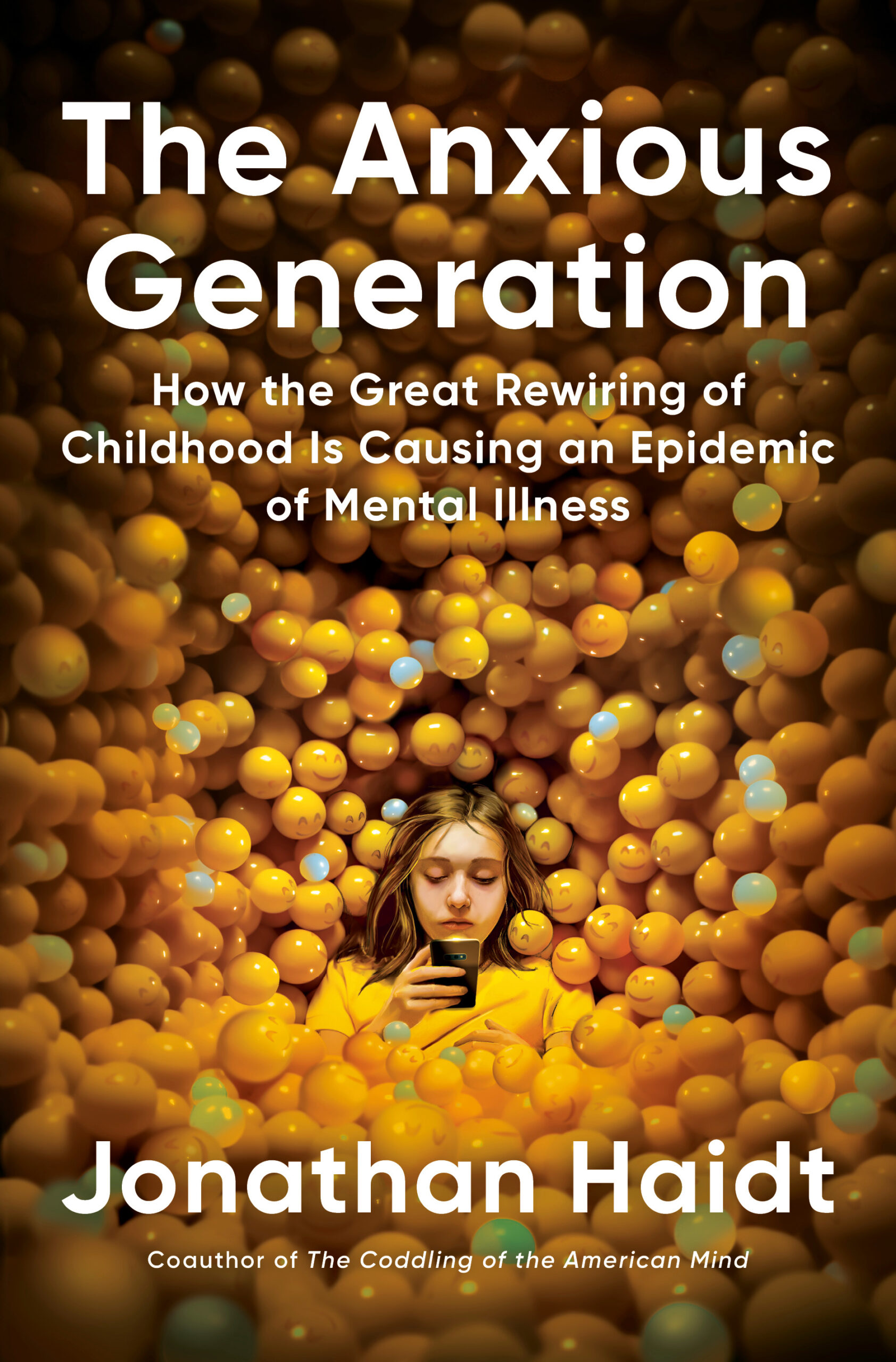
Resources
-
- American Academy of Pediatrics: The Family Media Plan
- The Anxious Generation: Research
- The Anxious Generation: Additional Resources
- American Academy of Pediatrics: Center of Excellence on Social Media and Youth Mental Health
- HealthyChildren.org: Social Media & Your Child’s Mental Health: What the Research Says
- US Department of Health and Human Services: Social Media and Youth Mental Health
- The Atlantic: End the Phone-Based Childhood Now
- After Babel: Social Media is a Major Cause of the Mental Illness Epidemic in Teen Girls. Here’s the Evidence.
- World Happiness Report: Social media is harming adolescents at a scale large enough to cause changes at the population level
- CDC: 2023 Youth Risk Behavior Survey
- The Atlantic: What Kids Told Us About How to Get Them Off Their Phones
- The Guardian: ‘No smartphones before 14; no social media until 16’: The Anxious Generation author on how to fight back against big tech
- Harvard Medical School: Doomscrolling dangers
- American Psychological Association: Media overload is hurting our mental health. Here are ways to manage headline stress
- Acta Psychologica: Specification curve analysis shows that social media use is linked to poor mental health, especially among girls
- JAMA Network: Social Media Use and Depressive Symptoms During Early Adolescence
- The Lancet: Social Media Use and Adolescent Mental Health: Findings From the UK Millennium Cohort Study
- Preventive Medicine Reports: Longitudinal associations between problematic social media use and depressive symptoms in adolescent girls
- Nature Reviews Psychology: Mechanisms linking social media use to adolescent mental health vulnerability