Episode: 394
How to Eliminate Self-Doubt Forever & Build Unshakeable Confidence
with Dr. Shadé Zahrai
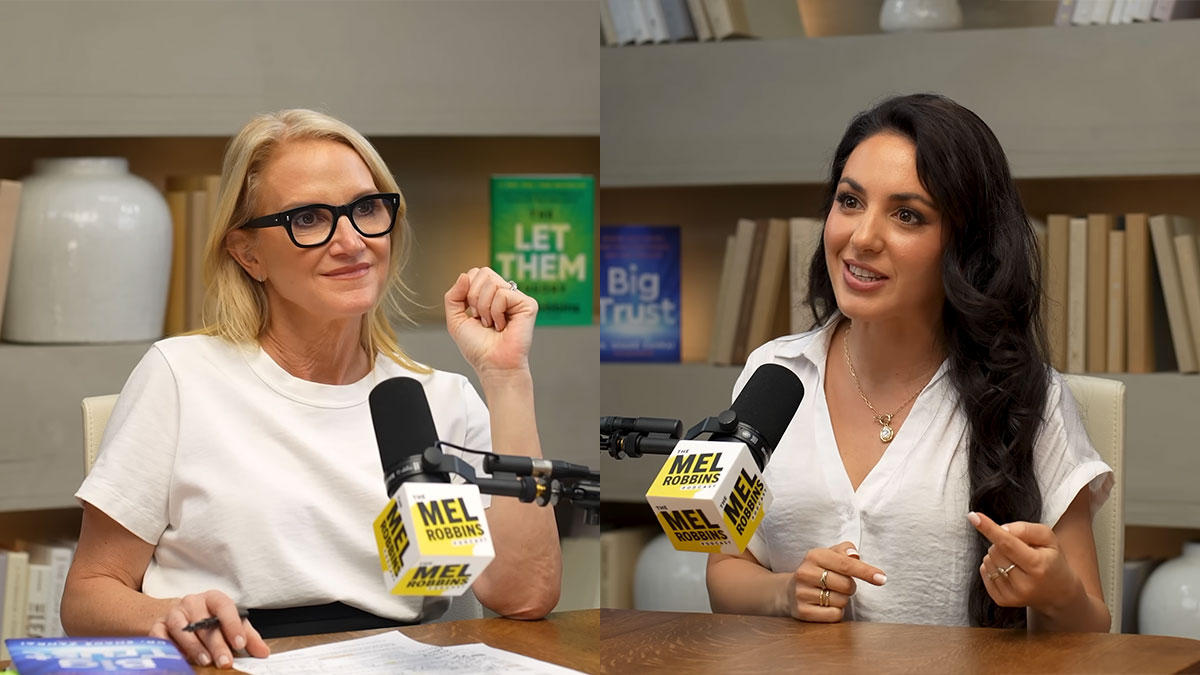
In today’s episode, you’ll learn how to beat self-doubt, stop procrastinating, and communicate with ease and confidence.
Joining Mel today is Dr. Shadé Zahrai, a behavioral researcher and confidence expert, to teach you a research-backed, 4-part framework for building unshakeable confidence and eliminating self-doubt.
Dr. Zahrai says that self-doubt shows up in many different ways - from overthinking, to constant comparison, to blame and resentment, and yes… to procrastination.
Today, she will walk you through the framework she says will start to dissolve that self-doubt once and for all, part by part.
By the time you’re done listening, you’ll have the tools you need, and you’ll know which one to use for your own personal struggles, so that you finally show up for your life with the confidence you deserve.
Listen on:




You don’t see the world as it is — you see it as you expect it to be.
Dr. Shadé Zahrai
All Clips
Transcript
Mel Robbins (00:00:00):
Today, you and I are going to learn all about this four-part framework that helps you build unshakable self-confidence.
Dr. Shadé Zahrai (00:00:07):
There are four attributes. We have acceptance, we have agency, we have autonomy, we have adaptability. Self-acceptance is fundamentally accepting that you are a work in progress. You don't need other people to validate your worth. You are worthy just by existing. Agency is that attribute that allows you to trust that you can do the thing and if you don't know how to do it, you will learn how to do it. Autonomy is the belief that you have a degree of control over your life. Adaptability is actually so much more than what we think it is.
Mel Robbins (00:00:39):
Dr. Shadé is a behavioral researcher and bestselling author with a PhD in organizational behavior.
Dr. Shadé Zahrai (00:00:45):
Some studies have found up to 82% of people have felt like an imposter at some point. And the beautiful thing about feeling like an imposter is it is a sign that you are growing. You don't realize how you're keeping yourself stuck when you complain about the things you have no control over. Show up for the life that you want now. Don't wait for it. Don't wait for permission. Don't wait till you feel ready. Don't wait till you feel worthy. If you show up for the person that you want to be now, your life will fundamentally change because everything will feel lighter.
Mel Robbins (00:01:17):
Dr. Shadé Zahrai welcome to the Mel Robbins podcast.
Dr. Shadé Zahrai (00:01:22):
Thank you so much for having me.
Mel Robbins (00:01:23):
I am so excited you're here. Thank you for traveling halfway around the world to be here today. And here's where I want to start. Your research around self-doubt, building confidence, feeling worthy. It is so important. We're going to dig into it and here's where I'd like to start. Could you speak directly to the person who's with us right now and tell them what might change about their life? If I take everything to heart that you're about to teach us today and I apply it to how I feel about myself.
Dr. Shadé Zahrai (00:01:56):
If you actually apply what we're going to be exploring today, your life will fundamentally change because everything will feel lighter. People don't realize how insidious self-doubt is. And when you're living every day and you've got the insecurity and those negative thoughts and the self-criticism and the feelings of, I'm not worthy, I'm not good enough, it is a weight. It makes everything more difficult. It leads to so much hesitation and second guessing and missed opportunities. If you can learn to recognize, and you see the beauty of this work is that you don't actually have to eliminate the doubt. You just have to strengthen parts of yourself that allow you to move through it and then success becomes easier. Fulfillment in your relationships becomes easier. Happiness becomes easier and this is based on decades worth of research. So it's so incredibly important and that's why I'm so excited to have this conversation with you.
Mel Robbins (00:02:46):
Well, I'm excited for you to teach us some of the frameworks in your bestselling book, Big Trust. And in your work, you work with CEOs of Fortune 500, 150 CEOs in terms of who you are coaching, who you are advising, but the journey to doing all this research began with you having a crisis in your own confidence and feeling like you weren't enough. So let's just start there. How did you begin this?
Dr. Shadé Zahrai (00:03:16):
So my journey with self-doubt is really the driver of why I do what I do because I have felt the pain over the entire course of my life. I mean, I'm still shedding the doubts that I developed early on. And I think if I really reflect on where it started, it started really early for me.
(00:03:32):
So I would've been about three, four or five years old and I am part of this beautifully supportive family and every Friday night we would have dinner at my grandparents' place. And then after dinner, there was this family tradition where the little kids would dance for everybody. So I would hear Shah de Bayad Berase, which is Shade is going to dance for us. And as a young kid, I loved the attention and they'd put on the music and it made everyone so happy. What then happened though is over the years, as this became just this regular thing that we did every Friday, I started to feel less comfortable doing that being the center of attention as I became a little bit more self-conscious about who I was and my body and I was maybe eight, nine, maybe 10,
(00:04:13):
But I saw how happy everyone was when I was in this position of performing for them and I didn't want to let them down. So I didn't know how to say no. And it was around that age that I internalized this belief that I am only of value. I am only worthy when I'm making other people happy, even if I'm not happy. So for me, that was that early life experience that instilled this sense of lack of enough. And then that just kept becoming a self-fulfilling prophecy when I was at university. When I started working in the legal industry, when I moved into banking and finance, it followed me into every meeting, every conversation, every interaction I never felt like I was good enough to be there, but I've also discovered over the last five or so years, as I've really deep dived into this as I was doing PhD research into this, almost every single person experiences self-doubt.
(00:05:04):
It is not uncommon at all and yet those who are able to truly succeed, it's not that they eliminate the doubt, it's that they've found a way to strengthen who they are to move through it.
Mel Robbins (00:05:14):
It brings me to a question, Dr. Shadé. What drives self-doubt?
Dr. Shadé Zahrai (00:05:19):
Okay. So I have been fascinated by this question for over a decade. Even before I did my PhD research, I was seeing self-doubt in action in the workplace at every single level because I genuinely believed once you become a leader, once you achieve a certain thing, you don't have self-doubt. But I actually found that sometimes those at the more senior levels, sometimes those who have achieved a lot, they have even more self-doubt because they feel like there's even more opportunity for them to fall, more reputational damage if something doesn't go well. So I thought, what is actually driving this? And that's when I started looking into the research, what do the most esteemed minds have to say about this? And I want to share with you one particular study, which I have never forgotten from the moment that I came across it. It's from the late 70s, early 80s.
(00:06:04):
So a psychology professor by the name of Robert Kleck at Dartmouth, he conducted this fascinating experiment, which really reveals how self-doubt works and where it comes from. He brought people together and with one group, he drew a scar on their face, on the right side of their face between their ear and their mouth. This really noticeable, visible disfigurement, he let them see themselves in a mirror so they can go, "Okay, I have this scar on my face." And then he sent everyone out into conversations with strangers. Now after the conversations, he then asked everybody, "How did you feel the conversation went?" The group without the scar felt like it was a fine conversation. The group with the scar reported feeling judged, they felt like it was tense, their conversation partner was cold and they felt like they were treated differently because of that scar. Now that in itself would've been a really interesting experiment on prejudice and discrimination.
Mel Robbins (00:06:57):
Or perception of.
Dr. Shadé Zahrai (00:06:58):
Or perception of. Exactly. And that's where we get to the interesting piece because if I pause right now and I take you back right before these people were sent into these conversations, so they've just seen themselves in the mirror, right before they're sent into it, the researcher said, "Okay, I'm going to apply some moisturizing cream to the scar to set it so it doesn't crack."
Mel Robbins (00:07:16):
Okay.
Dr. Shadé Zahrai (00:07:17):
What was done though was the scar was removed entirely.
Mel Robbins (00:07:20):
Whoa.
Dr. Shadé Zahrai (00:07:21):
There was no scar. These people went into these conversations believing they had a scar
Mel Robbins (00:07:26):
And they didn't.
Dr. Shadé Zahrai (00:07:27):
They didn't and that led them to have an expectation about how people would treat them, which then led them to pay attention to things that objectively did not exist. It changed how they showed up. They created the reality they expected, and this is called expectation bias. We don't see the world as it is. We see the world as we expect it to be. Wow. Now, when we think about what that means for us, when you're thinking about this from your own perspective, anyone who is watching or listening, what kind of scars are you carrying into every single conversation, every interaction, every meeting, every interview, every conversation with your loved one? How is that affecting how you not only show up, but what you're interpreting and noticing that may not even be there? Because until we're aware of these scars, we don't realize just how much they're creating the world that we're living in.
Mel Robbins (00:08:20):
Dr. Shadé, how do you rewire these moments of self-doubt?
Dr. Shadé Zahrai (00:08:27):
So I have an analogy that I love to share to help us understand what we're actually rewiring when we're talking about self-doubt.
Mel Robbins (00:08:33):
Great.
Dr. Shadé Zahrai (00:08:33):
So what I have here is two glasses filled with yellow water.
Mel Robbins (00:08:37):
Okay. Now I want to narrate this because the majority of you listen and I don't want you to miss a thing. So Dr. Shadé is sitting here at the table for the podcast. She has two the brim, bright neon yellow glasses full of yellow water sitting on a tray. And in one hand, do you have a ping pong ball?
Dr. Shadé Zahrai (00:08:58):
I have a ping pong ball.
Mel Robbins (00:08:58):
And on the other hand, she has a bright yellow golf ball. Okay.
Dr. Shadé Zahrai (00:09:02):
Now if I were to take the ping pong ball.
Mel Robbins (00:09:05):
And what does the ping pong ball represent?
Dr. Shadé Zahrai (00:09:07):
The ping pong ball represents self-doubt. In fact, both balls represent self-doubt.
Mel Robbins (00:09:10):
Oh, they do.
Dr. Shadé Zahrai (00:09:11):
And what's going to happen in the cups is it's going to help us understand different approaches to self-doubt.
Mel Robbins (00:09:16):
Okay. All right, great. So self-doubt might be, let's just take one we can all relate to. We've all had those mornings where you look in the mirror and you just go, "Ugh." And because you've shared the scar example, let's just go with this perception that how we look has something to do with our value to the world. And so the form of self-doubt that the ping pong ball or the golf ball might represent is just this belief that because you look ugly today or your acne's on fire or maybe what's happening for me, I constantly notice the jowls that seem to be forming and I don't like them and I feel a little bit of judgment and weight and I doubt myself, am I looking older? Are people going to judge me for that? And so is that what these represent?
Dr. Shadé Zahrai (00:10:04):
Yes.
Mel Robbins (00:10:05):
Okay. So we got a ping pong ball and a golf ball.
Dr. Shadé Zahrai (00:10:07):
So if I were to take the ping pong ball and place it on one of the glasses of water, what would happen to it?
Mel Robbins (00:10:14):
I think it would float because a ping pong ball is like kind of-
Dr. Shadé Zahrai (00:10:18):
Light?
Mel Robbins (00:10:18):
Yeah, light.
Dr. Shadé Zahrai (00:10:18):
Airy.
Mel Robbins (00:10:19):
Airy.
Dr. Shadé Zahrai (00:10:19):
So if we try that,
Mel Robbins (00:10:20):
What's happening? It's just floating there. So this is this thing that maybe you feel a little doubt about and it's just kind of floating on top.
Dr. Shadé Zahrai (00:10:29):
What happened to the water?
Mel Robbins (00:10:31):
The water stayed the same. What does the water represent?
Dr. Shadé Zahrai (00:10:33):
The water represents how we see ourselves, our self image.
Mel Robbins (00:10:37):
Oh.
Dr. Shadé Zahrai (00:10:38):
And so when we're talking about how doubt should be, because the goal again is not to eliminate the self-critical thoughts. That's too high a standard we're setting for ourselves. And we can't, can we? You can't do that. That's the function of the brain doing what it does. The goal is actually to allow the doubts to exist, but essentially to float on top of who we are.
Mel Robbins (00:10:55):
And what Dr. Shadé is doing right now, she's basically kind of gently pushing the ping pong ball across the top of the glass and it's floating there like you might see a little toy sailboat floating at a public park, just lightly drifting around. And so as an example of that, you look at yourself, you're like, "Not my best day, but no big deal." Oh, well, okay. Exactly. If I don't like the acne, I'll just put some foundation on. No big deal.
Dr. Shadé Zahrai (00:11:21):
Yeah. Focus on what you can control.
Mel Robbins (00:11:22):
We got this. Okay. Focus on what I can control.
Dr. Shadé Zahrai (00:11:25):
Now what most of us experience though-
Mel Robbins (00:11:27):
That's not what I experienced.
Dr. Shadé Zahrai (00:11:28):
No, and that's not what most people experience. It's a lot more insidious than that.
Mel Robbins (00:11:32):
So now you're holding a golf ball.
Dr. Shadé Zahrai (00:11:33):
Now I'm holding the golf ball. Now a golf ball is in comparison to the ping pong ball, it's what?
Mel Robbins (00:11:37):
Dense. It's heavy. It's got weight to it. Yes.
Dr. Shadé Zahrai (00:11:40):
And if I were to drop this into this other cup of water, what would happen?
Mel Robbins (00:11:44):
It's going to sink. Oh, not only is it sink, water just splashed everywhere and it sunk to the bottom.
Dr. Shadé Zahrai (00:11:53):
This is what happens when we internalize self-doubt. We allow it to mean something about who we are. So rather than just floating on the surface, we acknowledge it's there, we make it mean something about who we are. So instead of the, "Oh, I feel a little ugly today."
Mel Robbins (00:12:08):
Yes.
Dr. Shadé Zahrai (00:12:08):
Oh, well, you would say, "Oh, I feel ugly today. I am so ugly. I am so unworthy of other people's time and energy. I'm not valuable."
Mel Robbins (00:12:18):
Everybody's staring at me. Everyone is staring at me. I don't want to speak at work. Everybody's looking at this thing that I don't like about myself. And what's so stunning about the visual, and I want to really describe this for you as you're listening is on the right, you have this dopey little ping pong ball floating around, do, do, do, do, do, do, do. It's there. You haven't said you can't have the thought, but it's not sinking into your soul and dragging you down like an emotional weighted vest that then impacts every aspect of your day. The other thing that I want to point out is that on the left, the heaviness of the self-judgment, I got some acne, I'm short, my hair sucks today, whatever it may be. I got fired from that job, therefore I am not worthy of a job. You can see how it's just sitting there at the bottom of the glass.
(00:13:14):
And then even more sad, Dr. Shadé, is the spilled yellow water all over the place because what you get this sense of is as self-doubt weighs you down, you lose a bit of yourself to make room for carrying that doubt with you day in and day out.
Dr. Shadé Zahrai (00:13:34):
And then what's even more worrying is even if you go through the process of working on yourself. Okay.
Mel Robbins (00:13:40):
Now hold on. She's taking a spoon and she is now digging in and spilling more water out and she is getting the golf ball out of there. She's getting it out of there. So maybe our skin has cleared up. Maybe we have a better hairstyle. Maybe we have moved on from the job or the breakup and now we are out there interviewing again so we took care of the thing or so we thought.
Dr. Shadé Zahrai (00:14:03):
Or so we thought. But has that water miraculously refilled itself to the brim? No, there's a piece missing. And so what self-doubt does is it strips you of who you truly are because you're internalizing it, you lose a part of yourself. And even if you do the work, you enter what's called the void. So now, okay, the golf ball is out and maybe you are seeing that ping pong ball floating above.
Mel Robbins (00:14:26):
Yep.
Dr. Shadé Zahrai (00:14:27):
You're detaching from it, but then you enter that weird middle stage where you actually don't know who you are without the doubt because for so long it has driven your behaviors and your thinking and your actions and the way that you show up in the world. You've been acting to prove yourself to others or to seek their validation and suddenly you don't know what your true instincts are and who you are in the world. And so there's that really interesting little space where you need to discover who that is again,
(00:14:55):
But it starts with changing how we see ourselves. So when we talk about rewire self-doubt, it's actually not necessarily about the doubt at all. It's about strengthening how we see ourselves by strengthening these four attributes so that the doubt is no longer a golf ball, no longer becomes internalized, no longer infiltrates how we see ourselves and instead it's there. "Hey, okay, I can see you. I know that you're that voice up there, but I don't have to listen to you. I don't have to believe everything I think. "And that's so incredibly powerful when people both acknowledge it and then take the steps to actually get there.
Mel Robbins (00:15:31):
And I take it that what you're about to teach us not only helps us become more buoyant with the day-to-day self-doubts, but it also is going to help us fill that void with new capacities with ourselves that self-doubt stole from us.
Dr. Shadé Zahrai (00:15:49):
That's exactly what we're going to be doing. Let's get this water out of here.
Mel Robbins (00:15:53):
Dr. Shadé, you have this incredible framework based on research that helps us break apart self-doubt and build self-trust and self-confidence. Can you explain what this framework is?
Dr. Shadé Zahrai (00:16:03):
There are four attributes. We have acceptance, we have agency, we have autonomy, we have adaptability.
Mel Robbins (00:16:09):
Why is having this four-par framework helpful to breaking apart these moments of self-doubt and helping us build more confidence and self-trust? Why do we need a framework?
Dr. Shadé Zahrai (00:16:20):
It's because we misunderstand self-doubt as being one blob of worry, insecurity, fear, and anxiety. And that means then if we think it's one thing, we think there's one solution and that's why so many people are disappointed when they've tried the self-help route and they've tried this book or that a protent's not working and it's because self-doubt doesn't operate that way. There are actually four distinct elements. And once you figure out which one is lacking in you, which one is weak, then you know exactly what you need to focus on and then you can access the tools and the frameworks to help you move through and strengthen that so that everything in life just becomes so much more freeing. Let's start with acceptance. And so self-acceptance is fundamentally accepting that you are a work in progress. You don't need other people to validate your worth. You are worthy just by existing.
(00:17:05):
Now that doesn't mean that you accept that you will never change. It's actually acknowledging that I can change, I can grow, and be that work in progress knowing that self-improvement is possible. So it's a beautifully liberating state when you don't accept yourself, that is when you self-reject.
Mel Robbins (00:17:20):
You
Dr. Shadé Zahrai (00:17:20):
Self-reject before anyone else can.
Mel Robbins (00:17:23):
But how do you accept yourself if you don't like yourself? You know what I mean? And I'm just going to stay with the physical because every one of us has the example and when we start to get into psychological, I don't like myself because of X, Y, Z that has happened or these things that I did, it can get more complicated. And I want all of us to just stay right here and be listening for ourselves and listening for the people in your life who struggle with a lot of self-doubt. So if you do look in the mirror and you're like, yeah, and I don't want to accept that.
Dr. Shadé Zahrai (00:17:57):
So there are two things that I'd recommend you do.
Mel Robbins (00:17:59):
Okay.
Dr. Shadé Zahrai (00:18:00):
Well, actually there's three. The first one is that you need to acknowledge that until you accept yourself, nothing will change. If you are someone who is saying," I don't believe it.
Mel Robbins (00:18:09):
"Yes.
Dr. Shadé Zahrai (00:18:10):
In that case, what you want to do is use other strategies and tools
Mel Robbins (00:18:13):
That
Dr. Shadé Zahrai (00:18:13):
Allow you to strengthen the self-acceptance in other ways that naturally will help you recognize that you are valuable in spite of not believing that initially. Okay. So the very, very first tool is very simple. We call it the careless list. What you're going to do is grab a sheet of paper,
(00:18:30):
Divide it into two columns. On the left, I want you to write down all the things you want to care less about. I want to care less about my physical appearance. I want to care less about what people in the street think of me when I walk by. I want to care less about what my family keeps saying about my acne or my weight or how I look. Actually acknowledge it. Give it a physical outlet. A lot of people don't actually want to acknowledge their fears because they're afraid that they'll make them real. But I'm a proponent and a lot of evidence suggests that if you can just make them real, it gives you something to work with. You're not hiding from it. So you write down everything you actually want to care less about, put it in the left, and then just reflect on how you feel when you look at that.
Mel Robbins (00:19:08):
I love that.
Dr. Shadé Zahrai (00:19:10):
It's simple. So that's our careless list. We've identified all the things that we want to care less about. The next step is, okay, what do I want to care more about? What do I actually want to shift my attention to? Because attention is such a superpower. If we're not aware of it, we're going to be stuck in patterns that keep us stuck. But if we can become more aware of it, be a bit more curious about how we're thinking, this is called metacognition. It's the ability to think about your thoughts and it is a fundamental superpower because the moment you start thinking about your thoughts, you're no longer in your thoughts. So consciously write down, what do I want to care more about? Well, I want to care more about being a value in my life. I want to care more about having the kind of courage that allows me to take the step even if I've got the acne or I look a certain way.
(00:19:56):
You map them down and then it's a super simple practice. You just bring yourself back to this regularly to remind yourself, okay, my attention is going onto these things, but I really want to care less about them. How do I actively shift my attention to what I want to care more about? When you consciously take control of your thoughts, you're reengaging the prefrontal regions in your brain. We get more activation, more blood flow going here and then it fundamentally shapes how you're showing up. So that's a really, really simple practice if you're struggling with any kind of physical element.
Mel Robbins (00:20:26):
Well, it's also really helpful if you're moving through something emotional.
Dr. Shadé Zahrai (00:20:32):
Completely.
Mel Robbins (00:20:32):
If you have just gotten laid off, your job already was something you cared about for years. If you no longer have it, even if it was devastating to lose the job, don't you want to care less about that job that's no longer here and don't you want to care more about the future you and your future value and the next chapter of your career? Same thing with a breakup. You already gave years or months or however much time and energy to the relationship that's over. Don't you want to care less about it? Have it impact you a little bit less. Don't you want to care more about all of the things that could bring you happiness about reinventing yourself about stepping into this net? It's such a beautiful and simple illustration because it's true, Dr. Shadé. We live in our heads and I love that when you get out of your head and you put it on paper like this, it allows you to not be in your thoughts but to examine them and direct them differently.
(00:21:32):
It's brilliant. Dr. Shadé, could you walk us through just what does life feel like for somebody who has low self acceptance?
Dr. Shadé Zahrai (00:21:43):
So we see four really painfully familiar patterns with people who have low self-acceptance. The first one is what we call the pressure to prove. So this is where you feel like you're not enough so you have to prove your worth through achievement and setting and achieving the goal and getting the recognition and the title. But what happens is you tell yourself, "When I get there, then I will feel like I'm enough." And you get there and it doesn't feel like you thought it would, and then you just set the next goal. So you're perpetually chasing this feeling of enoughness and you're proving yourself, but it's not having the effect that you want. That's the first pressure to prove. The second one is what we call the likability trap. So if you don't accept who you are, you outsource your worth to how other people see you.
(00:22:31):
And if they can like you, if they can see you as acceptable, then maybe you can see yourself as acceptable. But then this leads you to sacrifice yourself. You say yes when you really mean no. You overapologize for things you shouldn't be apologizing for. You don't speak up in the meeting, you don't ask for what you deserve and you end up sacrificing what you want to need because you're prioritizing everyone else all the time and you don't know who you are. So that's the likability trap. We prioritize being liked over being true to who we are. And I say we because I struggle with acceptance. I speak from experience here. Now the third one is what we refer to as the shrinking syndrome. So this is where you see someone and you might resonate with this if you're watching or listening where an opportunity comes your way, an incredible opportunity, but suddenly your brain starts magnifying all the ways it could go wrong, the ways you might fall short, the ways you might fail, the what will other people think?
(00:23:27):
And so you know what? It's safer just to shrink back and make an excuse as to why you're not ready or why the timing is not right.
(00:23:34):
You shrink from those incredible opportunities. And then the fourth is the Shard and Floyd's cycle. This is a German term and it refers to that feeling that some people get, that feeling of pleasure when they see other people struggle or other people stumble or other people fail. And it's ego driven and it's because when they don't accept themselves, they like to see other people suffer too. It's terrible. It's terrible. It's absolutely terrible. It's more common than you'd think. It's why people love gossip. It's why people love reading headlines that are tearing other people down. It's very much a human experience, but it reflects that someone doesn't fundamentally accept who they are.
Mel Robbins (00:24:12):
Oh, I hate that.
Dr. Shadé Zahrai (00:24:14):
I hate that too.
Mel Robbins (00:24:15):
Wow.
Dr. Shadé Zahrai (00:24:15):
It happens.
Mel Robbins (00:34:35):
So let's move on to the second A in the four-part framework of rewiring self-doubt and building more confidence and that is agency. What is agency?
Dr. Shadé Zahrai (00:34:47):
So in the context of self-doubt, agency is that attribute that allows you to trust that you can do the thing. And if you don't know how to do it, you will learn how to do it. And so if you trust that you can do that, you're going to take the step. You're going to say yes, you're going to persist when things don't go well because deep down you believe that you can. Now, when this is weak, let's explore what this looks like. So if this is weak, if you struggle with your agency, we see a number of patterns here. The first one is the dreaded imposter syndrome where you have achieved things in your life, amazing things, maybe recognition, maybe awards, maybe an amazing job title and yet you feel like you don't deserve it. You feel like someone is going to highlight that you shouldn't be where you are.
(00:35:33):
And so essentially what it comes down to is that you believe other people think you're smarter or more competent than you really are. Now, a few things about imposter syndrome. The term imposter syndrome was not the term that was used initially when it was discovered. Back in the '70s, '80s, when it was first observed, they called it the imposter phenomenon. Now, what's the difference between a phenomenon? So a phenomenon is basically where you observe something in a population of people. A syndrome is something that seems medical and seems pathological and seems like something is wrong with us.
Mel Robbins (00:36:07):
A phenomenon seems like something that can appear occasionally.
Dr. Shadé Zahrai (00:36:12):
Yeah.
Mel Robbins (00:36:12):
Syndrome feels like a life sentence.
Dr. Shadé Zahrai (00:36:15):
Well said.
Mel Robbins (00:36:16):
Okay.
Dr. Shadé Zahrai (00:36:16):
And so we need to think when we feel like an imposter, it's actually far more common than you'd expect. In fact, some studies have found up to 82% of people have felt like an imposter at some point.
Mel Robbins (00:36:28):
And
Dr. Shadé Zahrai (00:36:28):
The beautiful thing about feeling like an imposter is it is a sign that you are growing. You are stepping out of your comfort zone because anyone who has ever done anything, you will be in a position where they haven't had all the skills or they don't know all the answers and it's very easy for them to then feel like I don't deserve to be here. But you have to honor the fact that you bring a track record with you and maybe we'll talk about a few tools to help with this a bit later.
Mel Robbins (00:36:53):
Yes.
Dr. Shadé Zahrai (00:36:54):
So that's the first one. The second one we see a lot of here with anyone who struggles with agency is social comparison.
(00:36:59):
They're comparing themselves to other people, not in a positive way, but in a, you are so far ahead of me and I'm inadequate, I could never do that. And we see this a lot when people again are leveling up in their lives, moving up in their careers, achieving more things in their business. Suddenly, as soon as you take that step to the next level, you're now comparing yourself with people at that level, which naturally means that there's more for you to develop and do and grow because they've been there longer than you. Maybe they are better at certain things, but if you start fixating on that and feeling like I can never do what they do, you undermine your agency. So that's the second one. I mean, comparison is natural, but we need to get better at making sure it's not filling us with self-doubt.
(00:37:42):
And then the third area here is where people are just constantly waiting to feel ready, to feel prepared. So they procrastinate by busying themselves with planning and reading and preparing. And they say, "I just want to learn a little bit more, but we know that the more you learn about something, the more you realize how little you know about that thing and the more doubt you have
Mel Robbins (00:38:03):
And
Dr. Shadé Zahrai (00:38:03):
The less likely you are to take the step."
Mel Robbins (00:38:06):
I think this is so fascinating. I just want to reflect back two things to you. So if you're somebody that struggles with agency when it comes to self-doubt, you may feel imposter syndrome, you may struggle a lot with comparison and you may also be a big planner. And one of the things that struck me that I've never thought about before is that when you identify and get very clear about a goal that you have, whether it's getting in better shape or it's dressing in a more stylible way, or it is earning more money, or it is changing your career and getting into real estate or learning how to make money online, simply identifying a new goal or a change means that you have a gap of having to become more capable in that area. You've never done this before. And so what are the tools other than saying, "I can figure this out, " or saying, "Hey, comparing myself is part of this.
(00:39:05):
It means that I want this. " How do you deal with imposter syndrome in particular?
Dr. Shadé Zahrai (00:39:11):
So the very first step, let's look at the feeling that you are fraudulent, that you don't deserve to be where you are.
(00:39:18):
What you want to think about is, okay, this is actually super common. This just means I'm stretching and growing. So how do I give myself time? And a very simple reframe because we know how powerful it is when we're changing the language that is going on in our heads is instead of, "I don't feel like I deserve this or I don't feel like I belong," immediately shift to what an incredible opportunity I have to learn and grow so simple and yet so effective because you're shifting your attention to everything you think you lack into, "Cool, I can fill some gaps." Amazing. Again, you don't have to lie to yourself. You're being really pragmatic about that. So that's the first step. The second one is to actually talk about it when it comes to imposter syndrome. So many people have experienced it just feeling undeserving. It's so common and when you speak about it openly, you realize that everyone is on this same journey and that sense of collective can be really helpful.
(00:40:14):
So in the 1980s, CitiCorp was merging with Travelers Insurance and they needed a graphic designer to come up with their new logo. So they hired the firm and Paula Shur was a partner at this firm. She's an incredible graphic designer. She comes in and she's sitting at the boardroom table with the decision makers and they're all talking about what they wanted for the logo. She grabs a napkin from the sign of the table and she starts scribbling on that napkin. A few seconds later, she slide that napkin across the table and she says, "Here is your logo." Now, the room was stunned. People were thinking, "How is it possible that you designed a logo in just a matter of seconds?" And she says, "I designed this in a second and 34 years. I designed this with everything that I have learned. So yeah, you got it in a few seconds, but it took me 34 years to be able to do that.
(00:41:04):
" And they ended up paying her $1.5 million for that logo. Now, what is the message behind this that we can take away? So often when we feel like imposters, we are just looking at the here and now the spotlight is on this current space that we're in and we forget that we have this incredible track record behind us. In Paula Sher's case, it was 34 years of work that got her to that point, but a lot of us will sit there in that meeting and think, "Oh gosh, I need to design something. I don't know if I've done this before. We fixate on all the gaps. I don't deserve to be here." So that's a really powerful lesson from that. Shift the spotlight back to everything that you have developed over the course of your life and your career. That reminds you, "Hey, maybe I do have certain capabilities and skills that I've earned that allow me this seat at the table."
Mel Robbins (00:41:52):
All right. I have two truths and one lie to share with you. Here we go. I high five myself in the mirror every morning. I'm an exceptional Fly Fisher woman and I have been a Verizon customer for over a decade. All right I lied. They're all true. And you know, Verizon is not as expensive as you think. In fact, if you bring your current carrier bill to Verizon, they'll give you a better deal. That's right, a better deal on the best mobile carrier network with more ways to save on plans, streaming, and phone deals. So take your current bill to your local Verizon store today. Get your better deal and start saving for real. And one of the reasons why I and my entire family have been Verizon customers for over a decade, they have the best cell phone coverage network everywhere and anywhere. I travel so much for work.
(00:42:48):
I also live in a rural area. Verizon is always there for me. Based on root metrics, best overall mobile network performance US second half 2025. All rights reserved must provide a recent consumer mobile bill from AT&T or T-Mobile in the name of the person who's redeeming the deal. Additional terms, conditions, and restrictions apply.
Mel Robbins (00:43:14):
The third A in this framework around self-doubt and building confidence is autonomy. What does autonomy mean, Dr. Shadé?
Dr. Shadé Zahrai (00:43:22):
So in the context of self-doubt, autonomy is the belief that you have a degree of control over your life. You feel personally powerful. Now that doesn't mean you can control absolutely everything because not everything can be controlled, but you focus on what you can and because of that, you feel like you have more control. Now, if you don't have a strong degree of autonomy, we see a number of common patterns here. And if you're paying attention, if you're listening to this, you will probably be able to identify at least someone in your life who is struggling here. We are less able to identify in ourselves because part of low autonomy is not taking ownership. So okay, let's look at these patterns. The first one is, if you struggle with autonomy, you complain a lot. You complain about everything wrong in your life because it's easier to complain than to do something about it because to do something about it requires you to take ownership and that is what low autonomy doesn't allow you to do.
(00:44:16):
So you complain. Now people don't realize when they complain about things, they are reliving the situation in vivid detail in their brain, which is creating deeper, more efficient neural pathways, which makes complaining your default. You basically become a negativity magnet because you notice more of the things to complain about. So we get complaining is the first pattern. The second one is blame. People are blaming others. The situation, the traffic, the weather, my husband, my wife, my boyfriend, my team. There's no personal accountability and they will share that with everybody else. The third one is resentment where again, they are resentful to other people because they feel like everyone else has an easier life than they do and that also leads them to play into this victim mindset, why me? Life is so difficult for me. And the fourth is, okay, so you know those people that come to you and they share with you their objectively difficult life stories and the first time they share it with you, you are so filled with empathy and compassion for what they've been through.
(00:45:20):
And then by the time they've shared it with you the 20th or 30th time, you realize they are keeping themselves stuck by ruminating on it.
Mel Robbins (00:45:28):
Yes.
Dr. Shadé Zahrai (00:45:28):
And because it's safer for them, they feel safer when they can hold onto a wound because it reinforces this view of, I am a victim. I am powerless. Look at how terrible my life has been. And they get sympathy from that so it's socially rewarding. So this is what we see. So the next question is, well, what do
Mel Robbins (00:45:44):
We do? Yes. Yes. What do we do? And I want to take them one at a time because so many people struggle with each one of these.
Mel Robbins (00:45:49):
So Dr. Shadé, what do you do if you are constantly overthinking everything?
Dr. Shadé Zahrai (00:45:54):
So if you're constantly overthinking everything, overthinking is a sign that you do not feel like you have control and it's your brain's attempt to try and manufacture certainty when there is none. Your brain says to itself, because the brain likes to be really efficient, it wants to save energy. And so it's fundamentally lazy. And so there's this part of it that goes, if I can anticipate everything that could go wrong, then I have to expend less energy when the consequence eventually happens. And this is why we get stuck in those loops of everything that could be out of our control. It's also what reinforces low acceptance because we start overthinking, do they like me? What did that mean? How come they haven't replied to me or agency? What if people find out I can't do this? What if I mess up there? So it's all a reflection of low autonomy.
(00:46:38):
So when we're overthinking, something that is terrible advice is to tell yourself, "Just stop worrying, stop overthinking." And yet you might have someone in your life that says this to you, "Just stop worrying." Bad advice. What we know is much more effective is to give your overthinking an outlet. What does that mean? Every time you have a distracting thought that pops up during the day, a worry, you're ruminating on something, grab a notebook and a pen and actually write it down. And then you say to yourself, "I'm not going to worry about you now. I will worry about you during worry zone."
Mel Robbins (00:47:11):
Okay.
Dr. Shadé Zahrai (00:47:11):
Okay. So you're parking it somewhere.
Mel Robbins (00:47:13):
Got it.
Dr. Shadé Zahrai (00:47:13):
Then at the end of the day, you want to actually schedule in your calendar about 10 minutes of worry time, not too close to bed because it might keep you up. So a good time is around five, four o'clock, five o'clock whenever works, you schedule it in your calendar. When that time comes, you set an alarm for 10 or 15 minutes, you bring out your worry list and you allow yourself to worry. Now this does a few things. It's called stimulus control for worry and research has found this is an incredibly effective technique.
Mel Robbins (00:47:41):
It is.
Dr. Shadé Zahrai (00:47:42):
It is. Because
Mel Robbins (00:47:42):
I'll be honest, it sounds dumb.
Dr. Shadé Zahrai (00:47:43):
It sounds completely dumb.
Mel Robbins (00:47:45):
It sounds like what?
Dr. Shadé Zahrai (00:47:46):
It sounds completely counterintuitive.
Mel Robbins (00:47:48):
Yes. But
Dr. Shadé Zahrai (00:47:48):
What happens is when you're not worrying about something in the moment, the emotions attached to it when it initially came up
(00:47:55):
Are no longer there. And when you're not worrying about it in the moment, when it comes up in the moment, it's driven largely by default areas in the brain, there's greater activation in the threat detection centers, in the fear centers of the brain. And so naturally we don't have access to the front regions, which allows us to process that rationally. But when you review it later, you suddenly, well, it shrinks the fear to size and the research tells us that you can so better manage your emotional state and actually assess, okay, well, are any of these actually going to happen and do I have control over any of these things? Now, the next step is once your alarm goes off, you actually close it and that's it. You're done with your worries. End of the week you reflect. What could I control? What couldn't I control?
(00:48:41):
And if there's something I can control, what am I going to do about it? It's a really effective way to deal with that overthinking.
Mel Robbins (00:48:48):
Dr. Shadé, what do you want to say to somebody who's a chronic complainer?
Dr. Shadé Zahrai (00:48:51):
You don't realize how you're keeping yourself stuck when you complain about the things you have no control over. It's cathartic. It feels good in the moment. It's rewarding, but it's actually keeping you stuck. The moment you find yourself complaining, the first step is to become aware of it, which is sometimes the hard part. The next step is to ask yourself, "Okay, well, I essentially have a few options here. I can accept the situation as it is. I can change the situation. I can leave the situation or I can change how I see the situation. They're the only four options I have. So you pick one and then acknowledge that if I keep complaining about this, I'm only going to feel worse. It is not going to help me. " So what is fantastic for anyone who tends to complain a lot? You will also hear language of should.
(00:49:41):
Oh, I should have done that. I should do this. Mel, how do you feel if I were to say to you, "Oh, you should." So- and-so. How would you respond to the word of should?
Mel Robbins (00:49:51):
I would feel like I've done something wrong.
Dr. Shadé Zahrai (00:49:53):
And you might feel a bit resistant,
Mel Robbins (00:49:54):
Or you might feel a bit defensive. When said, "Mel, you should." I was like, "Now what did I do?
Dr. Shadé Zahrai (00:49:59):
" It's because we experience something called reactance, which is this deep internal feeling of resistance. Don't tell me what to do. We want to feel like we're in control. When we are saying should to ourselves, when we struggle with autonomy, it makes us feel terrible. Now, research also shows that the language of should cuts off divergent thinking. We don't think as clearly, we don't think of solutions, we don't think of options. There is one swap. Move from should to could. Okay, what could I do right now? You're
(00:50:27):
Not committing to anything. It's really low stakes. And again, I encourage people to grab a sheet of paper, divide it into two. On the left, you write down your could list all the things that you could do in the moment. Then you move into your I will list. Pick one, two, or three things that you've identified and actually do them. Actually take the step. This is how you increase your autonomy. You bring your locus of control back inwards and it's so incredibly simple and it gets you out of the complaining spiral because sometimes all you need in that moment is to feel powerful and to do something.
Mel Robbins (00:51:02):
I love that. You can catch yourself by saying, "Oh, there I go saying I should have done this, making myself wrong, increasing self-doubt." Reframe it to, "I could," and then identify something that you will do. I love that because it's so simple. So simple. So simple.
Mel Robbins (00:51:18):
What if you're somebody that blames? The world isn't fair. My boss is a jerk. It's my ex that's ruining my life and you may have a lot of things going on, but talk to us about blame and self-doubt.
Dr. Shadé Zahrai (00:51:30):
Blame is attributing responsibility to everybody else. And we hear a lot of always and never from people who are blaming. You always do that. This never works out for me. It's always them. It's never that.
Mel Robbins (00:51:43):
This is something I struggle with. I have very- Interesting. Black and white language and it's something that I'm working on a lot because I tend to be very precise. It's always, or it's never or it's this, not with people, but a lot when things are happening with work or with myself. And so this is an area where I will admit it's not blaming other people. It's in the way that I talk probably has a lot of weight and blame to it.
Dr. Shadé Zahrai (00:52:09):
Oh, so what's actually really interesting, and I was going to say this about you, I think that your doubt profile from what you've shared with
Mel Robbins (00:52:15):
Me,
Dr. Shadé Zahrai (00:52:16):
Acceptance is your weak one. Autonomy is your absolute strength.
Mel Robbins (00:52:20):
Yes.
Dr. Shadé Zahrai (00:52:20):
Sometimes what happens when autonomy is so high and people take so much responsibility for things, they actually end up personalizing things that are not theirs to take.
Mel Robbins (00:52:29):
Well, as the CEO of the company, I think everything's my responsibility.
Dr. Shadé Zahrai (00:52:32):
Perfect example
Mel Robbins (00:52:33):
Of that. Yes,
Dr. Shadé Zahrai (00:52:34):
I do. And so you get into always and never because it's your way of holding yourself accountable, but sometimes it's not actually helpful in terms of how you feel
Mel Robbins (00:52:41):
And what you do. Yes. And I think parents do this too, that we think everything is our fault and take it on the chin like that. So let's talk about blame and how you deal with that if you're somebody that's recognizing it in yourself or you're thinking of somebody that's a big blamer and you're about to send this conversation to them.
Dr. Shadé Zahrai (00:52:59):
So the first thing to think is, okay, let's change the language, the intensity of the language that we're using. So instead of this always happens to me, let's bring that fact checker back in, right? Is that factual? Does that always happen to you? Usually the response will be, "Well, no, it's not always. It's maybe some of the time, maybe often, but it's not always." Okay. What's a more realistic way of looking at that? Okay. Well, instead of you always cut me off when we're speaking, you would say to yourself, I've noticed that there are times when I do get caught up when I'm speaking, then you shift responsibility to you. How can I speak differently to this person to reduce that happening? How can I change what I'm saying or how I'm saying it or when I'm saying it to reduce the chances that they're going to be interrupting me?
(00:53:46):
That's your first thing. So you take full ownership. The second stage is, okay, have I made this person aware of something that they're doing? You could go to the person and say, "Look, I've noticed when we speak, you either get really excited or you're not aware of it, but you do cut me off a lot and I would like to be part of a conversation and a relationship or a friendship where both of us feel valued in what we say." Were you aware of that? A lot of the time people are not even aware of it because they're so stuck in their worlds. So there are just a few little tools that you can use if you're blaming, try and bring it back to you. Instead of, "Ugh, he never takes the trash out. " Okay, is there something I could be doing to remind him to take the trash out or put it in a different place so he takes the trash out?
(00:54:26):
Just bring it back to you again that boosts your autonomy.
So the last of the four A's is adaptability, the ability to kind of go up and down with the curveballs of life. Why is this important for rewiring self-doubt and building self-confidence?
Dr. Shadé Zahrai (00:54:39):
Because adaptability is actually so much more than what we think it is, which is just adapting to life. In the context of doubt, it's adapting to the emotions that come with life
(00:54:51):
Because emotions are generally experienced when we do something and it doesn't work out. I mean, look, emotions are experienced all the time, but when it comes to self-doubt, there's something that we will have done or we'll be thinking of doing and then it doesn't work out and there's an emotion attached. The disappointment, that feeling of, I'm a failure, I'm not enough, these have emotional profiles attached to them. And so when we're deciding whether to do anything to take the step, to say yes, to ask them out, we're going through this checklist of, can I deal with the emotions of this thing if it doesn't work out? Because our brain is going through that process of all the ways that it won't work out. And if we don't believe that we can handle whatever emotion comes, we will not take the step. And that's why getting better at handling and harnessing the emotions that come makes everything in life so much easier.
(00:55:45):
Well,
Mel Robbins (00:55:46):
That makes perfect sense because if you don't feel like you can handle the emotions of going in and asking for a race or having the hard conversation or putting yourself in a situation where you're going to try something that makes you feel anxious or nervous, then you're not going to do it and your self-doubt is going to increase and you're going to be stuck in this gap between what you know you want or what you know deeply you're capable of, but you keep blocking your own momentum in life. And so that makes perfect sense. Is there one thing that if somebody recognizes that they are stuck in this aspect that they should do today?
Dr. Shadé Zahrai (00:56:26):
I'm going to share a super simple strategy here. It's called the opposite action strategy. It's so easy. When we are overcome with some kind of a negative emotion in relation to a self-doubt that we have, what usually happens to our body?
Mel Robbins (00:56:37):
We freeze. We kind of go into a nervous reaction
Dr. Shadé Zahrai (00:56:42):
And what usually happens to shoulders or neck or posture?
Mel Robbins (00:56:45):
Oh, we kind of shrink and feel like we want to hide, honestly. Yes.
Dr. Shadé Zahrai (00:56:50):
Exactly. And so what the opposite action strategy tells us is from dialectical behavior therapy. It simply says when there's no physical threat, do the opposite of what your body's telling you to do. Do the opposite of what your body's telling you to do.
Mel Robbins (00:57:02):
So in a situation where you feel that tension because you want to have the conversation, you want to do the thing, but now you're blocking your own momentum, do the opposite of what your body's telling you to do. So what do you do?
Dr. Shadé Zahrai (00:57:16):
So instead of withdrawing,
Mel Robbins (00:57:17):
Sit at
Dr. Shadé Zahrai (00:57:17):
The end of your seat, engage, look at the person, bring your shoulders back. I'm going to share again another really interesting tool that comes from the world of research. It was just published recently. Mel and everyone listening and watching, can you put your hand at the back of your neck?
Mel Robbins (00:57:30):
Okay.
Dr. Shadé Zahrai (00:57:30):
You're going to feel a joint.
Mel Robbins (00:57:32):
Yes. It's like a bony thing.
Dr. Shadé Zahrai (00:57:33):
It's like a bony thing. Give it a little massage. Yes. Now I want you to just tilt your head down and you're going to feel more of
Mel Robbins (00:57:38):
That.
Dr. Shadé Zahrai (00:57:39):
Okay. And then bring your head back up. Pointy bones is what I feel. Pointy bones. Great. Bring it back up. No,
Mel Robbins (00:57:42):
I'm putting my head back up.
Dr. Shadé Zahrai (00:57:43):
Now this is a great stretch. I encourage everyone to do it regularly. But this right here, that action of chin to chest and back up, that is called neck flexion.
Mel Robbins (00:57:51):
Neck flexion. Okay. Now
Dr. Shadé Zahrai (00:57:53):
We know that there's this connection between what our bodies are doing, our postures.
Mel Robbins (00:57:57):
Should I keep my hand
Dr. Shadé Zahrai (00:57:58):
Here? Oh, you can remove your head. Neck flexion. Neck flexion. There's a connection between what our bodies are doing and how we're feeling.
(00:58:04):
We know that if you have a big expansive posture, you tend to feel more powerful and confident. This study found that it's because of neck flexion that we feel that way. What? It is the connection between chin and chest. The distance between your chin and chest is what determines how you feel. Now, what does that mean for all of us? It means that when you're going into a high pressure situation, when you feel the self-doubt, when you're wanting to withdraw, you don't even have to think about posture. All you have to do is elongate your chin. Think about how to expand the distance between chin to chest. That's it.
Mel Robbins (00:58:36):
Oh, I just thought of a rhyme. Lift the chin. Let's begin.
Dr. Shadé Zahrai (00:58:39):
I love that. Perfect. That can go on a mug.
Mel Robbins (00:58:42):
See, I'll remember that. Okay. I'm feeling myself collapse. I'm getting nervous. I'm blocking my momentum. We got to lift the chin. Let's jump in.
Dr. Shadé Zahrai (00:58:50):
Beautiful.
Mel Robbins (00:58:50):
Oh man. Okay. I love that.
Mel Robbins (00:58:53):
Dr. Shadé, what does research say about your voice and clarity and how other people perceive you based on how you speak?
Dr. Shadé Zahrai (00:58:59):
Okay. So research and speech communication looks at the various tones that we have and what we've identified is there's generally two overarching ones. One of them is very much a throat voice, which happens when we're not really breathing very deeply and our voice entirely comes from our throat. It's very shallow. You see how it sounds friendly, it sounds warm, but maybe there's not a lot of credibility to it.
Mel Robbins (00:59:21):
Let me try that. I'm now trying to talk through my throat and it's like a different voice that you hear.
Dr. Shadé Zahrai (00:59:25):
Completely different.
Mel Robbins (00:59:26):
Wow.
Dr. Shadé Zahrai (00:59:27):
And that changes how you're perceived. Now, the other type of voice-
Mel Robbins (00:59:29):
It feels different too.
Dr. Shadé Zahrai (00:59:30):
It feels really different. This is what a lot of people do when they're nervous because their bodies tense up. So they're not able to get the oxygen in to fill up their lungs. And when you don't have a lot of breath because you're trying to retain it, that's when you get that higher sound. The other one is a more breathy voice where you're breathing into your diaphragm, which is much easier to do when you're not stressed and you're not feeling insecure. And so you've got breathy voice, which is generally higher pitched, which a lot of women unfortunately do when they're nervous or In loud spaces because they feel like they can be heard better, which is very interesting. But what we know is that this deeper diaphragmatic voice, which comes with breath, it comes with gravitas, this leads to perceptions of greater credibility. You come across as if you're more credible, you come across as if you're more confident, you come across as if you're more grounded.
(01:00:22):
A really simple tool for everyone or something to practice is to actually hear the difference in those voices. In one of them, just speak with a little bit of breath. Don't allow a lot to come out. It's not super breathy. Allow a lot of vocal fluctuation. And then the other one, which is going to be from the diaphragm, hear the difference. Now, if you're in an interview, if you're in a high stakes environment, try and really breathe into ... We call it breathing into the stomach. You're not actually breathing into the stomach, but when you take a deep breath into your lungs, your diaphragm drops down so you feel your belly coming out. When you breathe through that, breathe through that voice, it does wonders for how you're perceived.
Mel Robbins (01:01:01):
How can I train myself to speak more eloquently? Oh,
Dr. Shadé Zahrai (01:01:05):
Well, I came prepared. Mel, here is a pen.
Mel Robbins (01:01:08):
Okay.
Dr. Shadé Zahrai (01:01:09):
What you're going to do is grab this pen and put it between your teeth like this.
Mel Robbins (01:01:13):
Okay.
Dr. Shadé Zahrai (01:01:13):
So for everyone watching and listening, we're basically holding the pen between our teeth a bit like a dog would hold a bone.
Mel Robbins (01:01:18):
Okay, great. That's exactly what it looks like. It does. So Dr. Shadé has put it in between her teeth like a bone or stuck. Here we go. Okay.
Dr. Shadé Zahrai (01:01:26):
Now with the pen in your mouth, so everyone, make sure you clean your pen before you do this. I highly encourage that. You're going to grab a book
Mel Robbins (01:01:33):
And
Dr. Shadé Zahrai (01:01:33):
You're going to read any sentence or paragraph from that book and you want to pay attention to pronouncing every single sound clearly. Mel, would you like to do us the honors?
Mel Robbins (01:01:46):
I would.
Dr. Shadé Zahrai (01:01:47):
Good.
Mel Robbins (01:01:47):
Okay. I am reading from Page ... Oh, this is really hard.
Dr. Shadé Zahrai (01:01:53):
Make it really hard.
Mel Robbins (01:01:54):
I'm reading from Page 219 of your book Big Trust. Yes, you can do the hard thing. Of all factors that have been studied to understand motivation, the most potent one is simply feeling like you're making progress. Let that sink in.
Dr. Shadé Zahrai (01:02:19):
Beautifully done. Now you can take the pen out, you can wipe it. Can you try reading just another paragraph right now?
Mel Robbins (01:02:26):
I'm going to read from page 219 of Big Trust. Yes, you can. Do the hard thing. Of all factors that have been studied to understand motivation, the most potent one is simply feeling like you're making progress.
Dr. Shadé Zahrai (01:02:45):
Now, Mel, tell us how it felt once you took the pen out.
Mel Robbins (01:02:49):
Well, how it felt when the pen was in- Let's
Dr. Shadé Zahrai (01:02:51):
Start there.
Mel Robbins (01:02:51):
... was like being at the dentist when they're trying to take X-rays and your tongue is in the way and you're trying to move everything around and it feels very awkward and saliva's falling around and your mouth is not making the shapes that you want. But as soon as I took it out, it was as if I had a mouth that had been warmed up and stretched out and the words just felt more intentional.
Dr. Shadé Zahrai (01:03:16):
And this is exactly what this exercise does. So you're warming up your entire facial muscles, you're warming up your throat and your tongue and stretching what otherwise doesn't get stretched very often. And that's what leads us to mumble. That's what leads us to be difficult to understand. Communication really comes down to how well your message is received by the other person, and that can influence how confident you're perceived to be, how credible you're perceived to be, how people respond to you. When we're nervous, everything tenses and so we tend to mumble.
Mel Robbins (01:03:46):
So if you're somebody who mumbles or you have somebody in your life who is ... Does this pen trick and practicing it, is this something that you can do for free at home that will help you speak more clearly and eloquently and that will change the way people perceive you?
Dr. Shadé Zahrai (01:04:04):
Absolutely, yes. And I encourage you to do it often. Do it in the morning, do it at night, do it before every meeting, before every phone call, because that's how you're training yourself to be able to pronounce far better to enunciate better, which is going to improve how you're perceived.
Mel Robbins (01:04:19):
I love this simple pen trick. Holy cow, I hope you share this with everybody. It's so cool. And I've just started working with a voice trainer and I'm going to tell you there were so many things about this I didn't understand, but what you just showed and what I felt in terms of the difference is like having a professional voice coach and it's so important to take this seriously so that people take you seriously when you have something to say.
Mel Robbins (01:04:46):
Dr. Shadé, can you explain to me and to the person that's here listening or watching, what's courage versus humanness scale? What is that?
Dr. Shadé Zahrai (01:04:57):
So this is a scale that we will share with leaders and teams that we work with at the Fortune 100 companies that we're so blessed to support. Basically, when we look at teams, especially high performing teams, we find that there are two general qualities that come up. The first one is the humanness qualities. What do you think some of these are?
Mel Robbins (01:05:16):
Warmth.
Dr. Shadé Zahrai (01:05:17):
Yes.
Mel Robbins (01:05:18):
Care, positivity, confidence, humor.
Dr. Shadé Zahrai (01:05:25):
Exactly.
Mel Robbins (01:05:26):
All the collaboration.
Dr. Shadé Zahrai (01:05:28):
Empathy.
Mel Robbins (01:05:28):
Empathy. Compassion. Yes.
Dr. Shadé Zahrai (01:05:30):
All of these qualities that make us human and allow us to come to work in a place that we enjoy.
Mel Robbins (01:05:35):
Yes.
Dr. Shadé Zahrai (01:05:35):
Then we also have the performance-based qualities. We call them courage-based skills.
Mel Robbins (01:05:40):
Okay.
Dr. Shadé Zahrai (01:05:41):
What are some of these? What would a team need in order to make sure they're actually
Mel Robbins (01:05:44):
Performing? Leadership, decision-making, clarity, feedback, like definition of goals, process. Am I getting it? Absolutely. Okay, got you. Expectations, ROI. Here we go. KPI. All of those acronyms.
Dr. Shadé Zahrai (01:06:05):
And when we look at the research, this is looking at a scale. It's called the trust versus assertiveness scale. Some of them call it the compassion versus performance scale. We call it humanness and courage because it's easy to understand. Now, if we were to map these out, so I have a little visual.
Mel Robbins (01:06:19):
Okay. She's pulling up a whiteboard. I'm pulling up a wide board. Dorie, I am going to explain this. So she's got on this, we can't see it yet, but for you listening, imagine Four Square, the game that we played in elementary school, you're on the playground. There's four squares. We're standing in the square. She's got four squares. On one side, it says humanness. On the other side, it says courage. And we're about to find out what are in these four squares.
Dr. Shadé Zahrai (01:06:42):
So where we have teams or individuals, let's look at it from an individual level first. Someone who is very low ... Oh no, let's start with high. Someone who's very high on humanness.
Mel Robbins (01:06:50):
Yes.
Dr. Shadé Zahrai (01:06:51):
So a lot of that warmth and the empathy and that compassion, but very low on courage. What we get is the classic people pleaser. It's the person who wants everyone to like them and validate them and so they don't say what they mean in the meeting and they sit on their hands, but everyone's happy with them. What about someone who is really high on courage, but very low on humanness? I think everyone who has worked, especially in corporate, will know someone like this. And unfortunately, a lot of these people are in positions of leadership, which is not great.
Mel Robbins (01:07:21):
They're a steamroller.
Dr. Shadé Zahrai (01:07:22):
Steamroller, they're cold, they're calculated. You don't like working with them and they make you feel insecure. We call this the agitator.
Mel Robbins (01:07:29):
Oh God. Some days I'm like that. I'm just going to admit it. Usually it's because I haven't eaten or I'm getting over an illness or something disappointing happened and I don't mean to do this, but some days I am.
Dr. Shadé Zahrai (01:07:38):
I find that if you find yourself in this state, do your checklist. Have I had a nap? Have I had a snack? Have I done my exercise? Am I doing my breathing? Sometimes that's all you need.
Mel Robbins (01:07:47):
By the way, this works in a marriage and in a family. It does. And in every relationship.
Dr. Shadé Zahrai (01:07:51):
It does. And this is what happens when we don't have the balance of these two qualities that we need to be functioning people, team leaders, team members in a relationship as a parent. What about someone who's really low on humanist and low on courage?
Mel Robbins (01:08:06):
I mean, do they even have a pulse? I mean, what's happening?
Dr. Shadé Zahrai (01:08:09):
This is where we get apathy and toxicity.
Mel Robbins (01:08:12):
So if you're dealing with somebody who has behaviors that people are throwing around the label a toxic person, I don't like that because I prefer to say, just label the behavior. A person may not be aware that there's this way, but if you're with somebody who is reading on the toxic side in terms of their behavior at work or in friendship, what does that tell you about what they're dealing with based on humanness and courage? They have a lot of fear.
Dr. Shadé Zahrai (01:08:44):
They might have a lot of fear. They might also lack the agency to believe in their competence or, and this is something really important in the context of careers. There's something called career imprinting where the first few experiences we have in our career end up shaping our sense of identity when it comes to our career.
Mel Robbins (01:09:04):
That makes sense.
Dr. Shadé Zahrai (01:09:04):
So if you're starting out in the workforce and you have a really unsupportive environment, you have a micromanaging boss, you have team members who are not giving you the time of day that you need, you start to internalize that, I'm not worthy, I'm not good enough. And it's always going to be like this because it becomes what's called a schema, which is like a template in our mind. And then we go to a new company, a new team and everything might be amazing yet we expect that we're going to be overlooked and talked over like we were before and then we unintentionally create that in the new environment.
Mel Robbins (01:09:39):
Wow.
Dr. Shadé Zahrai (01:09:39):
That's why it's so important when we start thinking about career imprinting, when we think about that idea of us and our self image and the experiences that we have.
Mel Robbins (01:09:46):
Well, you just taught me something about myself. I think one of the reasons why, other than just personal values, I have such a innate sense of justice and fairness and injustice is because my first real big job out of college and law school was as a public defender representing people in the justice system who could not afford a lawyer and who had experienced systematic discrimination their entire life. Wow. And so it is like imprinted in my soul to both respond to moments that feel very unjust and also to get the Dukes up and fight when I have this sense that fairness is very important here. So that explains a lot.
Dr. Shadé Zahrai (01:10:30):
So you've had that career imprinting take
Mel Robbins (01:10:32):
Place
Dr. Shadé Zahrai (01:10:33):
And it's
Mel Robbins (01:10:33):
Continually
Dr. Shadé Zahrai (01:10:33):
Reinforcing itself.
Mel Robbins (01:10:34):
Absolutely. And what happens when you have high humanness and high courage?
Dr. Shadé Zahrai (01:10:39):
So this is what we call the partner
(01:10:41):
And we call it the partner because we're usually sharing this in the context of leadership, but this is someone who feels like they are a partner with every single person in that team. What do they say? When the tide rises, all ships rise and it's someone who recognizes that by them succeeding, other people can succeed and by them helping other people succeed, they succeed. It means that they are able to be appreciative of others and collaborative and cooperative while still giving the feedback that needs to be said, while still addressing behaviors that need to be addressed. So why this model's really valuable for anyone who is working in a company or working in a team or in relationships is just to recognize that if you struggle with any of the four elements of big trust that undermine your confidence and courage and self-trust and you have that self-doubt, it means that you're going to live in one of these spaces
Mel Robbins (01:11:30):
The people pleaser being apathetic where you can see if you're apathetic or toxic, you're a blamer. If you're a people pleaser, you're overthinking or you are comparing yourself or- And seeking
Dr. Shadé Zahrai (01:11:41):
Validation.
Mel Robbins (01:11:42):
Seeking validation. If you're the agitator, you're running people over and you're blaming lots of things and you're taking control, but in the wrong ways and complaining. And if you're the partner, you're just reaching for the tools. You're adapting, you are telling yourself you're capable of figuring it out or we are capable of figuring it. I see how this all tracks directly to what you've been teaching us. It's brilliant.
Dr. Shadé Zahrai (01:12:04):
Wonderful. So that's that. That's the matrix that we like to share. And so it's great to just see how this matrix maps back into big trust. It's not just an impact that we get for ourselves. It's an impact that we are taking into our lives because we don't live in a microcosm. We're constantly interacting with other people.
Mel Robbins (01:12:19):
Yes. Dr. Shadé, if the person listening takes just one action out of everything you've taught us today about the research around breaking self-doubt, rebuilding trust, what's the most important thing for the person listening to do?
Dr. Shadé Zahrai (01:12:36):
This is something that you encourage people to do, Mel, which is pick one thing that you have been hesitating from doing. One thing that you've been holding back on because self-doubt is getting in your way, break it down into this smallest possible step and just do the thing. Can I share a very quick story here? Please. So this is a story about Elizabeth Gilbert who wrote Eat Pray Love, which became a movie and a global bestseller. Now, when she was writing it, it's her memoir. You'd think a memoir would be kind of easy to write. It's your story, but she said that she couldn't get words on paper because she had this mantra of, "This sucks," running through her head constantly. Nothing was ever good enough. She would write, she would rip it up, she would write, she would delete. And then amidst all of that uncertainty and the self-criticism, she had this moment of clarity and she thought, "Hold on.
(01:13:25):
I never promised the universe that I would write brilliantly. I just promised the universe that I would write. I would write something." And so with that, she made write the goal and not write brilliantly the
Mel Robbins (01:13:37):
Goal.
Dr. Shadé Zahrai (01:13:39):
And so the message behind this is sometimes we need to lower our standards. We need to lower our standards. Don't aim for perfection. Just aim for good enough for now you can always improve later. So don't aim for going viral on social media. Aim for hitting post. Don't aim for building the billion dollar business. Aim for setting up a website or getting one paying customer. Don't aim to find your soulmate. Just aim to ask them out for a coffee. When you lower the standard, you make it so much more achievable and when you achieve it, then you see yourself being the kind of person who achieves these things, which fundamentally changes your self image, changes how you see yourself and what is possible for you and then that starts to change the rest of your life.
Mel Robbins (01:14:23):
I love that. Dr. Shadé, what are your parting words?
Dr. Shadé Zahrai (01:14:28):
Show up for the life that you want now. Don't wait for it. Don't wait for permission. Don't wait till you feel ready. Don't wait till you feel worthy. If you show up for the person that you want to be now, there's this beautiful phenomena called embodied cognition. And when you show up for it, the world starts responding to you as if you already have it. You see yourself speaking in the meeting, going after what you want, creating your own momentum and that is how you fundamentally shape your self image, which shapes your identity, which shapes who you're becoming. So don't wait. Just show up today and it is remarkable what you will be able to achieve.
Mel Robbins (01:15:07):
Dr. Shadé, I just want to say on behalf of the person listening and everyone that they will share this with, thank you because it's one thing to say that. It's a whole different ballgame when you show up with frameworks and tools and very specific things that you can do in order to understand the nature of how self-doubt is blocking you and exactly what is within your reach to push through it and continue moving toward the goals that you have, building the confidence that you know is within you and seeing yourself, doing the things that you had otherwise held yourself back from experiencing.
Dr. Shadé Zahrai (01:15:49):
Thank you so much for having me and for everyone watching and listening. Thank you for being here. Thank you for investing in yourself. And I'm excited to see where you end up when you apply some of what you've learned today.
Mel Robbins (01:16:00):
I am so excited too. I'm so excited that you decided to spend time listening to this or watching this. Today you got tools, you got frameworks, you got the research broken down in the simplest ways so you can start applying it today. I cannot wait to see how this changes your life. So make sure you tell me what happens. And one more thing in case no one else tells you today, as your friend, I wanted to be sure to tell you that I love you and I believe in you and I believe in your ability to create a better life. There is zero doubt in my mind that when you use the tools to rewire self-doubt, those moments that are going to keep coming and you double down on your capacity and the things that are in your control and the talents that you have inside you to push through what's happening and learn and grow, your life is going to get better.
(01:16:45):
I mean, how could it not? Alrighty. I will see you in the very next episode. I'm going to welcome you in the moment you hit play and thank you. Thank you for watching all the way to the end. I'm so excited that you're investing your time and learning how to create unshakeable confidence and I also want to thank you for sharing the link to this episode with people in your life that you care about, whether it's your sister or your partner, somebody in your life that keeps shrinking and blocking their own way. One way to be a great friend or a sibling or a great partner is to share these resources with people. And so I just really appreciate you doing that. And one more thing. My team is just showing me that 57% of you who watch the Mel Robbins podcast here on YouTube are not subscribers.
(01:17:28):
My goal is to get that number to 50%. So could you do me a favor? If the subscribe button is lit up, would you just hit it? It's free and it's the best way for you to say thanks, Mel, and thanks to the team here at the Mel Robbins Podcast and thanks to Dr. Shadé who flew halfway around the world to be here in Boston to teach you this. I really appreciate you doing that and I know that you would appreciate me recommending the next video. This you're going to love and I'll welcome you in the moment you hit play.
Key takeaways
You carry hidden “scars”, and your expectations shape reality, so when you assume judgment, you filter interactions, reinforce doubt, and unknowingly create the outcomes you fear.
When you internalize self-doubt, it sinks like a heavy weight, distorting your self-image and draining your energy, but when you let it float, it loses power over how you show up.
You don’t eliminate doubt—you strengthen yourself, so it becomes background noise, allowing you to act anyway, build self-trust, and stop letting fear define your identity.
Low self-acceptance traps you in proving yourself, chasing approval, or shrinking from opportunity, because you’ve tied your worth to outcomes instead of recognizing you’re already worthy as you are.
When you feel like an imposter, it’s not failure—it’s proof you’re growing, and shifting your focus to learning and expanding helps you reclaim confidence instead of questioning your place.
Guests Appearing in this Episode
Dr. Shadé Zahrai
Dr. Shadé Zahrai is a behavioral researcher, PhD, and bestselling author of Big Trust, known for helping leaders build confidence and perform under pressure.
- Visit Dr. Zahrai’s website
- Follow Dr. Zahrai on Instagram
- Watch Dr. Zahrai on YouTube
- Follow Dr. Zahrai on TikTok
- Check out Dr. Zahrai on Facebook
- Connect with Dr. Zahrai on LinkedIn
- Watch Dr. Zahrai’s TedTalk
-
Big Trust: Rewire Self-Doubt, Find Your Confidence, and Fuel Success
Drawing on leading research, over a decade of work with Fortune 500 companies, and experience educating millions of professionals worldwide, Dr. Shadé Zahrai reveals a proven system for breaking the cycle of self-doubt and building deep, unshakable self-trust. In Big Trust she shares her proven framework—the Four A’s: Acceptance, Agency, Autonomy, and Adaptability—and shows you how to take control of your inner world so you can thrive in the outer one.
With insights from her self-diagnostic quiz and actionable exercises throughout, you’ll learn to:- Reframe the beliefs that hold you back
- Break free from people-pleasing and perfectionism
- Quiet comparison and imposter thoughts
- Stretch your comfort zone and reclaim your power
- Channel emotion into clarity and conviction

Resources
-
- Harvard Business Review: Don’t Let Self-Doubt Hold You Back
- Harvard Business Review: Types of Overthinking — and How to Overcome Them
- Forbes: How To Speak Up In Male-Dominated Meetings And Get The Visibility You Deserve
- Forbes: The Four Crisis Lenses -- Which Lens Are You Wearing?
- Forbes: Seven Traits Of An Emotionally Intelligent Leader
- Forbes: Transformational Leadership: The One Missing Trait
- Wired: Study: inflated praise is damaging for children with low self-esteem
- Psychological Science: Positive Self-Statements: Power for Some, Peril for Others
- Nature Medicine: Hobbies for mental health
- Annual Review of Psychology: Self-Compassion: Theory, Method, Research, and Intervention
- Dartmouth College (Robert Kleck): Perceptions of the Impact of Negatively Valued Physical Characteristics on Social Interaction
- Journal of Psychology of Science and Technology: Arts Foster Scientific Success: Avocations of Nobel, National Academy, Royal Society, and Sigma Xi Members
- Journal of General Internal Medicine: Prevalence, Predictors, and Treatment of Impostor Syndrome: a Systematic Review
- Fast Company: 5 ‘Big Trust’ mindsets to build more self-confidence
- AP News: Remember to give thanks to yourself during the holidays and beyond
- The $1.5m napkin: Paula Scher’s 5 minute logo
2 Million Readers.
1 Life-Changing Newsletter
Simple and Straight-to-the-Point...
Just Like Mel.